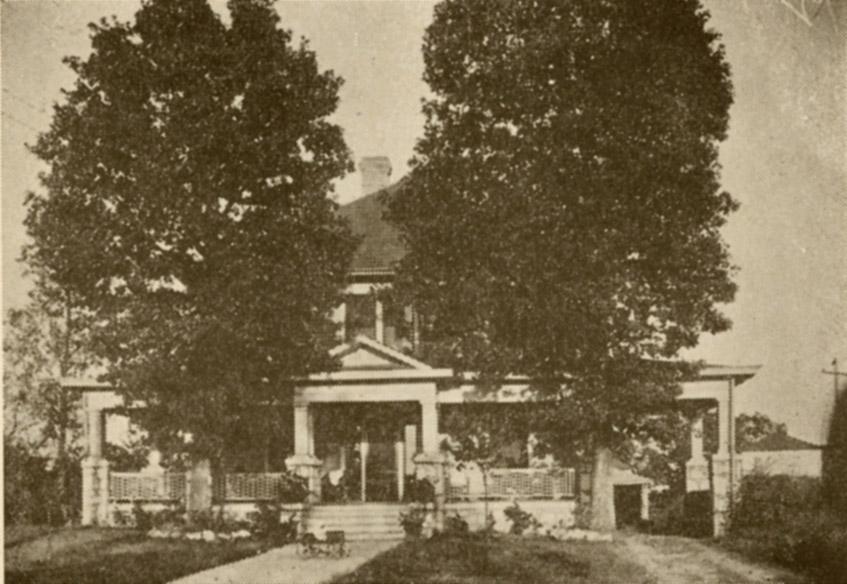
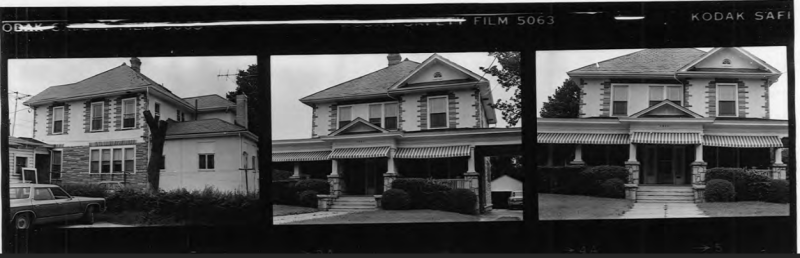
(Courtesy Duke Rare Book and Manuscript Collection / scanned by Digital Durham)
1211 Fayetteville was the Durham home of Dr. Joseph Napoleon Mills, a notable doctor from Kinston, North Carolina. Dr. Mills came to Durham circa 1908 after attending the Leonard Medical School at Shaw University. Dr. Mills was a general practitioner who specialized in gynecology and obstetrics. He is said to have “...delivered somewhere between seven thousand and eight thousand babies, sometimes as many as three generations in the same family.” Dr. Mills worked at Lincoln Hospital and had his own private practice, both of which he retired from in 1961 due to worsening health. Dr. Mills was also the school physician at North Carolina College, now North Carolina Central University, from 1935-1958. He served as the informal health officer at North Carolina College before 1935 as well.
Dr. Mills was actively involved in the Durham community beyond his medical practice. He was on the trustee board at St. Joseph’s AME Church and helped found Boy Scouts Troop 55, the first Black Boy Scouts Troop in Durham. He was also a field examiner for the Mutual Life and Savings Company.
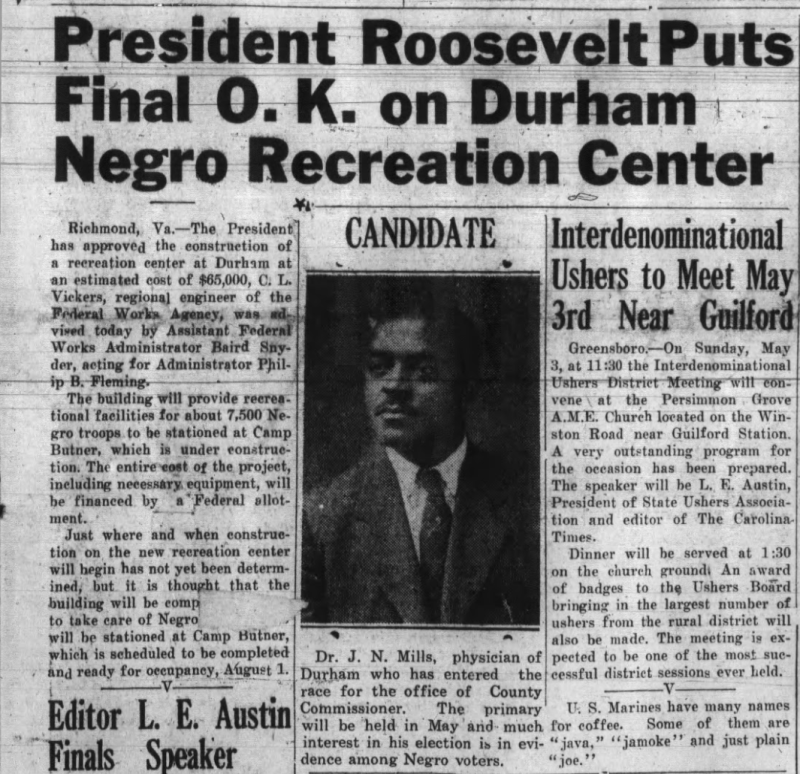
Dr. Mills was involved with Durham politics, running for county commissioner in 1940. During this election, he was the only African-American candidate for this position. His election campaign promoted African American voter registration and voting to help aid in his victory. His campaign also brought attention to numerous issues the African American community faced in Durham, and how these issues could have a greater chance of being resolved with African American representation. While Dr. Mills did not win a seat, he garnered 2,807 votes, roughly 2,500 of those from African Americans, and the rest from whites.
Dr. Mills also played a pivotal role in the lead-up to the Hocutt v. Wilson case, which was the first legal case to challenge segregation in secondary education. Two NAACP lawyers, Conrad O. Pearson and Cecil McCoy, sought a Black volunteer to apply to the University of North Carolina, knowing that they would be denied on the basis of race, to then appeal the rejection in an attempt to desegregate higher education. Dr. Mills drove Thomas Hocutt, Conrad O. Pearson, Cecil McCoy, and Carolina Times editor, Louis Austin to the University of North Carolina-Chapel Hill registrar. It is of interest that Dr. Mills was the one to drive, as this was a highly contentious case within the Durham community, including among many notable Durham African-Americans such as Charles Spaulding and North Carolina College founder, Dr. James E. Shepard. In fact, James E. Shepard’s refusal to send Thomas Hocutt’s transcript to UNC-CH was a major factor in Hocutt losing the case. Shepard’s refusal was partially contingent on the possibility of North Carolina College losing funding. It was also supplemented by other local and state politics articulated in Jerry Gershenhorn’s “Hocutt v. Wilson and Race Relations in Durham, North Carolina, during the 1930s.” Despite its failure in court, it was a pivotal moment in challenging segregation in North Carolina and the United States as a whole.
Dr. Mills’ family also lived in the home at 1211 Fayetteville Street. His first wife, Bessie Smith Mills, passed away in 1948. He then remarried in 1952 to Edna Rosser Mills. Edna was from Lynchburg, Virginia, and attended both St. Augustine’s College in Raleigh and North Carolina College in Durham, where she got her master's degree. She also studied at the following universities: Temple University, George Washington University, the University of Indiana, and the University of North Carolina at Chapel Hill, all through Carnegie and Rockefeller grants. Edna’s career was in teaching, and she taught at numerous public schools, including Payne School (Lynchburg, VA), Carver College (Rockville, MD), and North Carolina College, where she retired a few years before her passing.
Edna’s father, Preston Joseph Rosser, also lived at 1211 Fayetteville, but tragically died by suicide in 1964.
Dr. Mills and Bessie had three children together: Dr. Amey Mills Winter, Joseph Mills, and Clinton Mills. Dr. Winter attended Howard University. After marrying her husband, Dr. Harold Vorhees Winter, she moved to Brooklyn, New York, where she interned at Greenpoint Hospital. She eventually moved to Pompton Plains, New Jersey, and was awarded a golden merit for 50 years of service by the Medical Society of New Jersey in 1999.
Joseph Mills went to North Carolina College and then attended the School of Art Institute in Chicago, Illinois. Mills worked in the art field, as a musician and advertising art/design. Mills played saxophone for the Lewis King Orchestra in Chicago, as the only Black member in the swing section. In Durham, he hosted his own radio program with WDNC and directed the orchestra at St. Joseph’s A.M.E Church.
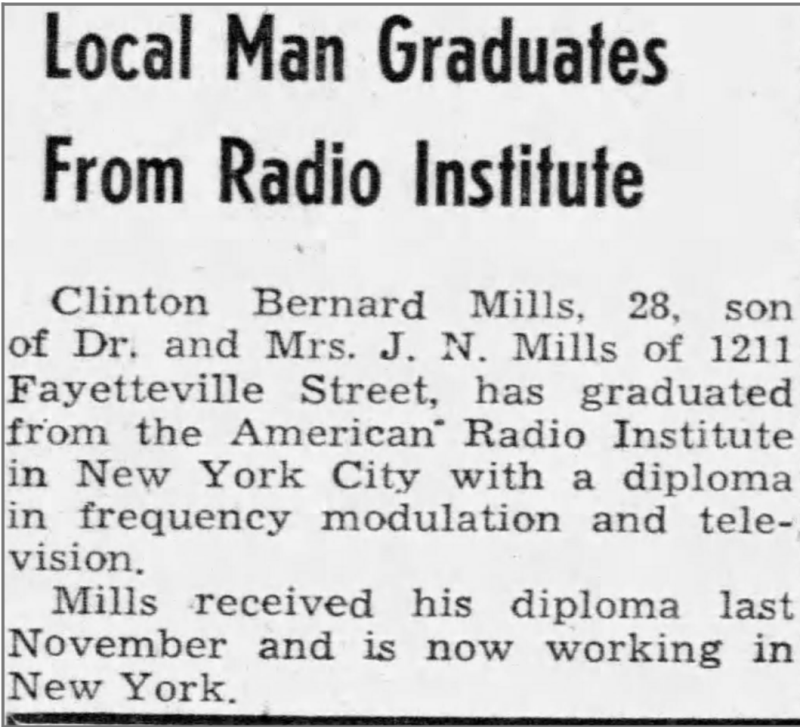
Clinton Mills was a member of the Tuskegee Airmen, the first-ever Black military aviation squadron (99th Pursuit Squadron). He attended the Tuskegee Institute, where he earned the highest average in his class and the highest honors on the shooting range during his tenure there. He was a 1st Lieutenant while he fought in Italy in World War II. He impressively shot down a German Focke-Wulf 190 during his time in the war. He returned multiple times to Durham to discuss his time fighting during the war. Clinton then went on to study at the American Radio Institute, where he graduated in 1949 with a degree in frequency modulation and television. He then continued to work in New York for a period, but eventually ended up in Hawaii.
In the early 2000s, the home was used as the offices for Turner’s Youth Education Resources Center. Started by Waltier Turner, then 16 years old, Turner’s Youth Education Resources Center was a center designed to help struggling students stay in school and address other issues affecting young people in the Fayetteville St area. Individuals in the Fayetteville Street community, like J.C. “Skeepie” Scarborough, supported the center on the advisory board. Turner also says she was motivated by then-chair of the Durham Committee on the Affairs of Black People, Lavonia Allison.
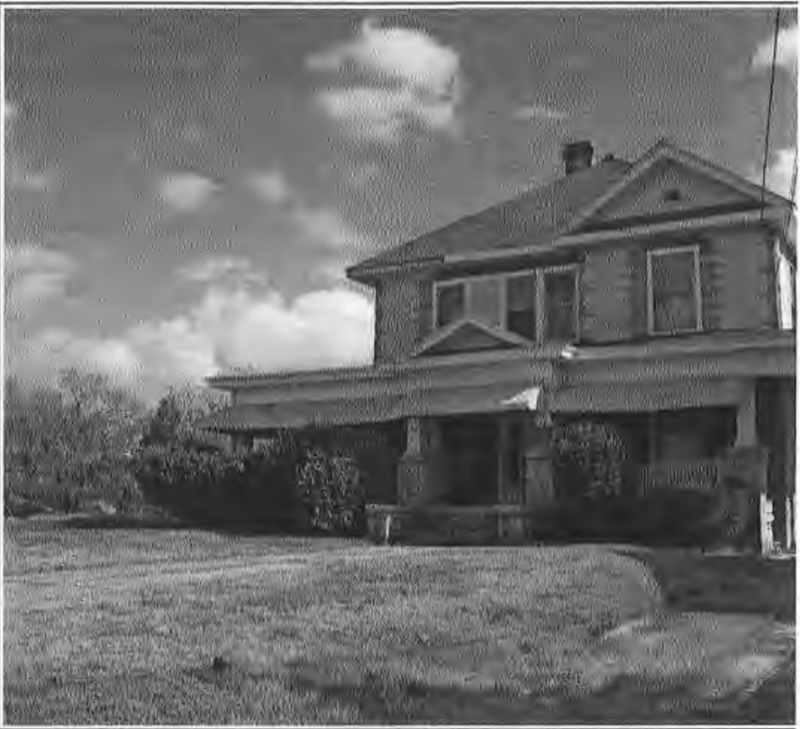
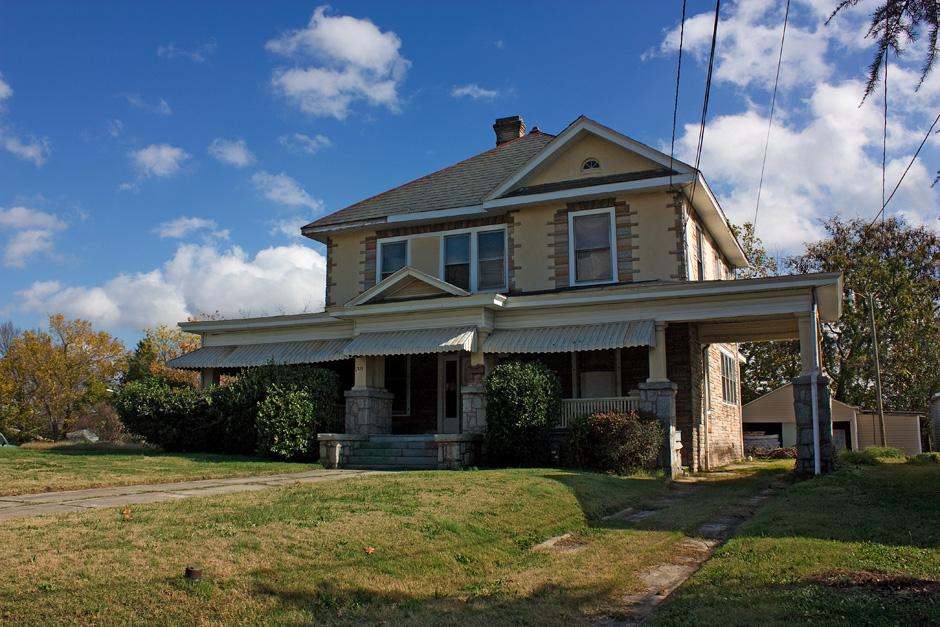
Looking northeast, 11.15.08
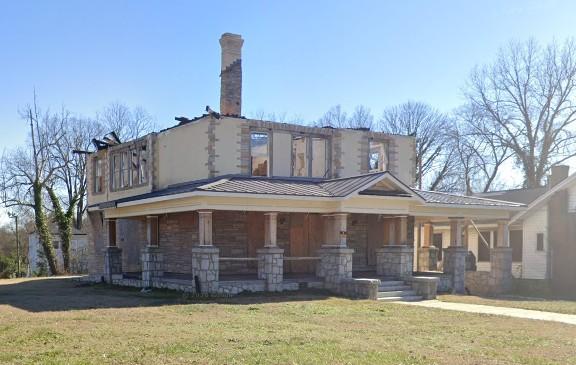
On September 3, 2023, a fire ignited in the attic of the house while undergoing renovation, causing severe damage to the property and halting the highly anticipated renovation of the home.
January 2025
Sources:
Carolina Times
Durham Sun
Herald-Sun
Interview with Conrad Odell Pearson, April 18, 1979” by Walter Weare, Southern Oral History Project, April 18, 1979, https://docsouth.unc.edu/sohp/H-0218/H-0218.html (last accessed December 19, 2025).
Jerry Gershenhorn. “Hocutt v. Wilson and Race Relations in Durham, North Carolina, during the 1930s,” The North Carolina Historical Review 78, no. 3 (2001): 275-308, http://www.jstor.org/stable/23522330.
North Jersey Herald and News
From Stokesdale National Historic District Nomination:
This two-story, pyramidal-roofed house is three bays wide and double-pile with projecting two-story gables at the left end the façade, the east end of the north elevation, and the north end of the rear elevation. There is also a one-story, hip-roofed rear ell on the southeast corner and a shed-roofed block north of the ell. The house has a later stone and stuccoed veneer, an original slate roof, and an interior corbelled brick chimney. It has one-over-one, double-hung wood sash windows and an original one-light-over-one-panel front door with matching transom and sidelights. Soffits and fascia on the house and around the porch have been covered with vinyl. The one-story, hip-roofed porch extends across the façade and wraps around the north side of the house; it extends beyond the house on the right end to form a porte-cochere. It is supported by tapered wood posts on granite piers and retains an original wood railing and a low, projecting gable over the entrance stair. Stairs to the porch are concrete with granite knee walls. The porte-cochere is supported by matching posts-on-piers and has a low granite wall on the south side. Dr. Joseph N. Mills erected the building in 1917, shortly after his marriage to Sarah J. Amey. Mills was a graduate of Kittrell Normal and Industrial School in 1907 and moved to Durham shortly after to practice medicine. In addition to his private practice and position on the medical staff of the Lincoln Hospital, Dr. Mills served as a field examiner for N. C. Mutual Life Insurance Company, a physician for North Carolina College, a director of the Mechanics and Farmers Bank, and president of Peoples Drug Store. Mills lived in the home until his death in the 1960s. NC-alt Garage, c. 1940– The front-gabled, frame one-car garage has vinyl siding and a shed-roofed lean-to on the south elevation.

Add new comment
Log in or register to post comments.