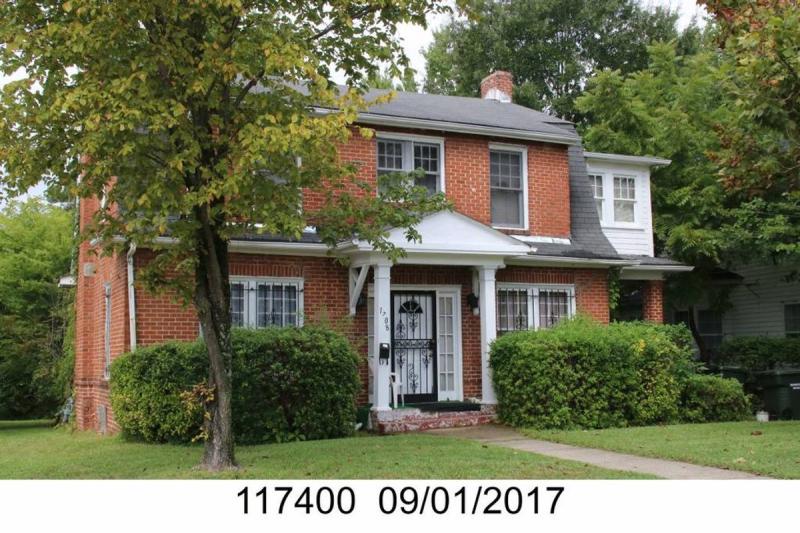
Three bays wide and double-pile, this brick-veneered house has a typical gambrel roof, with chimneys at each gable end, and a centered entrance under a small gable roof supported by square posts and brackets. A full width shed roof dormer sits at the rear, as well as a one-story shed-roofed wing, likely an enclosed porch. An open porch with brick and wood posts is at the north side, with a second-floor sleeping porch under a hipped roof. Original nine-over-one wood double hung windows, often paired, are throughout, with a pair of six-over-ones over the front entrance.
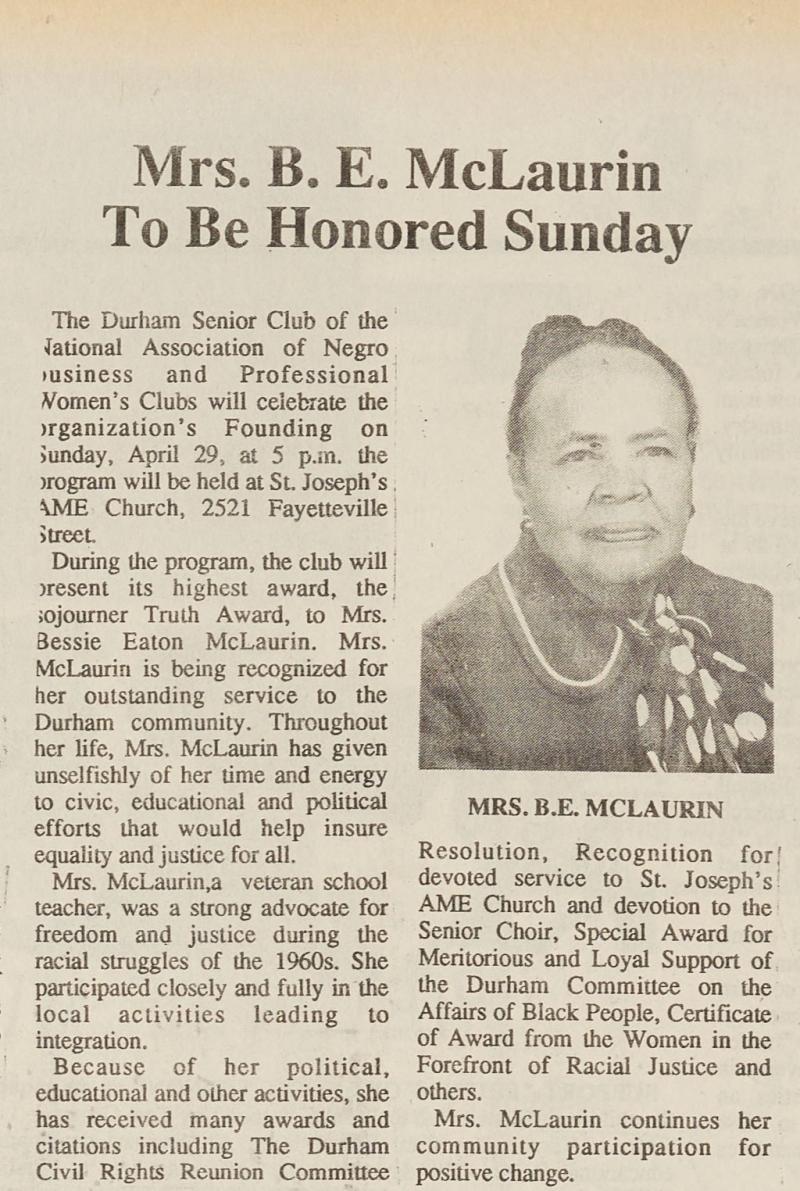
1708 Fayetteville was the long-term home of Bessie Eaton McLaurin and her husband, Charles McLaurin Sr. Bessie lived in the home from its construction until she passed away in 1995. Bessie was a Durham native, and throughout her lifetime in Durham, she made an incredible impact on the community as an educator and civil rights leader.
Bessie attended the National Religious Training School and Chautauqua–now North Carolina Central University–for her undergraduate and graduate degrees. She went on to teach elementary school in Durham, notably at Lyon Park School. During her years as a teacher, she was a pillar in the community, an advocate for a strong education system to support children’s future. She demonstrated this activism through the programs she was involved in. One such demonstration was through her leadership of tutoring groups with Operation Breakthrough, an anti-poverty organization. Bessie led this program, which included students from local universities and high schools helping elementary-aged students with math and reading. Bessie didn’t discriminate in her advocacy for education, teaching elementary students, prisoners, African American veterans, and more. Bessie believed that education was a key pillar in preventing and ending poverty and crime, and advocated for this belief through her dedication to teaching throughout her career and volunteer opportunities alike. Her advocacy and education enrichment programs led to her consideration by the 1974 Durham City Council Committee as a possible nominee to fill a vacant city council spot, which she ultimately did not fill.
Bessie was also an important advocate and activist for civil rights and women’s rights. One of her most notable contributions to the civil rights movement in Durham was her dedication to integrating the Carolina Theater. In 1961, in protest of the segregation of the theater, African-American protesters began to picket outside the Carolina Theater. In 1962, after the theater’s management refused to negotiate to desegregate the theater, the protesters shifted to a Round-Robin style protest, wherein Black protesters would walk up to the white-only ticket booth and attempt to buy a ticket. When they were refused, they returned to the back of the line to try again, an act of civil disobedience to pressure the theater to integrate its seating. In 1963, the theatre began the desegregation process, with a trial period of integrated showings. As a member of the Congress on Racial Equality (CORE), Bessie helped coordinate ticket sales for the trial integrated showings. Bessie felt that the process was degrading but necessary, saying the process felt as if white Durhamites were saying, “you crawl. As long as we make you crawl.”
Bessie was also involved in numerous other advocacy groups, including as vice-chair of the Durham Committee on the Affairs of Black People, a co-chair of Citizens for United Organization for Community Improvement, a member and representative of the Durham/Chapel Hill branch of the League for Peace and Freedom, a member and assistant treasurer for Women In Action, and more. She was a staunch advocate for women's and African-American rights, working with many groups that advocated for both issues, as well as the intersection of the two identities.
Bessie’s advocacy work was recognized on state and national levels. For her work with the Women’s International League for Peace and Freedom, she was called on to chair the opening session of the Southern conference in 1967. She was a Durham representative in the North Carolina Assembly on Women and the Economy, which sought to “...develop policy recommendations, designed to improve the status of North Carolina’s women in the state’s economy. She was also invited to the White House for a Religious Leaders Consultation on the SALT II Treaty because of her work with the National Board of Partners in Ecumenism.
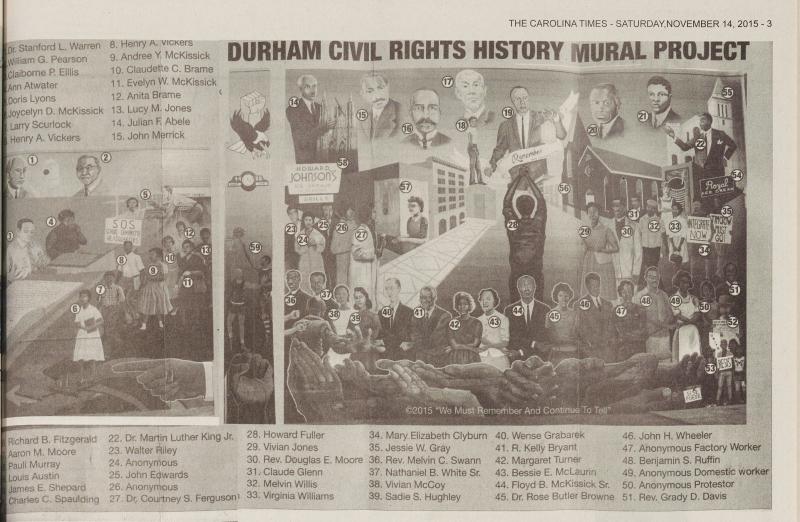
Bessie was honored by many of the groups she was a part of for her work and lifelong dedication to the causes she supported. One of the most resonant indications of Bessie’s impact is her inclusion in the Durham Civil Rights Mural, an art piece dedicated to the civil rights movers and shakers in Durham, located outside of the Durham Arts Council.
Bessie was involved in the community beyond her advocacy work, namely in numerous community clubs. Some of the clubs Bessie participated in were the Daughters of Dorcas, the Model Mothers Club, and the local bridge club. She was an original member of the Durham Beta Pi Sigma Chapter of the Sigma Gamma Rho Sorority, which prioritized service to local communities, particularly for the youth. For a time, she also wrote the “Durham Personal Mention” column in the Carolina Times, reporting on community events and organizations. She was involved in church organizations as well, as she was a dedicated congregant of St. Joseph’s A.M.E. Church throughout her life.
Bessie married Charles McLaurin in 1924. Charles was a WWI veteran, serving as a Sergeant 1st Class in the Sigma Corps. After his stint in the military, Charles worked as a bricklayer before starting a funeral business. Charles opened McLaurin Funeral Home in Durham in 1927. The McLaurin Funeral Home was located at 1108 Fayetteville, and Charles owned and operated the business until his death in 1946. The funeral home continued to operate under new ownership at 1108 Fayetteville, rebranded and operated by Johnson Ray. Charles lived in the home at 1708 Fayetteville until he died in 1946.
As of 2026, the home is in good and stable condition.
Sources:
Carolina Times
“Confronting Change: The History,”Carolina Theatre, last accessed March 25, 2026, https://carolinatheatre.org/confronting-change-the-history.
Durham Sun
Heather Fearnbach, “St. Joseph African Methodist Episcopal Church,” January 4, 2024, https://www.hpo.nc.gov/nrac-agenda/st-joseph-ame-nomination/open.
Herald-Sun

Add new comment
Log in or register to post comments.