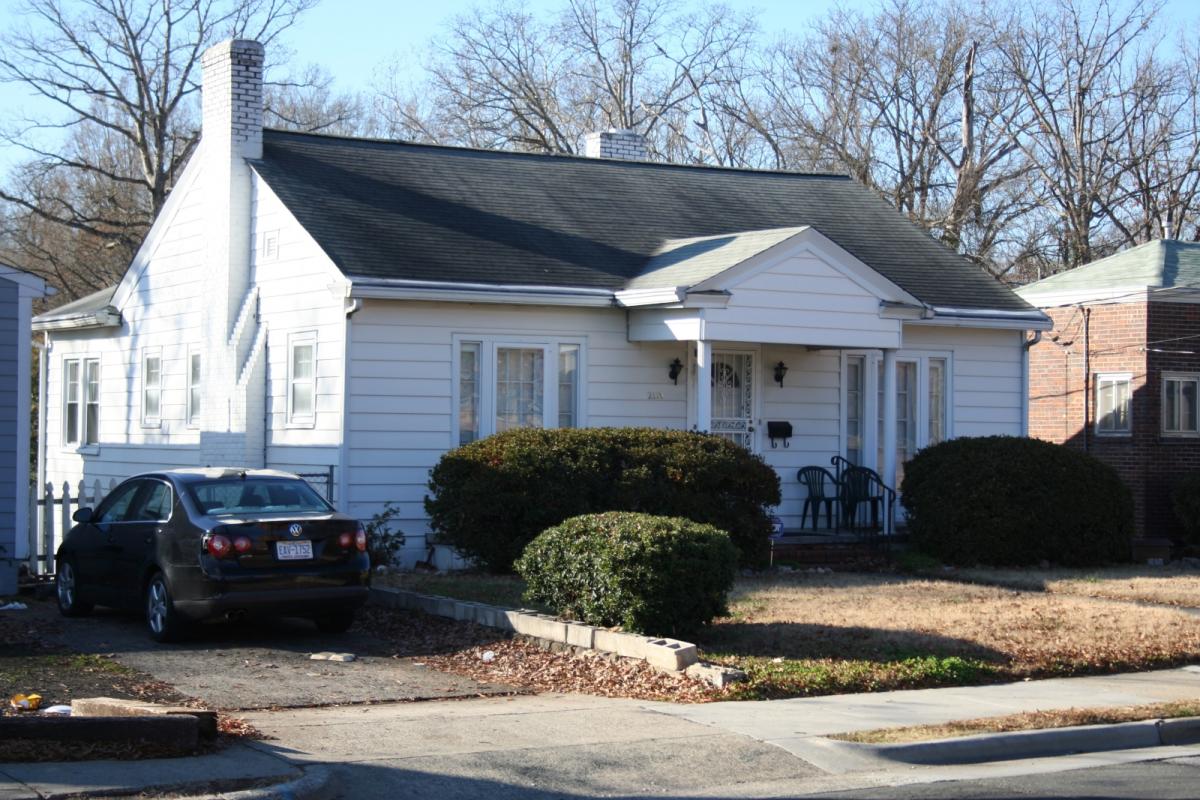
A photograph of 2110 Fayetteville Street by Heather Slane (hmwPreservation) - December 2017.
Earl and Irma Carter were the first owners of 2110 Fayetteville Street. Earl Carter, originally from Charleston, West Virginia, attended West Virginia University before starting his career in the insurance industry. He moved to Durham to work at the North Carolina Mutual Life Insurance Company (NCMI). During his time in Durham, he also served with distinction in both the Pacific and European theatres during World War II.
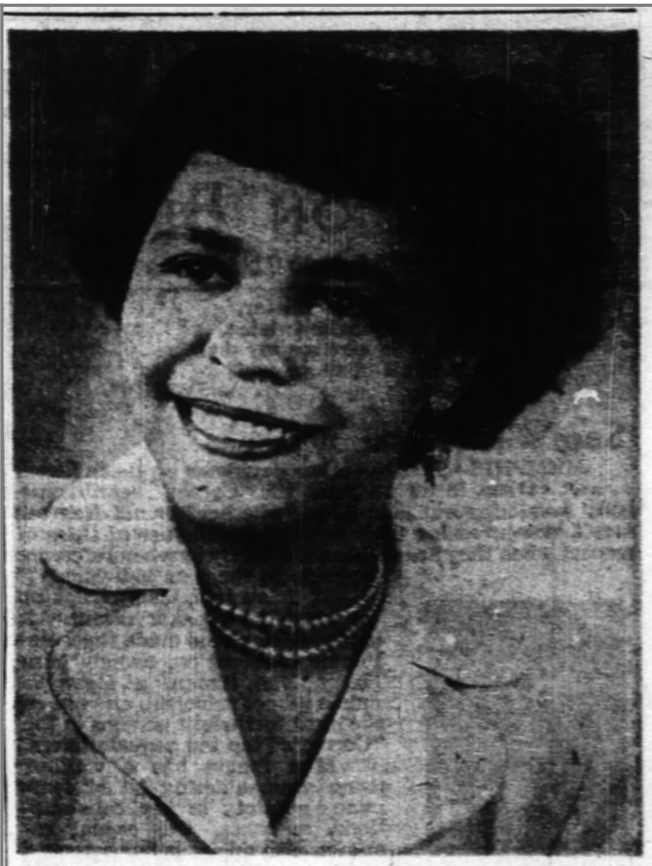
A portrait photo of Irma Cox Carter (New Pittsburgh Courier) - March 24, 1951.
His wife, Irma Cox Carter, also lived in the home. Irma was from Indianola, Mississippi, and was the daughter of a prominent NCMI businessman, George W. Cox. Irma also attended West Virginia State University and worked as a clerk at NCMI.
The couple eventually split up in the 1940s. Earl relocated to Birmingham, Alabama, where he managed the local NCMI district, and ended his career managing the Charlotte branch. Irma moved to Detroit, Michigan, in 1943 to attend Wayne University, where she graduated with her B.A. and M.A. degrees. She served in World War II as a Red Cross Army Nurse before returning to Detroit, where she taught in the public schools. She remarried to Parker Derrand Penick, who worked as a salesman for an aluminium company. In 1960, Parker claimed to have accidentally shot Irma, which led to her death. The death was ultimately ruled an accident, and Parker was not charged with homicide.
The home was rented out to numerous individuals between the Carters' and the next family’s occupancy. One of the renters was Durham icon, Floyd McKissick. He lived in the home for one year in 1952, while attending law school at North Carolina College, now North Carolina Central University. McKissick attended North Carolina College after being refused admission at the University of Chapel Hill law school because of his race. He went on to challenge this refusal through the court system, and won, leading to the UNC-CH law school and its other graduate and professional schools to integrate their programs. McKissick eventually established a law firm in Durham, where he defended civil rights. One such case was his defense of the Royal Ice Cream Sit-In protesters. He also defended the students and parents who sought to integrate Durham public schools, which included his daughter, Jocelyn, and his wife, Evelyn.
A portrait photo of George W. Cox, Jr. (The Herald-Sun) - December 12, 1992.
George W. Cox Jr., Irma’s brother, and Rosemond Hogan Cox were the next owners of the home. They lived in the home until George died in 1992. Just like his sister, George was born in Jackson, Mississippi, but was raised in Durham, North Carolina, where he attended public schools. He attended Morehouse College in Atlanta, Georgia, for his bachelor's degree and New York State University for his master’s degree. He followed in his father's and sister’s footsteps, working for NCMI. He started as a supervisor of field clerk services, then moved up in the company, becoming vice president in 1973, the same role his father had held years before. He also served in the U.S. military for four years in the South Pacific, reaching the rank of technical sergeant. He was part of the Durham American Veterans of World War II and Korean (AMVETS) organization, where he served as the 3rd vice commander.
As a Durhamite for most of his life, George was invested in his community, particularly in supporting extracurricular activities. In his childhood, he was a charter member of the first Boy Scout Troop for African American boys in Durham, Troop 55. The Coxes had a family legacy with Troop 55, with George Sr. in the first Court of Honor, George Jr. as an original member and eventual chairman, and George Jr.’s son, George Cox III, as an award-winning scout. George also supported the Blue Ribbon Tennis Club, an organization that promoted Black youth in tennis across the nation. George taught tennis to children at the Algonquin Tennis Club, a pivotal institution in the Hayti community. George was also a board member for the Daisy E. Scarborough Nursery School and the John Avery Boys and Girls Club, further demonstrating his dedication to children’s education and extracurricular activities.
Beyond his work with numerous children’s community organizations, George was involved with other pivotal institutions in Durham. He was a member of the St. Titus Episcopal Church. He was also a 50-year member of the Beta Phi Chapter of the Omega Psi Phi fraternity. George passed away in 1992, at the age of 73.
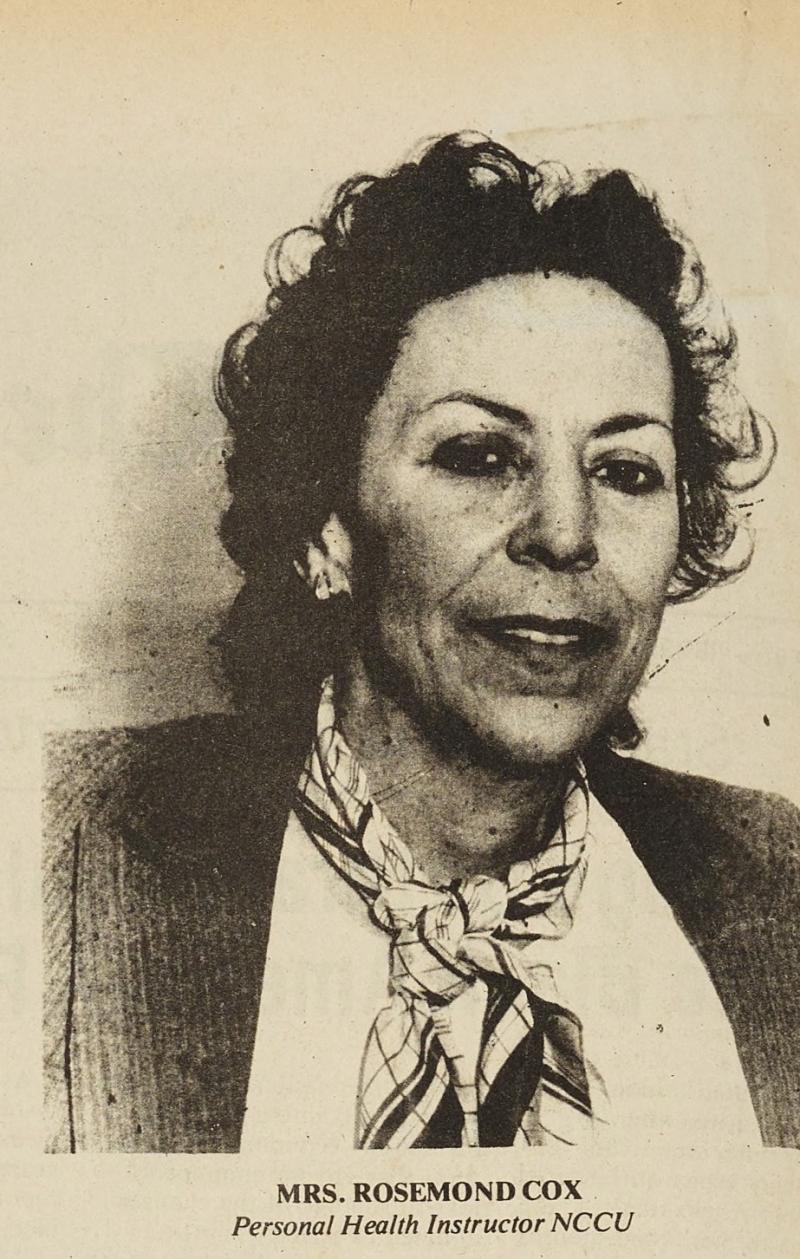
A photograph of Rosemond "Rose" Anita Hogans Cox (Carolina Times) - December 15, 1984.
George lived with his wife, Rosemond “Rose” Hogan Cox, at 2110 Fayetteville Street. Rose was born in Charlotte, North Carolina. She attended Bennett College and graduated in 1947. She was dedicated to the school throughout her life, notably as a member of the Durham Chapter of the Bennett College Alumnae Association. The chapter honored her with a celebration in 1997. In Durham, Rose worked at North Carolina Central University as a professor of Personal Health. She was also a part of many women’s organizations that sought to better the community, including the Women-In-Action club, the Durham Alumnae Chapter of the Delta Sigma Theta Sorority, and the National Smart Set. For her contributions to the community, the National Council of Negro Women honored her and 92 other local women in 1987. Rose, like her husband, was a dedicated congregation member at St. Titus’ Episcopal Church and was awarded for her devotion to the church in 2010. Rosemond died in 2022 at the age of 96.
From the 2018 National Register of Historic Places application for College Heights:
This one-story, side-gabled Minimal Traditional-style house is three bays wide and double-pile with a full-width, gabled rear wing. The house has aluminum siding, six-over-six wood-sash windows, an interior brick chimney, and an exterior brick chimney on the left (south) gable end. The replacement front door, centered on the façade, is sheltered by a front-gabled roof supported by vinyl columns. It is flanked by fifteen-light French doors, each with five-light sidelights. There is a shed-roofed enclosed porch near the rear of the right (north) elevation with a basement-level entrance below the porch and basement-level glass block windows on the north elevation. The earliest known occupant is Viola G. Thompson, an office secretary at NC Mutual Life Insurance Company, in 1940 and the first female member of the company’s board. By the late 1950s, the house was occupied by George and Rosemond Cox, both employees at NC Mutual.

Add new comment
Log in or register to post comments.