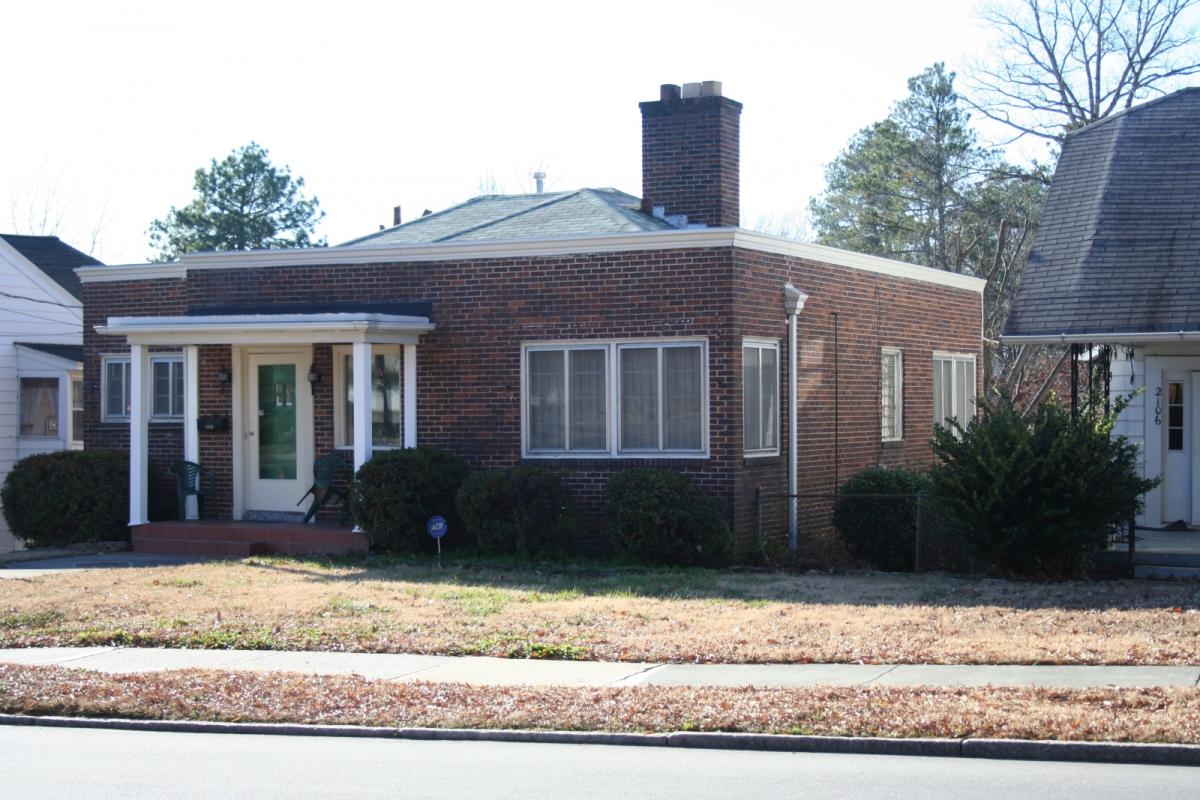
Photograph of 2108 Fayetteville Street by Heather Slane (hmwPreservation) - December 2017.
Viola G. Turner had the home at 2108 Fayetteville Street built in 1940 for approximately $4,600. The Union & Insurance Realty Company built the house and promoted it as a model home with open inspections. She married Elbert C. Turner in 1943, when he also moved into the home. The couple lived in the home until their respective deaths.
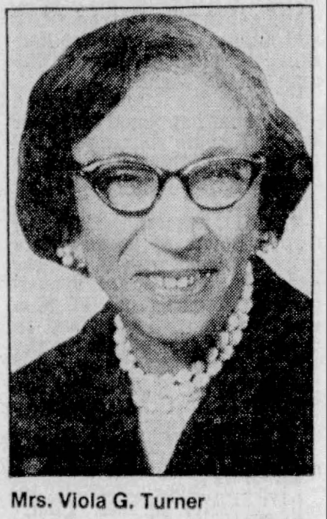
A portrait photo of Viola G. Turner (The Herald-Sun) - February 2, 1988.
Viola G. Mitchell Turner was born in Macon, Georgia, circa 1905. She attended Morris Brown College in Atlanta, where she eventually taught for a short period. She was also a secretary for the Tuskegee Institute. She had been specially recruited for this job, never having applied, but requested directly by the university’s president, R.R. Morten, on recommendation by a former classmate. After her time in Alabama, she moved to Jackson, Mississippi, to work with the Mississippi Department of Education. Eventually, she relocated to Oklahoma City, where she began working for the local North Carolina Mutual Life Insurance Company branch in 1920. She was then hired in 1924 to work for the original Durham branch of the North Carolina Mutual Life Insurance Company. She worked here for the rest of her career, starting as a secretary. From there, she continued to advance within the company, making history as its first board member, board vice president, treasurer, and financial vice president. This achievement cannot be understated, as she was one of the few women in the entire country in her position. It was even more extraordinary considering that the North Carolina Mutual Life Insurance Company was the biggest Black-owned business in the country in the twentieth century.
In an oral history conducted by Walter B. Weare, Mrs. Turner discusses the difficulties that she overcame as a Black woman in a male-dominated field. In the oral history, she recalls an anecdote she used to tell about the differences in business schooling for men versus women. In this anecdote, she explains how women were trained to be secretaries, whereas men were trained for top management. Mrs. Turner then explains the extra work she had to do to earn the executive positions she met, including doing additional research and learning the minutiae while she sat in on meetings in her secretarial position. This additional work set her up to make a name for herself within the company and within the greater financial field. She also notes her willingness to learn and ask questions, something that she believes many men weren’t willing to do. From this, she made a name for herself in the finance industry.
Like many of the male higher-ups at North Carolina Mutual, Ms. Turner was also involved in the leadership of numerous other organizations in Durham. Some of her roles included board member of the Mechanics & Farmers Bank, board member of Scarborough Nursery School, and a trustee of St. Augustine’s College. She was also involved with the YWCA, the Gourmet Bride Club, and the Iota Phi Lambda Sorority, and was a congregant at St. Titus Episcopal Church. In 1966, she was recognized for her work in the finance field with her appointment to the National Public Advisory Committee on Regional Economic Development, which sought to “provide expert counsel on problems of local and regional development.” She was also honored by her alma mater with an honorary Doctor of Laws degree in 1964.
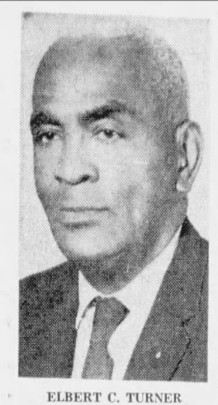
A portrait photo of Elbert C. Turner (The Herald-Sun) - February 5, 1970.
Ms. Turner was married three times, with her final marriage to Elbert “Pops” Turner, with whom she says she “hit the jackpot on the last go-round.” Pops, as Elbert was called by most in the community, was originally from Brooklyn, New York. Pops was an impressive football and baseball player, making a professional career out of it for a period. Pops was the quarterback at West Virginia State, during which time he was selected as the quarterback for the All-American Team. After his college career, he played professional and semi-professional football and baseball with the Negro Leagues. Pops played against numerous legendary baseball players, many of them white, during the barnstorming tours. Barnstorming tours were games where traveling teams would come to play in areas with no major league teams nearby. These games drew audiences of eighteen to twenty thousand. During these games, Pops played against other notables, including Babe Ruth, Rogers Hornsby, and Jimmy Foxx. After he eventually retired from baseball and football, Pops umpired for the Negro Leagues, demonstrating his continuous love for sports.
After his own sports career, Pops started coaching football and baseball at North Carolina College, now North Carolina Central University. He then began working for the Mutual Life Insurance Company and was sent to work at the Norfolk, Virginia, branch. He eventually settled in Durham in 1943 after marrying Viola and moving into 2108 Fayetteville Street. In Durham, he started his own beauty supply company, “Turner Beauty and Barber Supplies Inc,” which became a statewide success.
Outside of his work, Pops was a member of St. Joseph’s A.M.E Church, a member of the Kappa Alpha Psi fraternity, and a past master of the A.S. Hunter Lodge No. 285 F&A.M. Pops was also an organizer of the One O’Clock Luncheon with the Durham Business and Professional Chain. He passed away in 1970, and Viola followed him in death eighteen years later in 1988.
Sources:
Carolina Times
Durham Sun
Herald-Sun
Troy Kickler, “North Carolina Mutual Life,” North Carolina History Project, last accessed May 6, 2026, https://northcarolinahistory.org/encyclopedia/north-carolina-mutual-life/.
Viola Turner, “Interview with Viola Turner,” by Walter Weare, Southern Oral History Program Collection, Documenting the American South, April 15, 1979, https://docsouth.unc.edu/sohp/C-0015/C-0015.html.
From the National Register Historic District description, where it is listed as a "non-contributing property" because of modifications made in the 1970s:
This one-story, hip-roofed house was significantly altered in the 1970s with the construction of a flat-roofed brick wing that extends across the façade and wraps around the north and south elevations of the house, fully obscuring the original building. The original part of the house appears to be a hip-roofed building with an interior brick chimney and projecting hip-roofed bays on the right (north) end of the façade and at the right rear (northwest). The flat-roofed brick addition follows this form with the right three bays projecting to wrap around the original projecting front bay. The brick wing has paired metal-framed casement windows and a glass block window on the right elevation. The entrance, located near the center of the brick wing has a solid door with four lights and is sheltered by a two-bay-wide, flat-roofed porch supported by square wood columns. A fixed one-light window is located immediately to the right of the door. County tax records date the house to 1940 and the earliest known occupants are Earl A. Carter, an agent at NC Mutual Life Insurance Company, and his wife, Irma S. Carter, in 1940.

Add new comment
Log in or register to post comments.