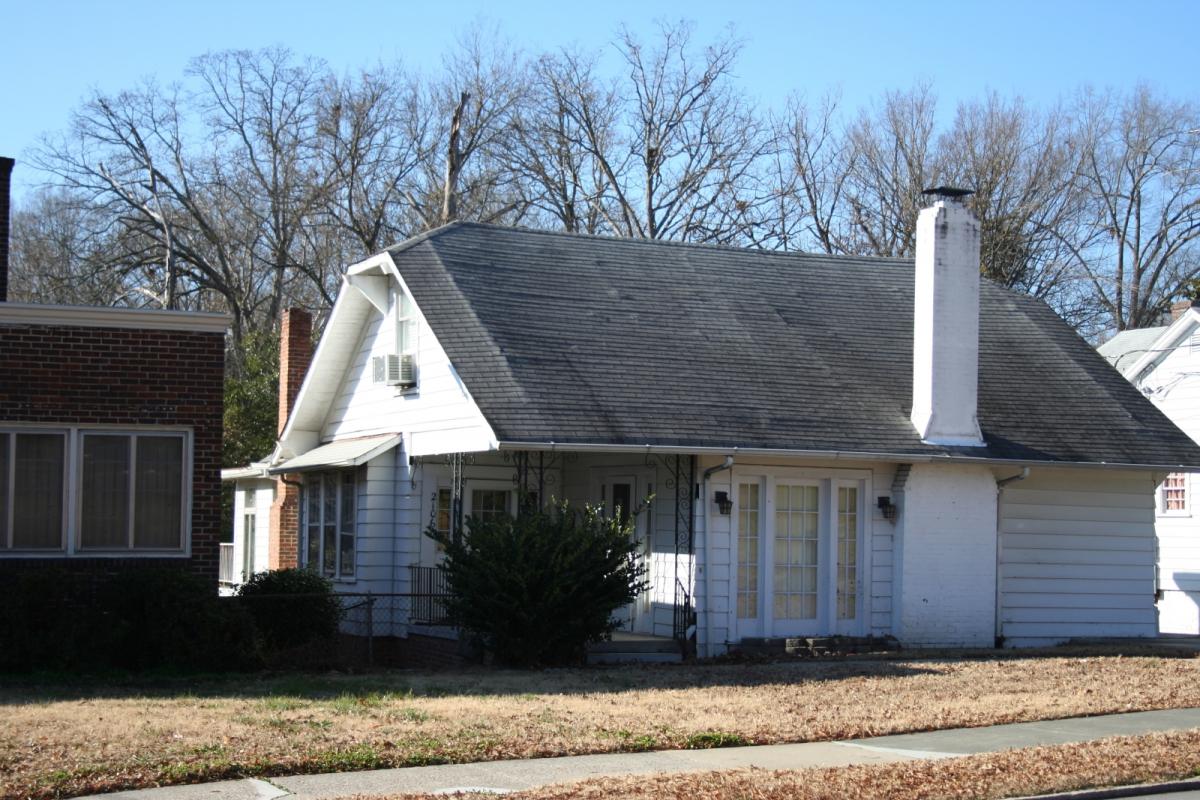
Photograph taken by Heather Slane (National Historic District Submission) - December 2017.
The Taylor family, the first owners and occupants of 2106 Fayetteville Street, was a family of educators who dedicated their time, energy, and resources to civil rights activism in Durham. James T. Taylor was born in Danville, Virginia, and raised in Wilson, North Carolina, but lived most of his life in Durham after attending the National Religious Training School (now North Carolina Central University) in 1913. He was an early student at the school, back when it operated as both a high school and college. He completed his high school training at the school, then continued to attend college there. He took a brief leave of absence while serving in the military from 1918 to 1919, during which he rose from private to second lieutenant. He returned to school in 1918, slightly before he was honorably discharged. He graduated from the school with a Bachelor of Arts with honors in 1921. After graduating from the National Religious Training School, he then attended Ohio State University, where he earned his B.S. and M.S. degrees. After five years as principal of Pine Street School in Hamlet, North Carolina, Mr. Taylor took a position teaching psychology at North Carolina Central University (NCCU) in 1926; he later served as the first chair of NCCU's Psychology Department. Thus would begin his long journey working for North Carolina Central until 1970.
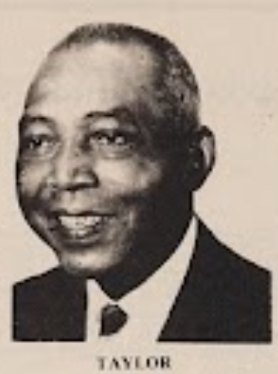
A portrait photo of James T. Taylor (The Carolina Times) - August 10, 1985.
Over his 44 years of service to North Carolina Central, Mr. Taylor worked in numerous positions. Beyond his professorship, Mr. Taylor also served as the university’s Dean of Men until 1960. He was active on campus in other ways as well, including as chief of the Veterans Guidance Center and as the executive director of the James E. Shepard Memorial Foundation. For his dedication to the university, NCCU honored Mr. Taylor in multiple ways over the years. In 1948, he was the first North Carolina College alumnus of the year. In 1957, he made history again as the first-ever recipient of the James E. Shepard Hamilton Watch Award for Teachers. He was also awarded an Honorary Doctor of Laws degree from the university in 1965, officially making him Mr. James. T. Taylor. One of the university’s biggest honors for Mr. Taylor came just months before he died in 1970, when the university named a campus building, the James T. Taylor Education Building, in recognition of his over 40 years of dedication to the school.
Mr. Taylor was also incredibly involved in government and political affairs. During World War II, Mr. Taylor worked as the North Carolina assistant information officer for the Office of Price Administration. Mr. Taylor was the first African American to work for this administration in the eight-state Atlanta region. Through this role, he oversaw the education of African American communities in 52 counties throughout North Carolina, sharing the work the OPA did. In 1953, he became vice chairman of the North Carolina Good Neighbor Council. Governor Terry Sanford introduced the Good Neighbor Council as an initiative to address poverty in North Carolina by supporting job training throughout the South and promoting jobs to all qualified individuals, regardless of race. Later that year, Mr. Taylor was also hired as the administrative officer for the North Carolina Employment Security Commission, making him the first African American to work in a state-level job with the commission.
Beyond his work with the state government, Mr. Taylor also worked in local politics. His local political career started in 1936, when he was elected as the Durham Courthouse precinct chairman for the Durham County Democratic Executive Committee. He was reelected in this position in 1938. In 1951, Mr. Taylor ran for city council for the first time. He would subsequently vie for a city council spot in the 1952, 1953, and 1957 elections, with varied support each race, but never ultimately winning.
While Mr. Taylor was unsuccessful in securing a city council seat, these losses did not deter him from his local activism. In 1935, he and six other activists created the Durham Committee on Negro Affairs, now the Durham Committee on the Affairs of Black People. This organization is still active in the Durham community, and from its outset has a legacy of being an influential political group with “a commitment to the improvement of life for all in the black community.”
Mr. Taylor was also a major activist for the public school system and the education of Black children. He led multiple education advocacy groups as president, including the North Carolina Association of Personell Deans and Advisers to Men in Negro Institutions and the North Carolina Teachers Association. He was instrumental in growing the influence of the North Carolina Teachers Association, an originally all-Black organization. This is evidenced by the development of the NCTA headquarters, held in a building Mr. Taylor purchased in Raleigh. One of his central advocacy goals was to bring attention to the disproportionate investment in white schools and teachers versus Black schools and teachers. Some of his platform points were increased job security for educators teaching about civil rights; increasing teachers’ pay, and more specifically equalizing pay between Black and white teachers; and hiring more faculty, such as a Black assistant superintendent to oversee Black schools. These policies not only addressed central issues such as unfair facilities instituted through segregation, but also targeted lesser-known systemic issues that affected what students were taught and the protection of Black teachers. Mr. Taylor was also supportive of the desegregation of Hyde County schools in his role as chairman of the North Carolina Good Neighbor Council
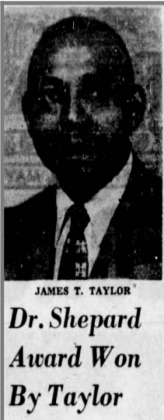
A portrait photo of James T. Taylor after he became the first recipient of the James E. Shepard Hamilton Watch Award for Teachers at North Carolina College (now NCCU) (Durham Sun) - May 9, 1957.
Mr. Taylor was influential in the Durham community in numerous other ways. He was an active congregant at White Rock Baptist Church, where he taught Bible Class for over 40 years. He was also treasurer for the American Tennis Association, a position he held for 25 years. Furthermore, he was imperative in ensuring better facilities and treatment of Black fans at the historic Durham Athletic Park. Mr. Taylor’s widespread activism and community involvement is thus felt throughout many of the Durham institutions that still exist to this day.
Mr. Taylor married Gertrude E. Taylor in 1922. Gertrude was originally from Madison, Indiana. She attended Livingstone College where she received her A.B., Ohio State University where she received her B.S. in education, and the University of Michigan where she received her M.A. She did postgraduate work at the University of California in Berkeley and the American University in Mexico City. Gertrude was also influential in the Durham education system, notably in her role as supervisor of Durham County Negro Schools. She held this position for nearly twenty years, from 1926-1945. From 1950 until a little before she passed away in 1954, she taught at Little River High School.
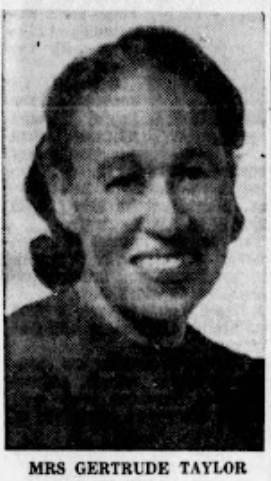
A portrait photo of Gertrude Taylor (The Carolina Times) - January 1954.
Gertrude was very involved in the Durham community, especially at St. Titus Episcopal Church. She was the first chairman of the Interracial Committee at the church, as well as the chairman of the District of the Diocesan Women’s Auxiliary. She was also a member of the Alpha Kappa Alpha Sorority and a hostess/attendee of the Saturday evening Bridge Club.
After Gertrude passed at the young age of 54 in 1954, Mr. Taylor remarried in 1955 to Galatia L. Taylor. Galatia was born in Chester, South Carolina, in 1912. She spent much of her life in High Point, North Carolina, where she taught in the city school system for 21 years. She was active in the High Point community, working with the YWCA as the Youth Fellowship Group chairman and with the local Girl Scout troop. She was also active with St. Mark’s Methodist Church in High Point, where she led the youth program and was a member of the Women’s Society of Christian Service.
After coming to Durham, she taught at Fayetteville Street School. She started attending the Asbury Temple Methodist Church, where she led the church’s commission on missions. She was also involved with numerous clubs and organizations throughout her life. She was the Anti-Basileus Elect of the Alpha Kappa Alpha Sorority and a member of the Durham Classroom Teachers Association, North Carolina Teachers Association, and the National Education Association. She passed away unexpectedly in late 1963.
Sources:
Carolina Times
Durham Sun
Herald-Sun
From the 2018 National Register of Historic Places application for College Heights:
This one-story, clipped-side-gabled Period Cottage is two bays wide and double-pile with a wide, gabled rear ell. The house has aluminum siding, vinyl windows, aluminum-covered knee brackets in the gables, and an exterior front-facing brick chimney near the center of the façade. A fifteen-light French door left (south) of the chimney is flanked by ten-light sidelights. An inset porch on the left end of the façade is supported by decorative metal posts and shelters a nine-light-over-two-panel door with three-light-over-one-panel sidelights and a second entrance with five-light sidelights on the right (north) side of the inset bay. There is a projecting, shed-roofed bay on the left elevation with a group of three windows. The house has a single window in each gable, an exterior brick chimney on the south elevation of the rear wing, and a shed-roofed dormer on the north elevation of the rear wing. A gabled ell at the right rear (northwest) has a shed-roofed bay to its south and a modern wood deck at its rear. The earliest known occupants are James T. Taylor, a professor at North Carolina College (later North Carolina Central University), and his wife, Gertrude E. Taylor.

Add new comment
Log in or register to post comments.