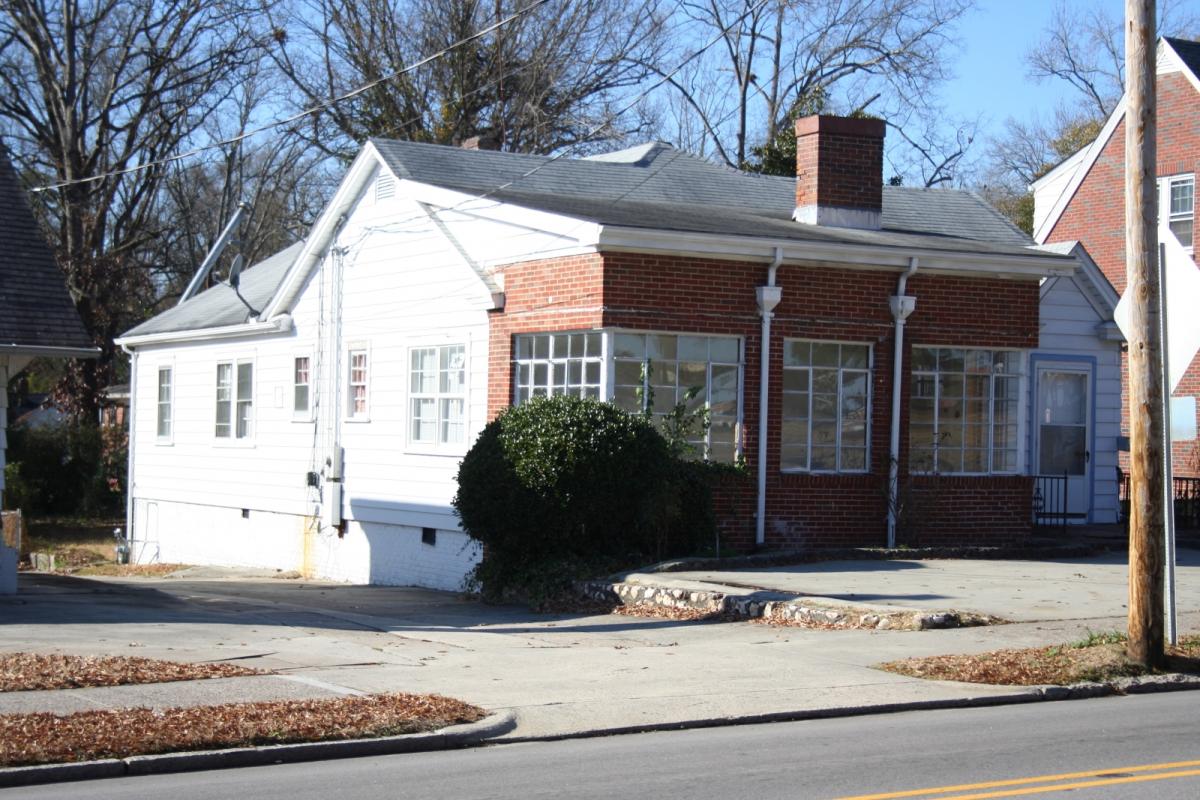
Photograph taken by Heather Slane (National Historic Register Submission) - December 2017.
Dr. Norman H. Cordice, Sr. and Eugenia Allbritton Cordice lived at 2104 Fayetteville Street for nearly 50 years, purchasing the home on September 11, 1945, from Ida Mae Bass. Originally from Saint Vincent and the Grenadines, Dr. Cordice moved to Durham, NC, in the early 20th century after marrying Terrell, Texas-native Eugenia Allbritton in 1929. Norman was the primary dentist of the College Heights community, using parts of the 2104 Fayetteville Street home as a dental office to provide neighborhood residents with general dental care. A few years prior, Dr. Cordice had an office at 120 1/2 South Mangum Street. He was also on the staff at Lincoln Hospital and served as the long-time Secretary of the Alexander Hunter Society of Durham, a local Black dentist organization.
Similar to her husband, Eugenia also worked in health care. After receiving her education at Prairie View A&M University, Meharry Medical College, Columbia University, and North Carolina College, Eugenia served communities across North Carolina as a registered nurse. During her time as a public health nurse for the State of North Carolina, Eugenia primarily lived away from her husband in Durham, working down east in Washington, NC. She also taught as a clinical instructor at Winston-Salem State University. In Durham, Eugenia worked as a staff nurse at Lincoln, Duke, and Watts Hospitals – and, for over 40 years, at Scarborough Nursery School. Outside of her nursing career, she was a member of Alpha Kappa Alpha Sorority, Inc., the Ladies Auxiliary of the Old North State Dental Society, and the Meharry Medical College Alumni Association. Eugenia also volunteered as a chaperone for the Health Careers Club at Hillside High School.
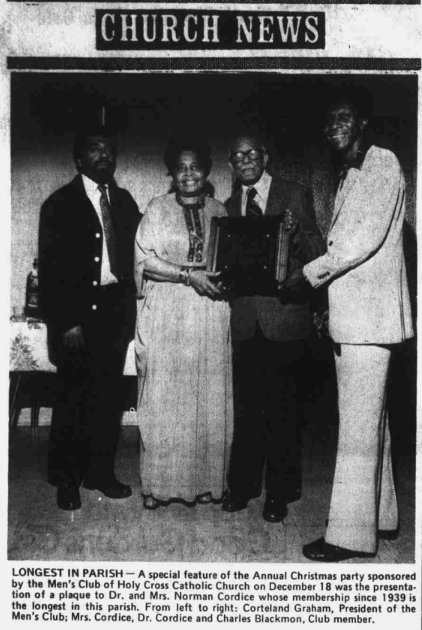
A photograph of Mrs. Eugenia Allbritton Cordice and Dr. Norman H. Cordice (pictured in the middle) receiving a plaque for holding the longest membership at the Holy Cross Catholic Church in Durham (The Carolina Times) - December 25, 1976.
Norman and Eugenia were founding members of the Holy Cross Catholic Church in Durham. The first masses for this African American-based mission were held in 2104 Fayetteville Street, before the church purchased a 16.9-acre lot at 1400 South Alston Avenue. Eugenia served in the church’s Legion of Mary Rosary Society and the Altar Society. Norman, on the other hand, led different statewide initiatives through the church, such as co-chairing the 6th annual North Carolina Catholic Laymen’s Association convention. Norman and Eugenia were active in the Holy Cross Catholic Church for over 40 years.
On November 17, 2003, Norman H. Cordice, Jr. and his wife, Marjorie B. Cordice, sold the 2104 Fayetteville Street property to William V. Lucas and Pebbles Lindsay Lucas. The house has had tenants periodically, and currently, William V. Lucas uses the property as a law office.
Sources:
Carolina Times
“Mass of Christian Burial for Mrs. Eugenia Allbritton Cordice,” Scarborough and Hargett Funeral Home (Durham, North Carolina), September 5, 2000.
“Our History,” Holy Cross Catholic Church, last accessed June 9, 2026, https://www.holycrossdurham.org/our-history.
From the 2018 National Register of Historic Places application for College Heights:
This one-story, side-gabled house is unusual for the construction of a shed-roofed brick wing on the left (south) end of the façade, likely constructed in the 1950s to house a business. The main portion of the house features a side-gabled roof and a full-width gabled rear wing resulting in a triple-pile form. It has aluminum siding, two interior brick chimneys, and a combination of six-over-six wood-sash and vinyl replacement windows. A replacement door is located in a projecting, front-gabled bay on the right (north) end of the façade and is accessed by an uncovered brick stoop. Two pairs of original six-over-six wood-sash windows remain on the right elevation with an original triple window at the rear of the right elevation replaced with a single window and the wide opening enclosed with vinyl siding. A shed-roofed wing projects from the right rear (northwest). The shed-roofed, brick wing on the left end of the façade is three bays wide with metal-framed casement windows that wrap around the front corners of the wing. There is a six-light-over-two-panel door on its right elevation that is accessed by a brick stoop. County tax records date the house to 1940 and the earliest known occupants are Norman H. Cordice, a dentist, and his wife, Eugenia A. Cordice, a registered nurse, in 1958. They were the parents to a son, who later became a dentist.

Add new comment
Log in or register to post comments.