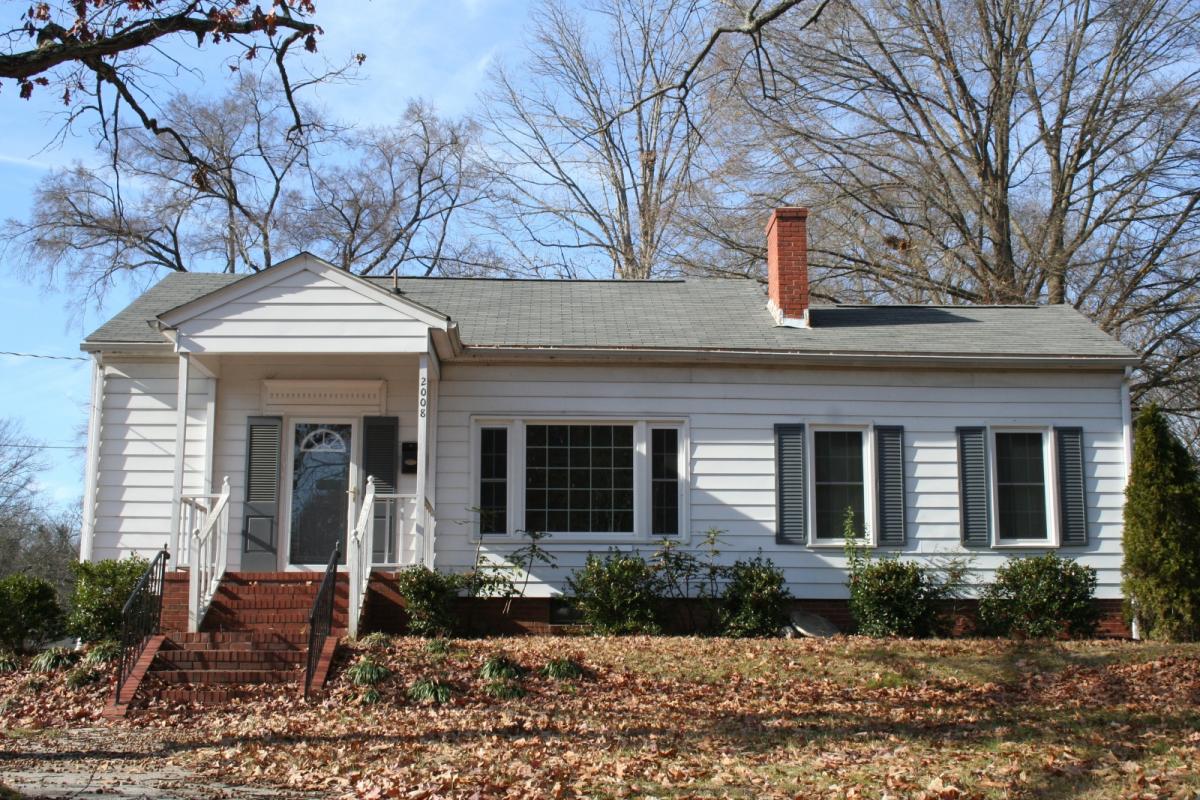
Photograph taken by Heather Slane, National Historic Register Submission, December 2017
From Preservation Durham Historic Plaque Application
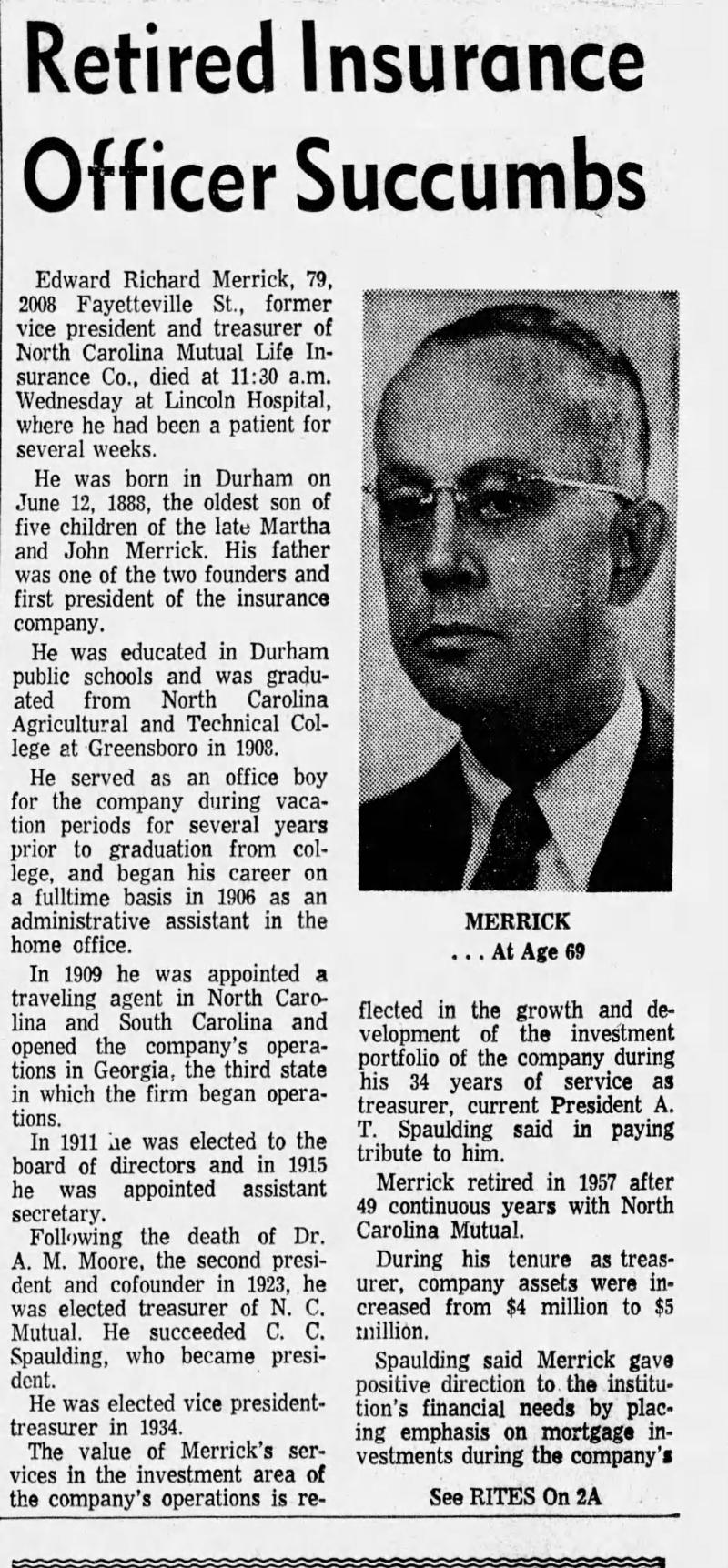
Edward Merrick and Lyda Vivian Moore Merrick were the original owners of 2008 Fayetteville Street. Edward lived in the home from 1964 until he died in 1967. Lyda lived in the home from 1964 to 1978. Lyda was the daughter of Dr. Aaron McDuffie Moore, the first Black doctor in Durham and considered a member of the triumvirate of Black Wall Street. Edward was the son of John Merrick, another member of the Black Wall Street triumvirate. Together, Dr. Moore and John created the North Carolina Mutual Life Insurance Company. The marriage of Edward and Lyda represented the melding of two of the most influential families in Durham.
Edward was John and Martha Merrick’s oldest son. Born and raised in Durham, Edward attended Durham public schools. He then attended North Carolina Agricultural and Technical College and worked at the North Carolina Mutual Life Insurance Company as an office boy during the summers. He would work in various positions during his lifetime career at NC Mutual, including as an administrative assistant, a travel agent, the treasurer, and finally retiring as vice president in 1957. His most valuable contributions to the company were made during his time as treasurer, in which he oversaw the company’s assets increase from $4 million to $5 million. For all of Edward’s accomplishments, his alma mater posthumously recognized him in 1967, naming the mathematics building in his honor.
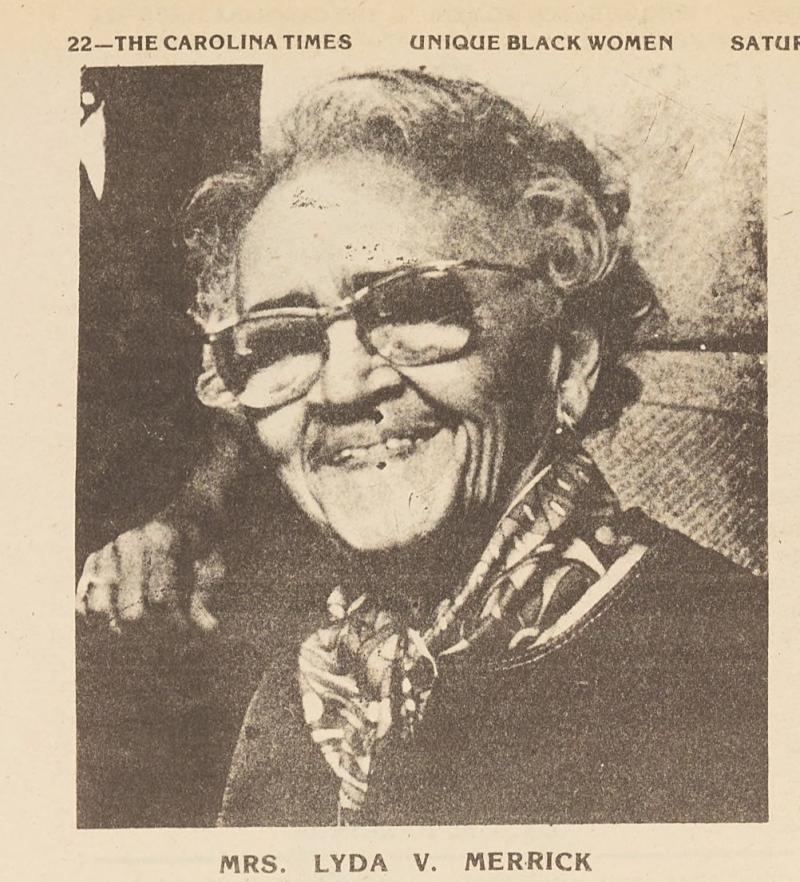
Lyda Vivian Moore Merrick was the daughter of Dr. Aaron McDuffie Moore and Sarah McCotta Dancy Moore. Lyda went to Whitted School in Durham for her primary education. She then went to Scotia Seminary School (now Barber-Scotia) and Fisk University. She was an artist and musician, teaching music in Durham up until she married Edward. She is believed to have led one of the earliest music classes in Durham, and was upset at the prospect of giving up her classes when her husband wanted to be the sole provider for the family. Lyda continued to play music throughout her lifetime, though, at both White Rock Baptist and St. Joseph’s A.M.E. Churches. She was also a skilled painter, painting using oils and watercolors. Her paintings ranged from portraits to landscapes. A painting she did of her father can still be seen today at the Stanford L. Warren Library.
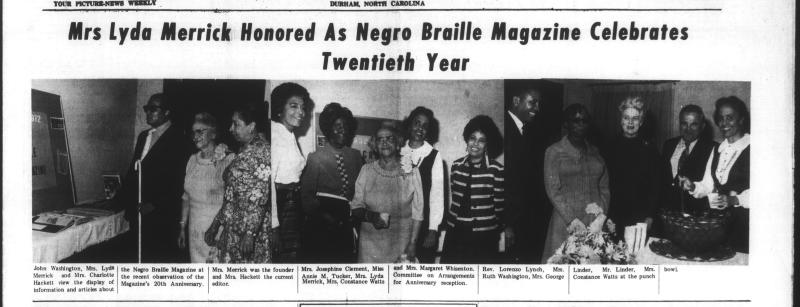
Another of Lyda’s biggest contributions was her founding of the Negro Braille Magazine, later renamed the Merrick/Washington Magazine for the Blind. John Washington, a blind friend of Lyda, was the inspiration behind the magazine. He emphasized the need for a braille magazine for blind people all over the world. Lyda delivered, starting the magazine in 1952, and going on to ship free copies to people throughout the United States and internationally. She did extensive research and outreach to ensure this project would be successful, taking it upon herself to learn more about journalism and braille types, all on a volunteer basis. The magazine was also originally largely self-funded by the Merrick family, with Edward contributing significantly to printing costs. The magazine was in production until 2019, since when production has been paused.
Lyda was engaged in community affairs through participation in numerous clubs and organizations. She was a member of the Daughters of Dorcas and led the organization as president for seventeen years. She was an honorary member of the Delta Sigma Theta Sorority, and the organization even named an award in her and two other notable Durham women’s honor, the Merrick-Fisher-Spaulding award. She was also a member of the Volkamenia Club, the North Carolina Mutual Retirement Club, and an honor board member for the North Carolina Federation of Colored Women’s Clubs, Inc.
Edward and Lyda were both very involved at St. Joseph’s A.M.E. Church, a community pillar in the Hayti community. In 1959, both were recognized for 25 years of attendance at the church. Edward was a trustee of the church and a nearly lifelong member. Lyda was also a longtime congregant. Beyond her many years of service to the church, she and her daughter, Lyda Constance Watts, were also instrumental in the preservation of St. Joseph’s A.M.E. church after it was nearly demolished due to the urban renewal project in the 1950s that built NC-147. Today, the church remains, although now as the Hayti Heritage Center, a culture and arts center. In recognition of Lyda’s dedication to the church, the Hayti Heritage Center galleries were named “The Lyda Moore Merrick Gallery.”
The Merricks were not the first occupants of 2008 Fayetteville, though; rather, their daughter, Vivian Merrick Sansom, and her husband, James J. Sansom Jr. Vivian was born at Lincoln Hospital, the hospital her maternal grandfather founded. As the granddaughter of two of Durham’s most prominent families, Vivian’s childhood was rooted in the Durham community. She attended Durham public schools until ninth grade before attending the Palmer Institute, a notable African-American high school, known for its high success rates for students going on to attend college and postgraduate education. Vivian added to that success rate, as she went on to receive her bachelor's degree from Talladega College and her master's degree in Health and Physical Science from Boston University.
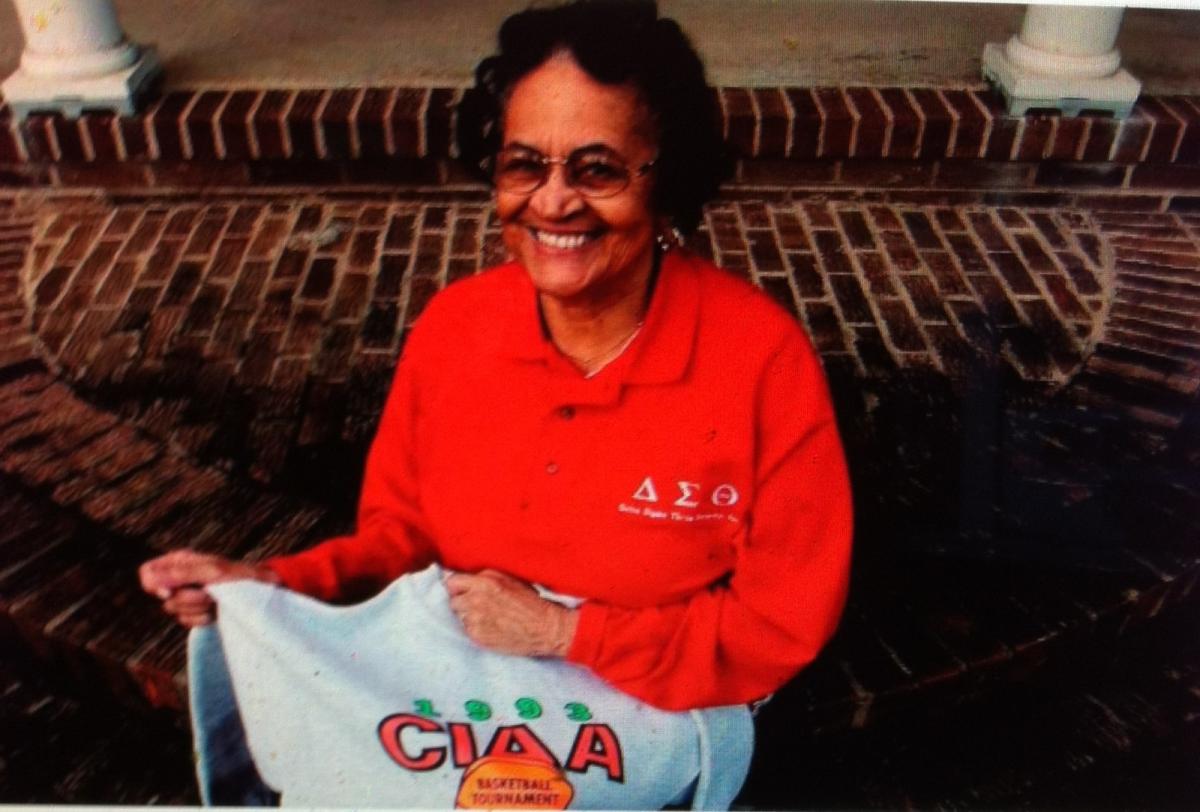
Vivian had a career in health and physical sciences, starting as the first female physical education instructor at North Carolina College (now North Carolina Central University). She eventually moved to Winston-Salem with her husband, James J. Sansom. In Winston-Salem, she worked as the Assistant Director of the YWCA. Her family then moved a final time, to Raleigh in 1959, where she worked at Shaw University, first as a professor of Health and Physical Education, and then as the Physical Education department chair. Vivian was a staunch advocate for women’s sports, building the women’s athletic program at Shaw University. For her dedication to women’s sports, Shaw created an annual basketball classic in her honor, entitled the Vivian Sansom Memorial Basketball Classic. Shaw also recognized Vivian in 2008 with an honorary doctorate for her contributions to the school’s athletic program.
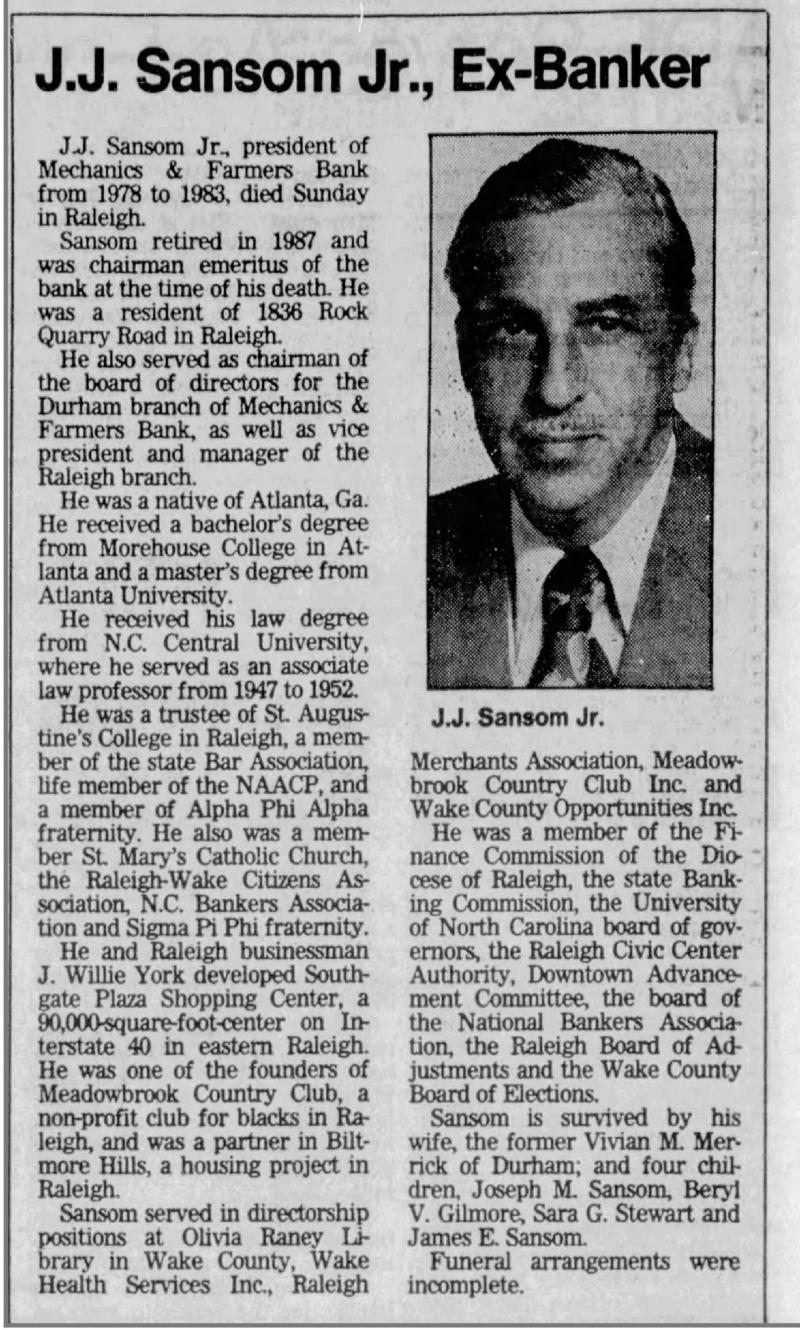
Vivian married James J. Sansom in 1942. James was originally from Atlanta, Georgia, but moved to Durham after taking a job with the Mechanics and Farmers Bank. Throughout the 1940s, he worked at the bank while also taking night classes to earn his law degree. After completing his education, James taught law as an associate professor for four years at North Carolina College. John Wheeler, then president of the Mechanics and Farmers Bank, who had secured James’ job with the bank, recommended James for the managerial position at a new Wachovia branch opened in Winston-Salem. James worked at Wachovia for six years until John Wheeler once again called upon him, this time to lead the Raleigh Mechanics and Farmers Bank as vice president and manager. He would go on to become president after John Wheeler died in 1978.
James owned and operated many other organizations and businesses. One of his biggest success stories was the Southgate Plaza shopping center, which was “...the first minority owned shopping center between Washington D.C., and New Orleans, La. to be built without government expenditure.” Vivian and her family continued to operate the shopping center after James’ death. James also co-founded Meadowbrook Country Club, an African-American non-profit country club. Another one of his projects was Biltmore Hills, a low-income housing development in Raleigh.
The home was then rented out to multiple tenants. Today, the NCCU Foundation owns the property and operates offices out of the building.
Sources:
Carolina Times
Charles W. Wadelington, “Palmer Memorial Institute,”NCpedia, last updated May 2023, https://www.ncpedia.org/palmer-memorial-institute.
Herald-Sun
John Gartrell, “Lyda Moore Merrick: A Life in Care, Art, and Community,” The Devil’s Tale: Dispatches from the David M. Rubenstein Rare Book & Manuscript Library (blog), November 18, 2025, https://blogs.library.duke.edu/rubenstein/2025/11/18/lyda-moore-merrick-a-life-in-care-art-and-community/.
Kyesha Jennings, “Hayti Heritage Center, Then and Now,” Bull Voyage (blog), October 5, 2025, https://www.discoverdurham.com/blog/hayti-heritage-center-then-and-now/.
News & Observer
Previous Entries
Typical of post-World War II housing, this one-story, side-gabled, Minimal Traditional-style house is two bays wide and double-pile with a projecting two-bay-wide, side-gabled wing on the right (north) elevation that is flush with the façade. The house has vinyl siding and windows, an interior brick chimney, and a replacement door on the left (south) end of the façade that has a classical surround and is flanked by fixed shutters. The entrance is sheltered by a front-gabled porch on square posts. There is a picture window to the right of the entrance and windows at two levels on the left elevation indicate that the house may have a split-level plan on the interior. County tax records date the house to 1950 and the earliest known occupants are Jason J. Sansom Jr., a treasurer at Union Insurance & Realty and a professor at North Carolina College (later North Carolina Central University), and his wife, Vivian Sansom, in 1950. (College Heights National Register Nomination)
The Sansoms were the parents to four children.
According to county deed records, Lyda V. Merrick and her husband, E.R. Merrick sold the lot to J.J. Sansom, Jr. and his wife, Vivian Sansom, on August 19,1953. The Merricks were the parents of Vivian Sansom.
The Merricks were a prominent black family in Durham. Vivian Sansom was the granddaughter of Dr. Aaron Moore and John Merrick, founders of North Carolina Mutual Life Insurance Company and among the founders of Mechanics and Farmers Bank. Dr. Moore was the first black physician in Durham and founded Lincoln Hospital. Lyda Merrick, her mother, co-founded the first magazine serving blind African Americans. When Nat King Cole would visit the city, he would always come to the Merrick home to entertain on the piano in their home. Vivian had the pleasure to team up in a doubles match at the Algonquin Tennis Club with Althea Gibson, the first black player to integrate and win a Grand Slam title.
After finishing her education at Hampton Institute, Vivian Sansom spent some years raising her children but did not lose her interest in physical education. She was one of the first female faculty members at North Carolina Central University (then called North Carolina College for Negroes) where she taught physicial education for six years, then teaching at Shaw University for over 30 years.
J.J. Sansom, Jr. died in 1989 and on Juy 26, 2011, Vivian sold the home to Joseph M. Hester, Jr. and Betsy A. Hester, after she had moved to Raleigh. The Hesters owned the house until March 29, 2018 when they sold the property to the NCCU Foundation, Inc. The property is still owned by the Foundation and is used as office space.
Vivian Sansom died on September 11, 2017, at the age of 97.
Vivian Sansom, News and Observer, file photo by John L. White, 2003

Add new comment
Log in or register to post comments.