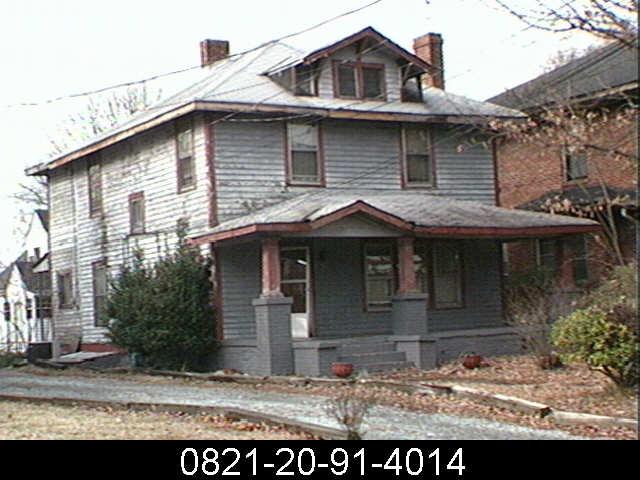
Durham County Tax Administration photograph, c. early 2000s
From Preservation Durham Historic Plaque Application:
Felicia D. Miller and her family were the original and long-term occupants of 1610 Fayetteville Street. Felicia was the original owner and occupant. Numerous family members lived with her, including her mother, Catherine J. Miller, her sister, Catherine A. Miller, her brother, Felix H. Miller, her then-sister-in-law, Annie Miller, and her niece, Yvonne Miller.
Felicia and her siblings were born in Goldsboro, North Carolina. Felicia went on to attend Barber Scotia College in Concord, and subsequently moved to Durham in 1920, when she started working at the Banker’s Fire Insurance Company. She continued to work at the company right up until her death, moving up to assistant secretary in 1943. She would join the board of directors of the company in 1945. She was also a notable member of the Rho chapter of the Iota Phi Lambda Sorority, cited as a pioneer of the organization.
Felicia’s sister, Catherine “Cat” J. Miller, had a similar career trajectory as Felicia. After attending North Carolina Central University, Cat worked as an assistant secretary of Bankers’ Fire and Casualty Insurance Company and as treasurer and administrative assistant at North Carolina Mutual Life Insurance Company.
Their brother, Felix Miller, also attended North Carolina Central University and worked for North Carolina Mutual Life Insurance Company, retiring in 1979 as an auditor. Felix’s ex-wife, Annie Miller, lived with the family before their separation and eventual divorce. Together, they had two children, Yvonne and Alexine Miller, who also lived at 1610 Fayetteville for a time. Felix remarried in 1927 to Leila Barnes Thompson.
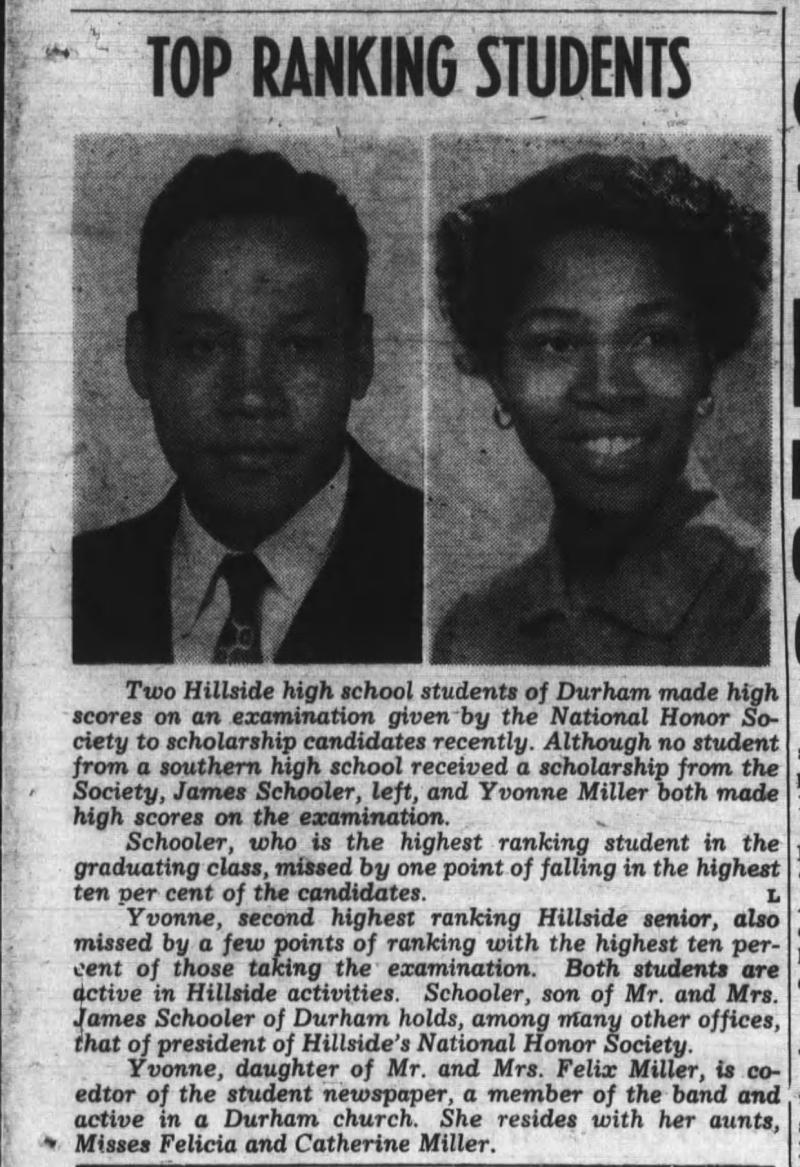
Yvonne was in school at Hillside High School, while living at 1610 Fayetteville. She was the salutatorian of her class and was highly lauded for her grades and high test scores. Her academic rigor secured her a spot in the Hillside High School National Honor Society. Yvonne was also a news editor for Hillside’s newspaper. Yvonne would go on to attend Spelman College, where she received a Bachelor of Science in biology. She would take the U.S. Public Health Service Hospital’s medical laboratory technologist program. She worked at numerous hospitals, including the New York Fertility Institute, Montefiore Hospital, and Durham Regional Hospital, from which she retired.
In 1949, Yvonne, with Felix as her adult representative, was one of 60 student plaintiffs in Blue et al v. Durham Public Schools. This was a school equalization case, arguing according to the ruling set by Plessy v. Ferguson, that segregation was legal in the case of separate but equal facilities. In 1951, the court found the Durham Public Schools to be guilty of discriminatory treatment in the unequal distribution of resources in Black versus white schools. This success was, “...the first school discrimination victory for black North Carolinians…” The NAACP would soon pivot to desegregation to challenge unequal treatment rather than school equalization, making this, “...the nation’s last successful school equalization lawsuit…” This was a major step in ensuring equal resources for Black students, albiet under the legal structure of racial segregation.
The Millers attended St. Titus Episcopal Church during their time in 1610 Fayetteville. The family was also involved with the church beyond attending as congregants. Catherine A. Miller was a co-chairman of the Episcopal Churchwomen’s membership committee, and Felix was a member of the Laymen’s League. Yvonne would eventually become the church’s organist.
Unfortunately, the home was demolished sometime after 2022. The home was proposed for demolition at the August 2022 Durham Historic Preservation Commission meeting. The Durham HPC voted to delay the demolition by 365 days to give the developer enough time to find another possible solution to the demolition. Unfortunately, the house was demolished after the 365-day delay.
Sources:
Carolina Times
Donovan J. Stone, “Blue v. Durham Public School District and the Campaign for School Equalization in North Carolina,” North Carolina Civil Rights Law Review 1, no. 1 (2022): 1, accessed February 24, 2026, https://scholarship.law.unc.edu/cgi/viewcontent.cgi?article=1001&context=nccvlrts.
Durham Sun
Herald-Sun
Previous Entries
Below in italics from the National Register nomination for the Stokesdale district:
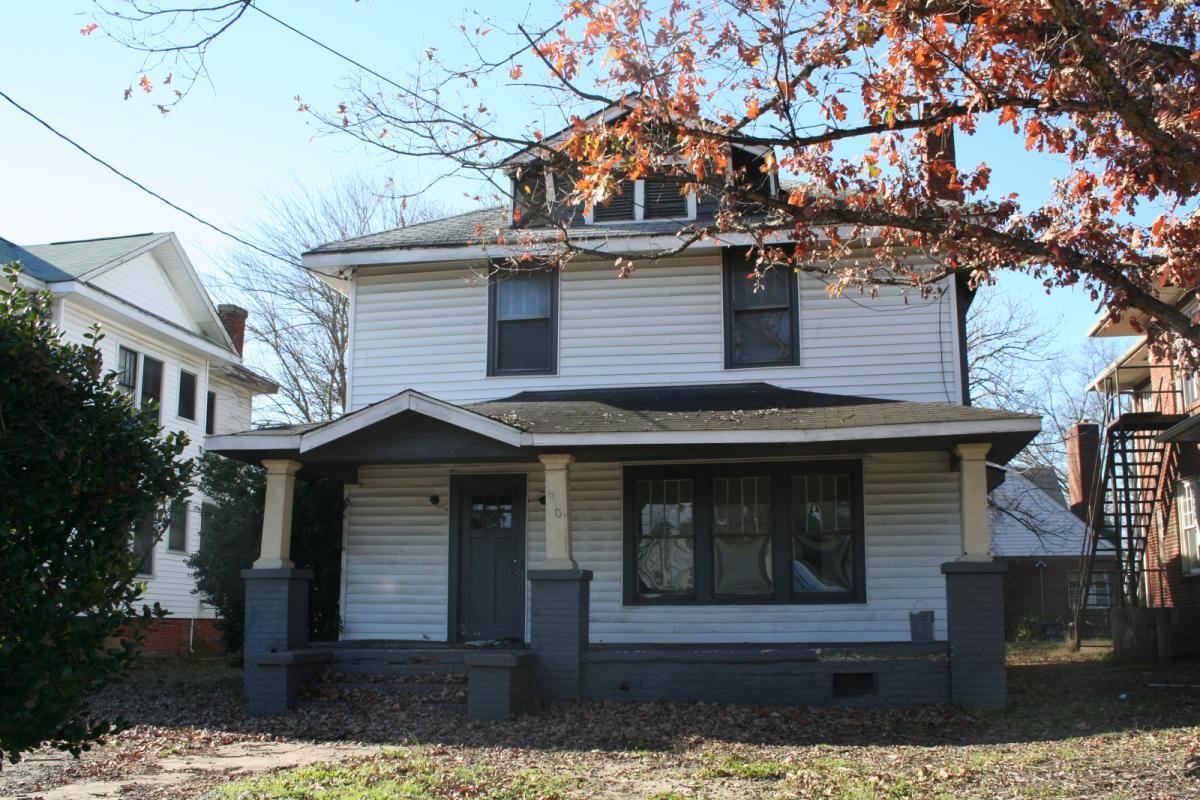
This two-story, hip-roofed Foursquare house is two bays wide and double-pile with a one-story, gabled rear ell on the northwest corner. The house has a brick foundation, vinyl siding, and two brick chimneys: an interior chimney just south of the ridgeline and an exterior chimney on the north elevation. A one-story, shed-roofed bay on the north elevation does not retain any windows. The rest of the house retains four-over-one, Craftsman-style windows. The gabled front dormer has two louvered vents, exposed rafter tails, knee braces, and wood weatherboards. The hip-roofed front porch is supported by tapered wood posts on concrete-capped painted brick piers; it is accessed by a painted brick stair with brick knee walls. County tax records date the building to 1926; the earliest known occupant is Felicia D. Miller (clerk, Bankers Fire Insurance Company) in 1930.
In fact, this was the home of both Felicia Miller and her younger sister Catherine for more than a half-century. Born and raised in Goldsboro, North Carolina, Felicia Miller studied at Barber-Scotia College in Concord before coming to Durham. She was hired as a clerk at Bankers Fire Insurance Company in 1920, the year it was founded by W. G. Pearson. Catherine Miller may have followed her sister shortly thereafter; by the mid-1920s she too appears in city directories working for Bankers, perhaps starting while a student at North Carolina College. After first residing a few blocks north on Umstead Street, Felicia Miller purchased this land from the Vickers family in 1925 and likely had this home constructed shortly thereafter.
Both women would eventually rise to assistant secretary of Bankers, working a combined 82 years for the company. They were longtime members of St. Titus Episcopal Church. Opening up their sizable home, the Miller sisters also hosted a niece, Yvonne Miller, who lived at 1610 Fayetteville while attending nearby Hillside High School in the early 1950s. After gaining salutatorian honors in 1953, she went on to study at Spelman. Around that time, the Millers built a garage on the property and added an additional room to the house - possibly to accomodate family members or other residents.
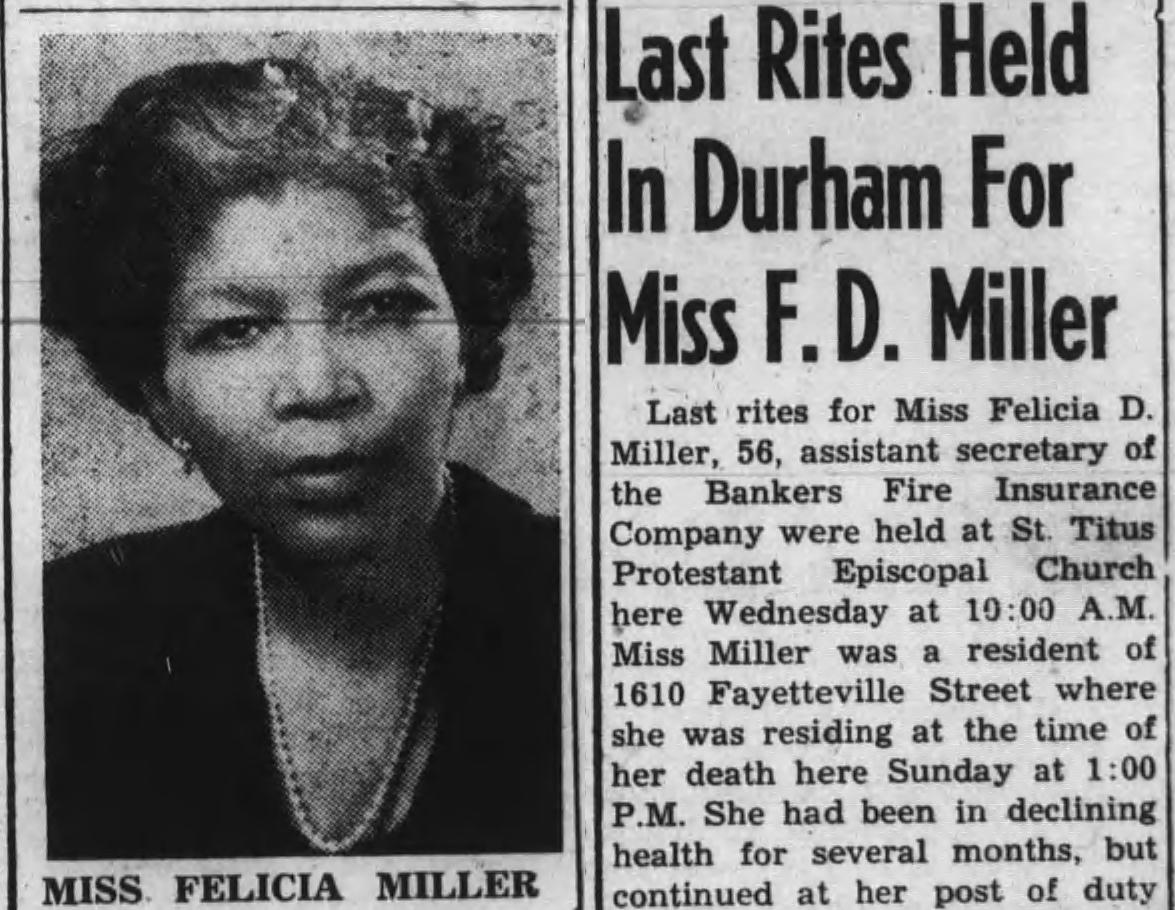
Only in her mid-fifties, Felicia Miller sadly passed away that same decade.
Clippings from the Carolina Times obituary for Felicia Miller, July 21, 1956 (online via DigitalNC).
Staying on at the house and the same company after her sister's death, Catherine Miller continued working for NC Mutual after it acquired Bankers in the early 1960s. At least two other siblings, Rebecca Miller and Essie Miller Hall, joined her to live at 1610 Fayetteville for periods. Catherine Miller remained here until her own passing in 1984.
Unfortunately, this historic structure has suffered fire damage at least twice in the years since it was sold by heirs of its original owners, with a largely exterior flare-up in June 2000 followed by a more extensive second floor blaze that displaced residents in fall 2010.
Photograph by Heather Slane (hmwPreservation) for Stokesdale National Register application, December 2009.
As of 2013, this house is threatened with demoltion by the city. Unfortunately, the mayor and council's antagonism towards the Historic Preservation Commission likely means that NIS will take a more aggresssive stance towards demolition of structures in local districts. I fear that the intended chilling effect on the commission's purview may limit their willingness to fight the 'small' things.
Update, March 2022: though apparently not in use and the site of stalled construction work, the frame of the Miller House still stands.

Add new comment
Log in or register to post comments.