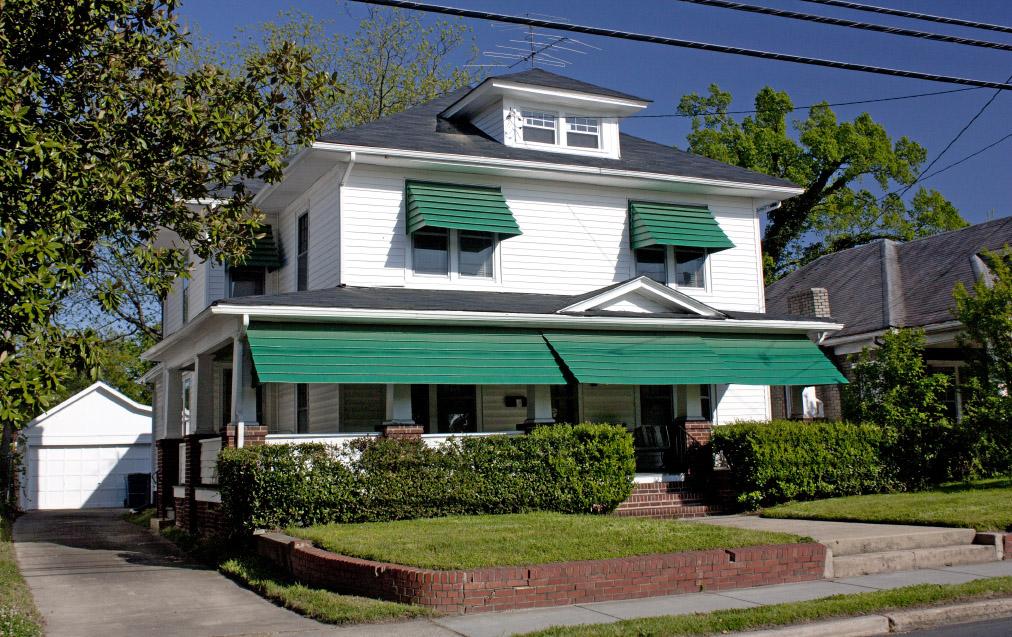
This two-story, hip-roofed house is three bays wide and double-pile with a projecting two-story hip-roofed bay on the north elevation and a two-story, gabled rear ell on the southeast corner. The house has a painted brick foundation, vinyl siding, and nine-over-one, double-hung wood sash windows. The hip-roofed front porch is supported by tapered wood posts on brick piers and has a low gable over the entrance, which is accessed by a brick stair with brick knee walls. The porch extends across the façade and wraps around the north side of the house, abutting the projecting bay. Original wood weatherboards remain in the porch gable and wood soffits and trim remain around the hip-roofed front dormer, which has a pair of six-light casement windows. The front door is a fifteen-light French door.
Ira D. and Sarah Evans were the original owners of 1503 Fayetteville, living in the home from 1924 to 1925. Ira was from Granville, North Carolina, and worked as an embalmer and taxi driver in Durham. Sarah worked as a laundress and housemaid. Sarah passed away in 1958 at the age of 62, and Ira passed away in 1968 at the age of 89.
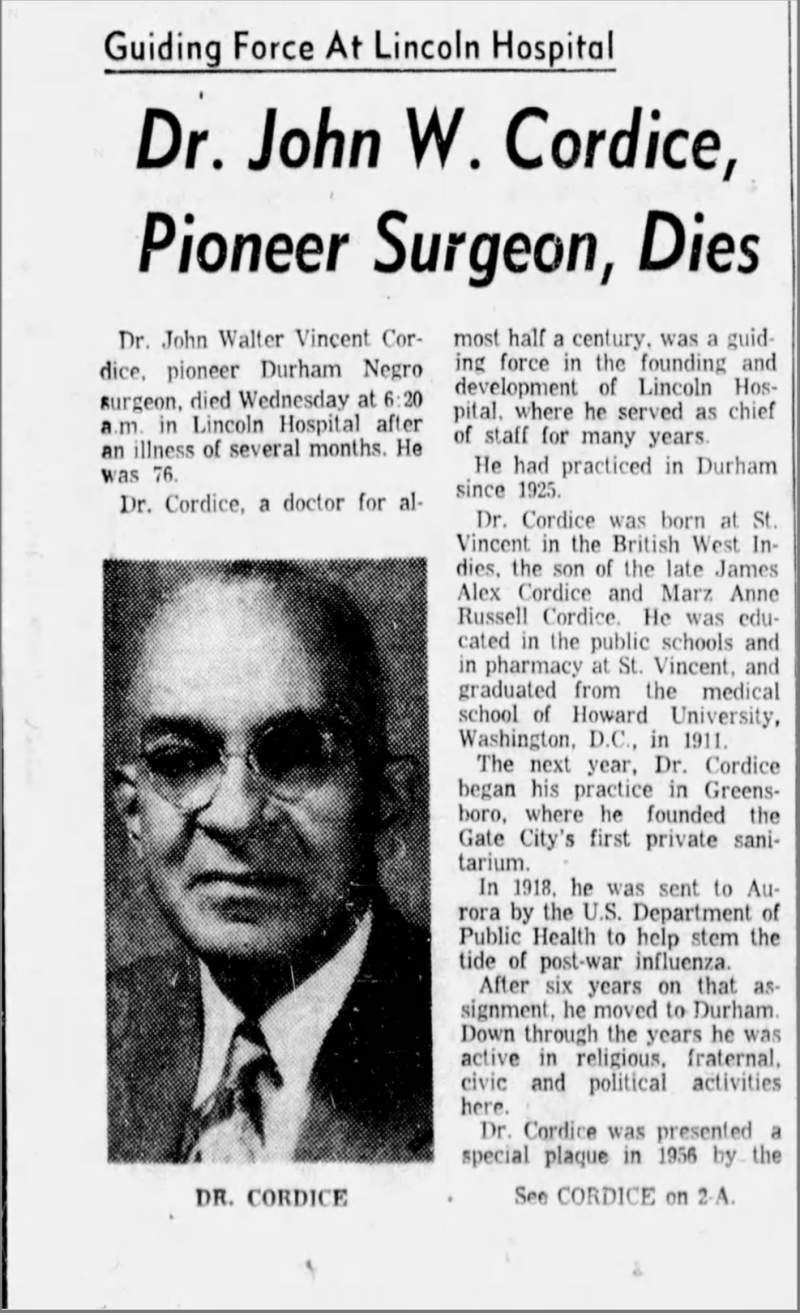
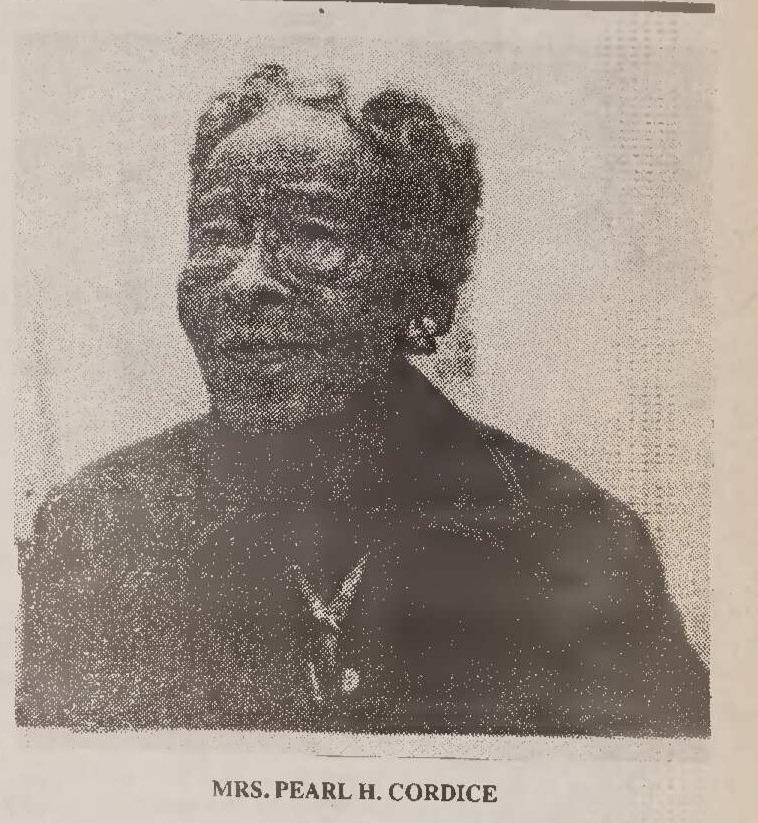
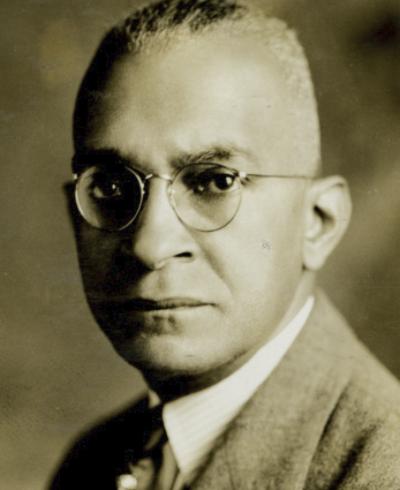
Dr. John Walter Vincent Cordice and Pearl Cordice were the longest owners of 1503 Fayetteville. They bought the house when they first moved to Durham in 1925. Dr. Cordice was born in St. Vincent, West Indies, where he received his primary education and studied pharmacy. He came to the United States and attended Howard University’s medical school, graduating as the honor graduate in 1911. He interned at Freedmen’s Hospital.
Dr. Cordice eventually started practicing medicine in Greensboro, North Carolina, where he opened the first private sanitarium in the city. While in Greensboro, he met Pearl Hollingsworth. Pearl was from Shreveport, Louisiana, and eventually moved to Guthrie, Oklahoma, where her father opened a store and ran a farm. When her mother died in 1904, she moved in with her oldest sister, Florence Hollingsworth Neal, and her family in Waco, Texas. During her schooling in Waco, Pearl was hailed for her singing capabilities. She earned a degree from Sam Houston High School and Normal College on a music scholarship in 1917. Pearl went on to work as the president’s secretary at Bennett College, which brought her to Greensboro.
Soon after Dr. Cordice and Pearl married, Dr. Cordice was stationed in Aurora, North Carolina, during World War I as a member of the United States Public Health Service. Aurora, North Carolina, had faced an outbreak of influenza, and Dr. Cordice had been “...the only doctor in a 200-mile radius of dying people.” During this time, Dr. Cordice also trained Pearl as a nurse and anesthetist. In Aurora, the Cordices worked together to help the community, delivering babies, performing surgeries, and providing general medical help. In an article dedicated to Pearl’s contributions, written by two of Cordice’s daughters, they emphasize that their parents helped all in the community, regardless of race or class, and often with little medical equipment and resources.
After finishing their time in Aurora, North Carolina, the Cordices came to Durham, North Carolina, so that Dr. Cordice could work at Lincoln Hospital. Lincoln Hospital was a non-profit hospital that served Black community members and was run by Black doctors and nurses. It was created after John Merrick and Dr. Aaron McDuffie Moore convinced Washington Duke to redirect funds that were going to go to building a monument dedicated to enslaved persons for “...their loyalty during the Civil War.” Merrick and Dr. Moore persuaded Duke to instead dedicate the funds to building a hospital because “...a hospital for the care of the descendants of the slaves would be more servicable.” While at Lincoln Hospital, Dr. Cordice served as the chief of surgical staff. Dr. Cordice also ran his own private practice at 711 Fayetteville.
Pearl attended North Carolina College, where she received her Bachelor of Arts in 1932. Pearl became a substitute teacher and continued her secondary education at Hampton Institute, where she studied elementary education. She earned her master’s degree in education from North Carolina College in 1944 and went on to teach at W.G. Pearson Elementary School. After initially retiring from teaching, Pearl returned to education, where she taught and eventually directed Mount Vernon Baptist Day Care Center.
Dr. Cordice was highly regarded for his work as a physician and surgeon. He was featured in “Who’s Who in Colored America,” a book listing over 3,000 notable African Americans and their accomplishments. The Old North State Medical Society also recognized Dr. Cordice as “Doctor of the Year” in 1955 and recognized Pearl for her service as president of the women’s auxiliary during their 25th anniversary in 1964. Dr. Cordice has also been recognized for his work at Lincoln Hospital, with memorial awards named in his honor, and an emphasis on his importance to the hospital in local histories.
Pearl was also recognized for her dedication to the Durham community. St. Titus Episcopal Church honored her on her 100th birthday for 50 years of service in the congregation. The Durham Section of the National Council of Negro Women also honored her for her community work.
The Cordices were very active in their community, as members of numerous clubs. Dr. Cordice was a founding member and chairman of the Wilkie-McNary-McNeil Republican Club in Durham. He was very involved with the Republican Party writ large, notably as the finance director for the North Carolina Negro division. Pearl was very involved with the local Garden Club, leading it as president from 1938 to 1963. Both Pearl and Dr. Cordice were presidents within the Old North State Medical Society, Dr. Cordice of the society and Pearl of the women’s auxiliary. They were also dedicated congregants of St. Titus Episcopal Church, deciding to attend Episcopal churches while in Greensboro as a compromise of their Roman Catholic and Methodist Episcopal backgrounds.
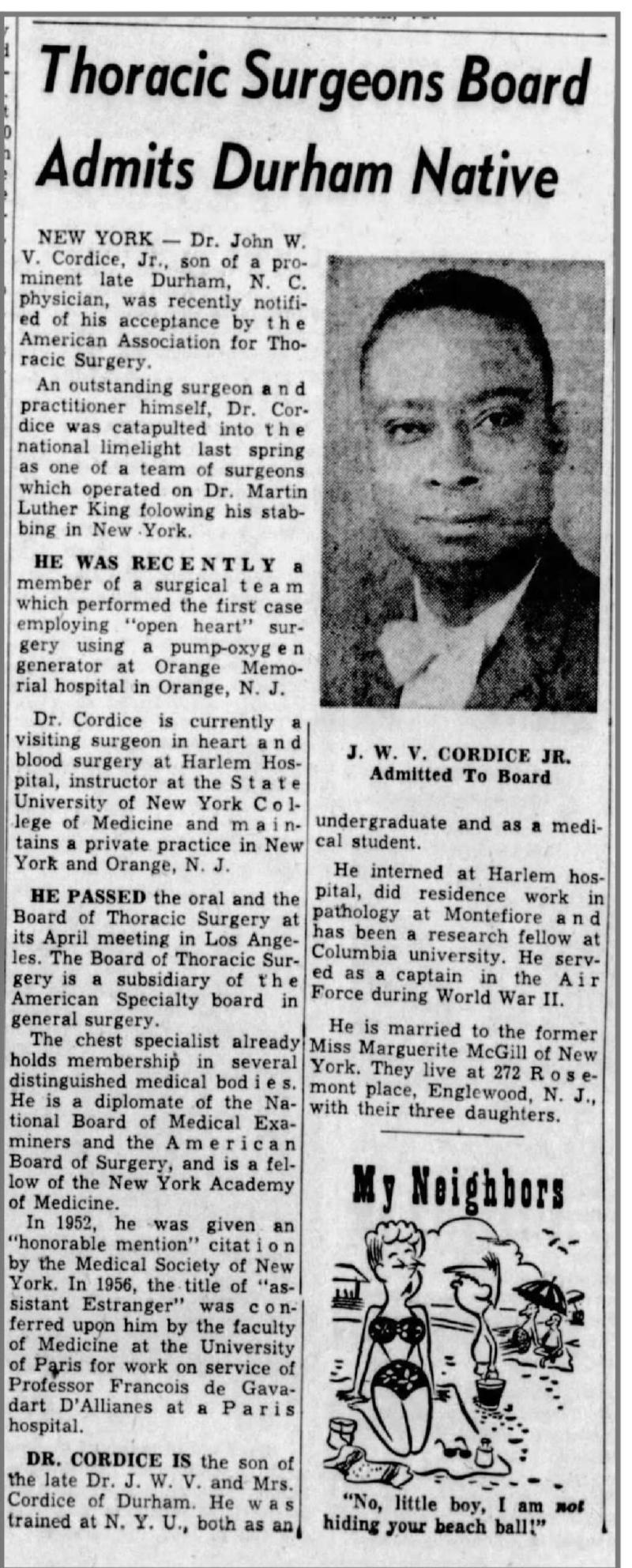
The Cordices had four children: Dr. J.V.W. Cordice Jr., Eulalee Marion Cordice Parham, Sarah Evangeline Cordice, and Victoria Cordice McCants. Dr. Cordice Jr. studied at New York University and was lauded as, “...one of the most brilliant students of (sic) ever matriculate at NYU.” Dr. Cordice interned at Harlem Hospital for a period before serving as the doctor for the Tuskegee Airmen, the first all-Black aviation battalion, during World War II. He then returned to his internship and moved his way up, eventually becoming chief of thoracic and vascular surgery. Dr. Cordice Jr. also studied thoracic surgery in France. In 1968, he was unexpectedly demoted from his position as chief of thoracic and vascular surgery, leading him to leave Harlem Hospital. He then worked for over twenty years at Long Island Jewish Medical Center. He would end his career as chief of thoracic and vascular surgery at Queens Hospital Center, while in his 80s.
Dr. Cordice Jr. had an incredible career as a thoracic and vascular surgeon, with numerous notable surgeries. While in France, he was a part of the team that completed the first open-heart surgery in the country. Dr. Cordice Jr. was part of the three-person team that performed surgery on Martin Luther King Jr. after an assassination attempt at a book signing. One of Dr. King’s most memorable quotes from his last speech before his assassination is,
“If I had sneezed, I wouldn’t have been around in 1960, when students all over the South started sitting in at lunch counters,” he said. “If I had sneezed, I wouldn’t have been around here in 1961, when we decided to take a ride for freedom and ended segregation in interstate travel. If I had sneezed, I wouldn’t have been here in 1963, when the Black people of Birmingham, Ala., aroused the conscience of this nation, and brought into being the Civil Rights Bill. If I had sneezed, I wouldn’t have had a chance later that year, in August, to try to tell America about a dream I had.”
This quote is in reference to the stabbing at the book signing, where the letter opener that was plunged in his chest was so dangerously positioned that, “Had Dr. King sneezed or coughed the weapon would have penetrated the aorta…. He was just a sneeze away from death.”
While Dr. Cordice, Jr. had been identified as one of the surgeons, it wasn’t until 1999 that Dr. Cordice, Jr. clarified that it was he and Dr. Emil Naclerio who completed the thoracotomy on Dr. King Jr. Previously, the credit had been given to Dr. Aubre de L. Maynard, who hired Dr. Cordice, Jr., but who had arrived after the surgery had begun. Dr. Maynard did have a role in the surgery, removing the blade from Dr. King Jr., but he had not conducted the entire surgery.
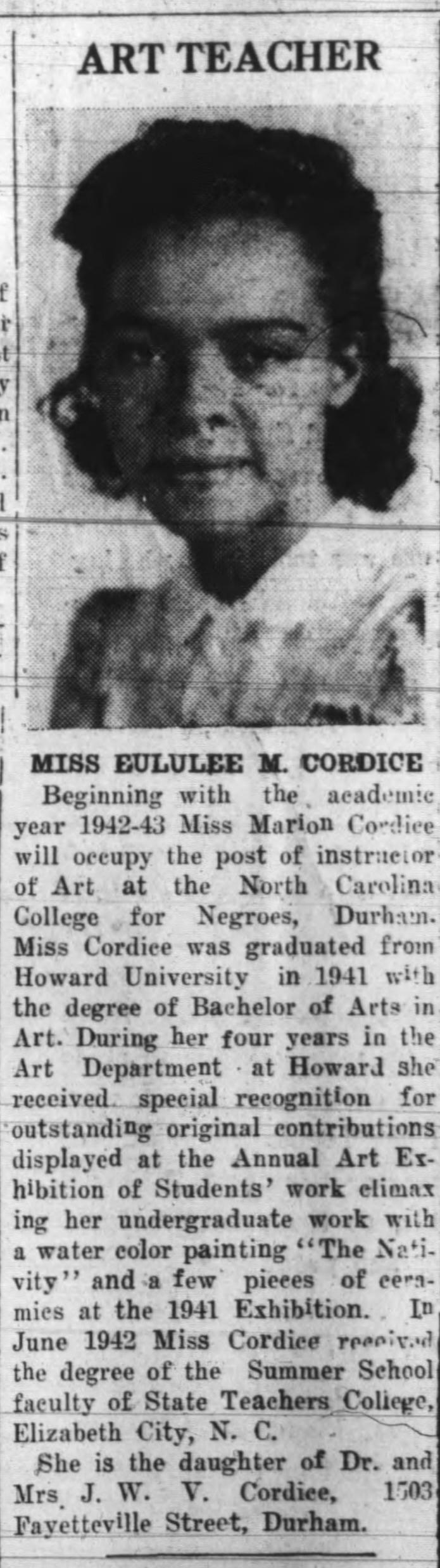
Eulalaee Marion Cordice Parham was an art educator for most of her life. Her talents were clear starting in primary school, where she won multiple school competitions for her artwork. In high school, she attended one year at the Palmer Memorial Institute, a private school for African Americans, which was nationally recognized for students’ success post-graduation. In the one year Marion attended Palmer Memorial, she received the highest honors for first-year students.
After high school, Marion attended Howard University, where she graduated with a Bachelor of Arts in Art in 1941. In the fall of 1942, she began working at North Carolina College as an instructor of art. She took a sabbatical to complete her Master’s degree at Columbia University, returning after having previously completed a year of her degree. When she returned to Durham, she married Thomas David Parham Jr., a chaplain for the U.S. Navy, who would go on to become the first Black Navy Captain. Marion frequently traveled with her husband, and she was remembered as a “surrogate mother for young naval officers.” She finished out her time at North Carolina College as chairman of the art department before leaving in 1955 to be with her husband. After leaving NCC, Marion taught at multiple public schools in Virginia, retiring as the art supervisor for Norfolk Public Schools.
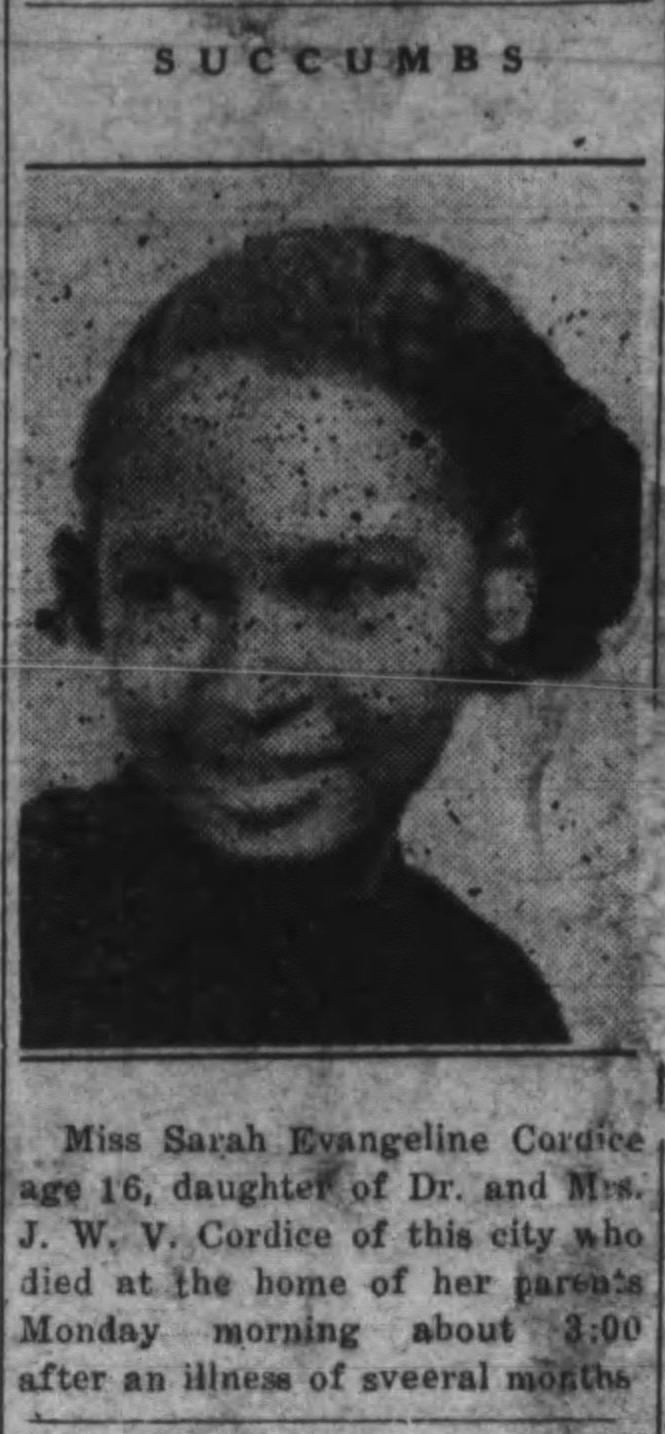
Sarah Evangeline Cordice was the Cordices’ third child. She died at the age of 16 years old from an extended illness. Similar to her mother, Evageline had a knack for music, studying it at Howard University. She had absolute pitch, meaning she could sing any type of note after only hearing it once. She discovered this talent while studying at the Chamberlain Music Studio in Durham, started by Margaret Spaudling Shearin. Evageline had completed her first year at Howard University, from which she received a music scholarship to attend. Evangeline and Marion were very close, and while in school together, were referred to as “Big Cordice” and “Little Cordice.” In dedication to her sister, Marion and Thomas named one of their children Edith Evangeline.
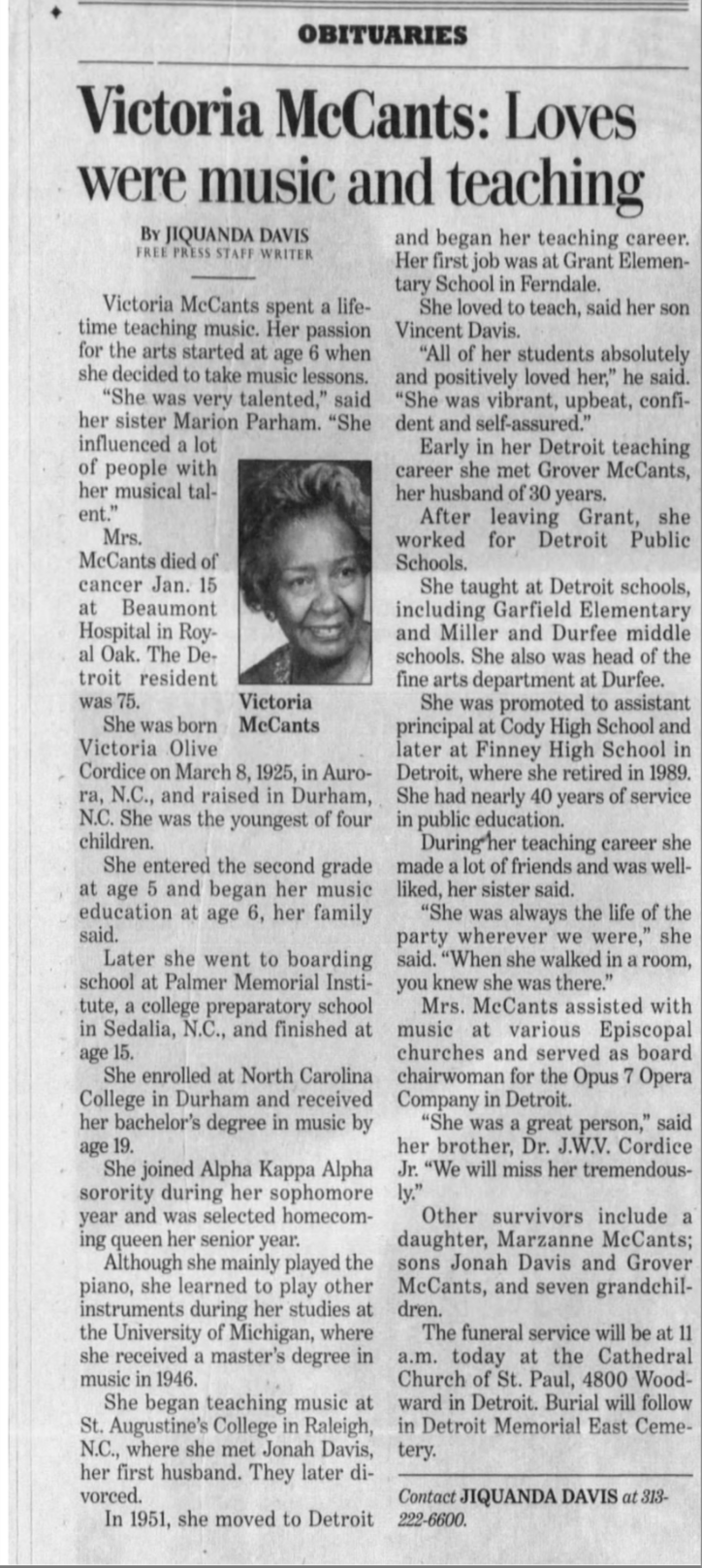
The Cordices' youngest child was Victoria Cordice McCants. Like her mother and sisters, Victoria took a career in teaching and was proficient in the music field. She started in music education at age 6, eventually learning how to play the piano. Just like her sisters, she attended the Palmer Memorial Institute, where she graduated at 15 years old. She then attended North Carolina College, where she studied music and graduated at 19. While at North Carolina College, she performed numerous piano recitals and was the organist for the school choir. She also acted, starring as the lead in “Lady Windermere’s Fan” for the North Carolina College Drama Club. She was crowned North Carolina College’s homecoming queen in 1944, demonstrating her activeness on campus.
Victoria then went on to get her Master’s Degree from Michigan University, further honing her music abilities as she learned how to play more instruments. She taught at St. Augustine’s College before moving to Detroit, where she started teaching at public schools. She taught at numerous schools, including Durfee Middle School, where she was also the supervisor of the fine arts department. She would go on to become assistant principal at Cody and Finney High Schools, retiring in 1989 after 40 years of teaching.
Preservation Durham protects the Dr. J.W.V. and Pearl Cordice House with an easement. As of 2026, the home is in good, stable condition.
Sources:
Carolina Times
Charles D. Watts and Frank W. Scott, “Lincoln Hospital of Durham, North Carolina,” Journal of the National Medical Association, no. 2 (1965): 177-183.
Charles W. Wadelington, “Palmer Memorial Institute,” NCpedia, 2006, https://www.ncpedia.org/palmer-memorial-institute.
Dave Forester, “Navy’s first black captain remembered as ‘spiritual giant’,” last modified August 7, 2019, https://www.pilotonline.com/2007/04/22/navys-first-black-captain-remembered-as-a-spiritual-giant/.
Detroit Free Press
“Eulalee Parham,” Washington Post (Washington, District of Columbia), August 24, 1917, https://www.legacy.com/us/obituaries/washingtonpost/name/eulalee-parham-obituary?id=6088310.
Herald-Sun
Herb Boyd, “The marvelous Dr. John Cordice Jr.,” last modified August 25, 2022, https://amsterdamnews.com/news/2022/08/25/the-marvelous-dr-john-cordice-jr/.
Jerry Mitchell, “1958: Woman stabs MLK in New York,” Mississippi Today, last modified September 20, 2024, https://mississippitoday.org/2024/09/20/1958-mlk-stabbed/.
“John Walter Vincent Cordice, Jr, MD,” McCune Smith Cordice Medical Society, last accessed January 16, 2026, https://www.mcscmedsociety.org/overview.
New Journal and Guide
Thomas Yenser, Who’s Who In Colored America: A Biographical Dictionary of Notable Living Persons of African Descent in America (Thomas Yenser, 1944), https://www.mmpe.net/blueridge/docs/WhosWhoInColoredAmerica-1941-1944-6thEd.pdf.
“Wounded Rev. King Develops Pneumonia,” Atlanta Daily World, 23 September 1958; “King ‘Out of Danger,”’ New York Times, 27 September 1958.
Stokesdale National Register Nomination:
1503 Fayetteville– Dr. J. W. V. Cordice House– c. 1925 C–Building This two-story, hip-roofed house is three bays wide and double-pile with a projecting two-story hiproofed bay on the north elevation and a two-story, gabled rear ell on the southeast corner. The house has a painted brick foundation, vinyl siding, and nine-over-one, double-hung wood sash windows. The hip-roofed front porch is supported by tapered wood posts on brick piers and has a low gable over the entrance, which is accessed by a brick stair with brick knee walls. The porch extends across the façade and wraps around the north side of the house, abutting the projecting bay. Original wood weatherboards remain in the porch gable and wood soffits and trim remain around the hip-roofed front dormer, which has a pair of six-light casement windows. The front door is a fifteen-light French door. A low brick retaining wall extends along the driveway and across the front of the property. The earliest known occupant is Dr. John W. V. Cordice in 1925. CGarage, c. 1935– Front-gabled frame garage with plywood sheathing, asphalt-shingled roof, and large overhead wood door; a shed-roofed block on the right side has a pedestrian entrance.

Comments
Submitted by Mae Pouget (gr… (not verified) on Sat, 10/4/2014 - 6:52am
Dr. Cordice bought the house from sisters who had it built. He had the kitchen remodeled removing the pot bellied stove and adding an eat-in area and put in central air conditioning. The family lived across the street while the house was being modified.
Add new comment
Log in or register to post comments.