Preserve Durham's History with a Donation to Open Durham Today!
OpenDurham.org is dedicated to preserving and sharing the rich history of our community. Run by our parent nonprofit, Preservation Durham, the site requires routine maintenance and upgrades. We do not ask for support often (and you can check the box to "hide this message" in the future), but today, we're asking you to chip in with a donation toward annual maintenance of the site. Your support allows us to maintain this valuable resource, expand our archives, and keep the history of Durham accessible to everyone.
Every contribution, big or small, makes a difference and makes you a member of Preservation Durham. Help us keep Durham's history alive for future generations.
From the Preservation Durham 2026 Home Tour Program:
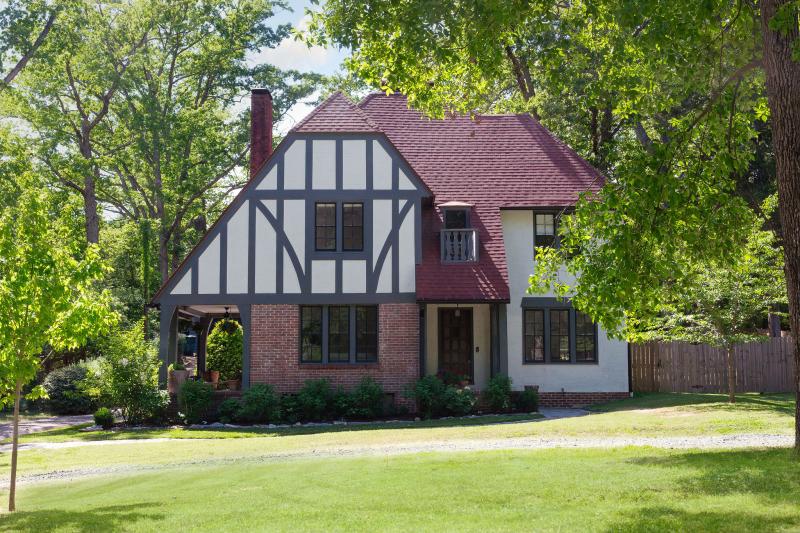
On nearly a quarter-acre lot in the Hope Valley neighborhood sits the Tudor Revival William and Katherine Brownell House, designed by George Watts Carr. The Brownell House was one of the earliest homes built in the neighborhood. The original developers of the Hope Valley neighborhood, R. Jesse Mebane and Walter E. Sharpe, built the Brownell home as one of the early speculative homes in Hope Valley.
The clipped-gable roof is one of the home's most notable features, along with the half-timbered clipped gable-wall on the front facade. The roof extends to form an engaged shed roof over the porch, which is supported by carved and pegged beams at the front entry. The clipped-gable side wing also covers a secondary entrance on the southwest corner of the home. The clipped-gable side wing comes down over the master bedroom, creating a slanted interior wall, which is lined with windows.
The home retains many of the original interior details, including the fireplace in the living room, the bathroom appliances, and the radiators. The current homeowner has been a dedicated steward of the historic home, implementing historically appropriate interior changes, such as replacing the current flooring with more period-accurate tiling in the half-bath on the second floor. Her dedication is further demonstrated by her journey to find a replica of the temperature indicator knobs for the bathtub.
William and Katherine Brownell were the first occupants of 3406 Dover Rd. William moved his family to Durham in 1930 to take a position as a professor of educational psychology in the Duke University Department of Education. Dr. Brownell’s work focused on mathematics education. He authored numerous books and articles on mathematics pedagogy. Dr. Brownell’s work was adapted by the Department of Defense during World War II in order to remediate American soldiers whose positions required a strong mathematics foundation. Most summers, Brownell also hosted the Summer Math Institute, in which students from across the country came to learn new and better ways to teach mathematics. Dr. Brownell’s career also took him and his family to Puerto Rico, where he studied the Puerto Rican educational system and gave seminars in mathematics education.
The Brownell family valued a strong, well-funded, public-school education. Katherine, much like her husband, was an advocate for public education. In 1948, Katherine wrote a letter to the editor of the Durham Morning Herald in support of the Durham school supplement levy, which would dedicate more tax money to Durham Public Schools. In the letter, Katherine argued that “a vote against the supplement was a vote for the Pied Piper of Ignorance.” While Katherine sought to fund local education, Dr. Brownell extended his expertise to better Durham Public Schools. Dr. Brownell was a frequent guest speaker at Durham Public Schools PTA meetings, speaking on topics such as the importance of extracurricular activities to education.
Mrs. Brownell’s education advocacy is further demonstrated in her work with the Durham Nursery School Committee, a committee focused on bringing nursery schools to all of Durham. Mrs. Brownell also supported the implementation of extracurricular activities in the Durham community. She, along with community members, attended a week-long training to create extracurricular activities for Durham County.
The Brownell children, Florence, Kathryn, and Carol, epitomized their parents’ belief in public-school education. Florence attended Durham Junior High School and later Hope Valley School. At Hope Valley School, Florence wrote a column for the Durham Sun, which provided updates on the various school activities. In 1944, Florence was recognized as the Best Speller in Durham County, winning the Durham County Spelling Bee. Florence went on to study at Allegany College. Kathryn and Carol also attended Hope Valley School. After they both graduated, they attended Oberlin College in Oberlin, Illinois.
Florence Brownell suddenly passed away while visiting her sister Kathryn at Oberlin College in February of 1949. Following her death, the Brownells created a memorial fund to honor Florence. A little over a year later, in May of 1950, the fund was used to upgrade lighting, add blinds, and give a fresh coat of paint to the classrooms of Hope Valley School. Even through their grief, the Brownells used their tragedy to benefit public education. A plaque was also purchased and placed at the Hope Valley School in honor of Florence.
The Brownell home served as a community gathering place for many of the clubs and organizations the family members participated in. As an avid reader, Katherine was a member of the Reviewers Club, a local literary club. During World War II, the Reviewers Club hosted a meeting at the Brownell home, which included a fundraiser for the Red Cross. Additionally, during the war, the Brownells, in conjunction with the Durham Garden Club, hosted a “how-to” session creating a home victory garden.
The work of the Brownell family in public education and their advocacy for quality, well-funded, public schools is of great importance to the Hope Valley neighborhood and Durham County as a whole.
The Brownells lived in 3406 Dover until 1950. Multiple occupants owned the home after the Brownells moved out, including the Youngs (1951-1954), the Woodys (1954-1977), and the Dixons (1977-2004). The current homeowner continues to hone the legacy of the home through her intentional historic-minded renovations
Comments
Submitted by adaawccpi (not verified) on Mon, 5/20/2013 - 7:03am

Comments
Submitted by adaawccpi (not verified) on Mon, 5/20/2013 - 7:03am
Add new comment
Log in or register to post comments.