The Mebane family was the first longtime homeowners of 1222 Fayetteville. Walker Whitted Mebane was the original owner. Walker worked as a shoe shiner and in the hotel industry. His sister, Jennie Mebane, and mother, Caroline Mebane, both lived with him for a time. Caroline passed away in 1932 at the age of 94. She had been previously enslaved and married her husband, John Mebane, while enslaved. Walker passed away in 1945, and Jennie passed away two years later in 1947. Walker and Jennie’s niece, Ruth Mebane Baskerville, and her husband, Frazier Baskerville, also lived with the Mebane family. Frazier moved into the home in 1940, and Ruth and Frazier continued to live in the house until 1954.
The next long-term owners were John W. and Bernadine S. Bailey. John was born and raised in Durham, North Carolina, and Bernadine was from Richmond, Virginia. They married in Virginia in 1936.
John graduated from North Carolina College (now North Carolina Central University) in 1937 with a Bachelor of Science in Commerce. One of his first jobs was working as the director of the Hillside Recreation Center. He was also an original founder of the John Avery Boys’ Club. The John Avery Boys’ Club was created after Mamie Dowd Walker, the first female judge in North Carolina, went to the Durham Committee on Negro Affairs to address juvenile delinquency in Durham. Thus, the John Avery Boys’ Club was created as an organization to support young boys in the Durham community.
John was very involved in the Durham education system for Black schools. He was appointed as the director of attendance for all Black primary schools in Durham in 1937, resigning from the position in 1944. He was also on the teacher committee with the city board of education, representing African American schools in Durham. He would go on to work as a clerk at the County ABC Board Store No. 2, and finally at the Mutual Life Whole Drug Company. After John’s death, North Carolina Central University gave a memorial award in his honor, joining the ranks of other notable members of the Hayti community, including Hattie Scarborough, C.C. Spaulding, W.G. Pearson, and numerous others.
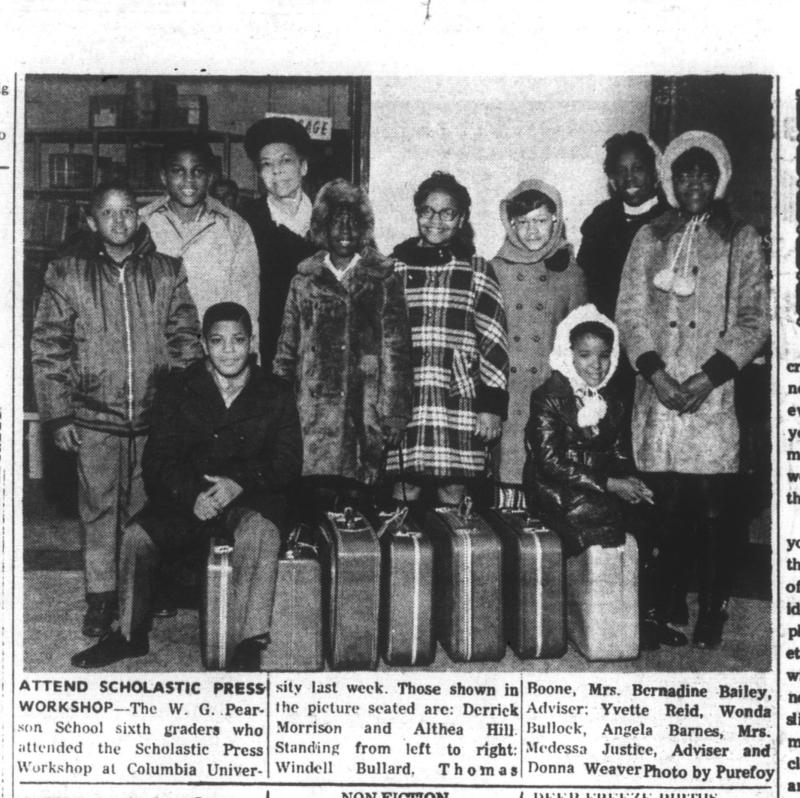
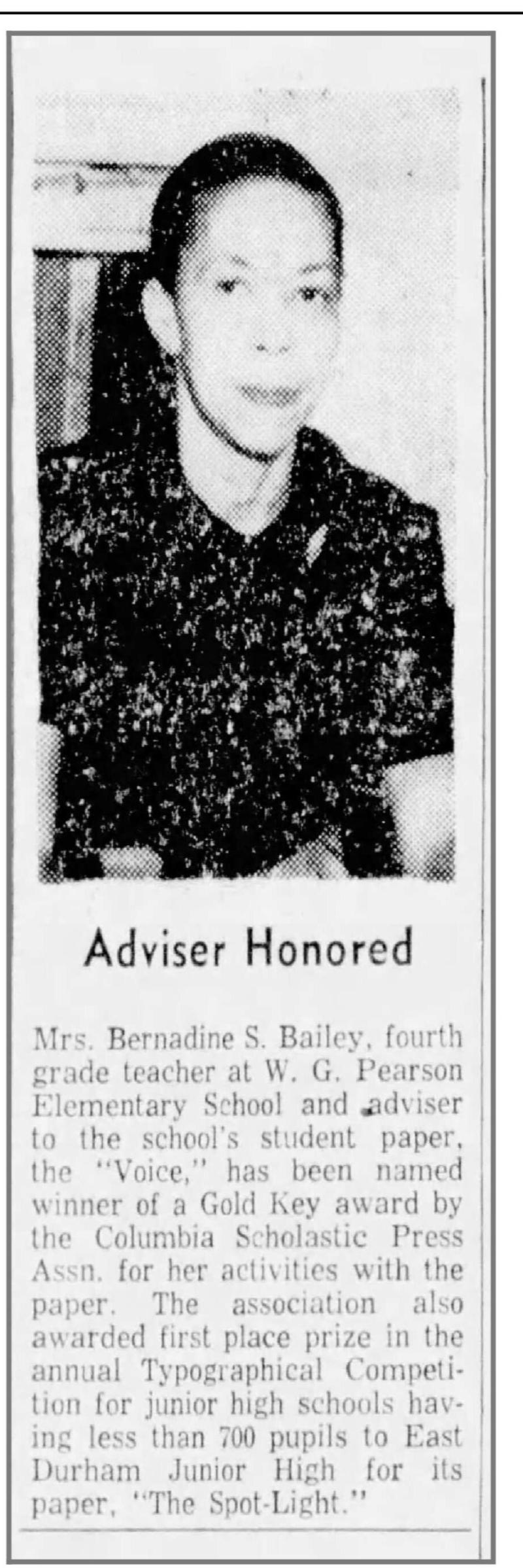
Bernadine Stoneham Smith Bailey attended Virginia Union University for her bachelor's degree. She then attended North Carolina College for her master's degree, and continued her education at the Primary Day School, Duke University, and the University of North Carolina-Chapel Hill. During her time at the University of Chapel Hill, she was the school’s newspaper advisor, which she carried over into her career as a teacher and the advisor for the student newspaper, “The Voice,” at W. G. Pearson School. She would go on to become incredibly involved with the Columbia Scholastic Press Advisers Association as a member, lecturer, presenter, demonstrator, and judge. The press honored her dedication by awarding her the Gold Key, and she was later honored with the Golden Crown for 50 years of service with the School Press of the United States. Under her advisement, multiple years in a row the school paper received “medalist rating,” which is the highest rating a paper could receive from the Columbia Scholastic Press Association. She also worked with the local chapter of the Girl Scouts, cited as one of the chapter’s first volunteers.
In their free time, the Baileys were part of many organizations and clubs. John attended St. Joseph’s A.M.E. Church and was a member of the choir for over twenty years. John was involved with the Boy Scouts of America, Doric Lodge, No. 28 of the Free and Accepted Order of Masons, and the Beta Phi Chapter of the Omega Psi Phi Fraternity. Bernadine was a member of White Rock Baptist Church. She was also the founder of the Little Slams Bridge Club, a life member and Golden Soror of Alpha Kappa Alpha Sorority of the Alpha Zeta Omega Chapter of Durham, and a member of the American Association of University Women.
The Baileys made significant repairs and changes to the home, including a two-room addition in 1953.
Ellen and Samuel Lann also lived in the home. Ellen and Samuel boarded in multiple homes along Fayetteville St, including 1208, 1210, and 1215 Fayetteville St. Ellen and Samuel both passed away while living at 1222 Fayetteville, Ellen in 1956 and Samuel in 1962. Ellen was a clerk at Williams Grocery but had no occupation when she passed away. Samuel was a chef and worked at Center Restaurant, Parker’s Restaurant, Malborn Hotel, and the Washington Duke Hotel. The Lanns had two children, Marie and Thomas Lann.
1222 Fayetteville is now a commercial property. D & M Barber Shop has operated out of the building for going on 30 years.
Sources:
Carolina Times
Drew Jackson, “Last call for NC barber shops brace for uncertainty as clients get their last cuts before coranavirus shutdown,” News & Observer, March 25, 2020, https://www.newsobserver.com/news/coronavirus/article241471371.html.
Durham Sun
Herald-Sun
“Our History,” Boys and Girls Club of Durham and Orange Counties, last accessed January 12, 2026 https://bgcdoc.org/our-history/.
From the Stokesdale National Historic District Nomination:
This one-story, gable-front-and-wing house is four bays wide and triple-pile with a large shed-roofed addition at the rear and a flush gable on the right end of the façade. The house has been altered significantly with the loss of all original doors and windows. Picture windows have been installed on the façade and the building is clad in vinyl. The house has a brick pier foundation with concrete-block curtain wall. The shedroofed front porch is supported by tapered wood posts on painted brick piers on a concrete slab floor. The house is now a barbershop and the front yard has been paved for parking. The building appears on the 1913 Sanborn map. It is listed as vacant in the 1920 city directory; the earliest known occupant is Walker Mebane (laborer) in 1925.


Add new comment
Log in or register to post comments.