Preserve Durham's History with a Donation to Open Durham Today!
OpenDurham.org is dedicated to preserving and sharing the rich history of our community. Run by our parent nonprofit, Preservation Durham, the site requires routine maintenance and upgrades. We do not ask for support often (and you can check the box to "hide this message" in the future), but today, we're asking you to chip in with a donation toward annual maintenance of the site. Your support allows us to maintain this valuable resource, expand our archives, and keep the history of Durham accessible to everyone.
Every contribution, big or small, makes a difference and makes you a member of Preservation Durham. Help us keep Durham's history alive for future generations.
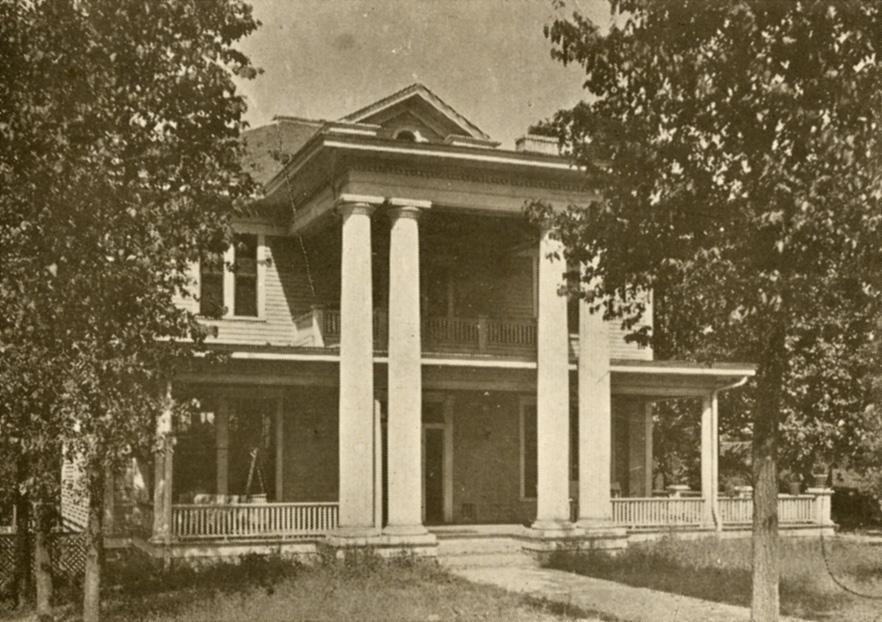
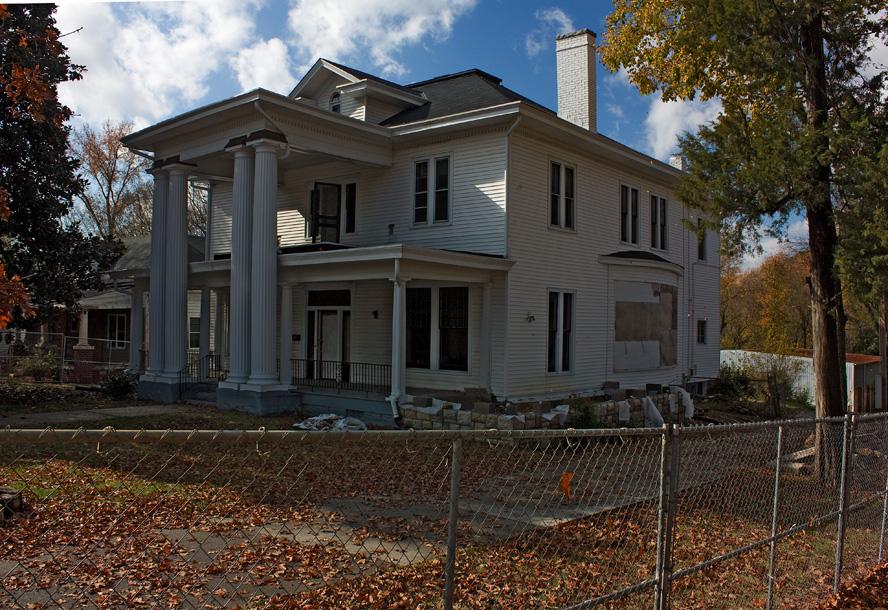
unknown- removal of wooden posts on front porch and replaced with iron posts, removal of second floor railing, replacement of second floor door, boarded up
(Courtesy Duke Rare Book and Manuscript Collection / Scanned by Digital Durham)
From Preservation Durham Plaque Application
1406 Fayetteville Street, widely known as the Scarborough House, was the primary residence of the Scarborough family. John C. Scarborough, Sr., was born and raised in Kinston, NC, during the Southern Reconstruction era. He received an education at Kitrell Business College, a historically Black institution, under the sponsorship of Black embalmer J.C. Hargett. He later graduated from Reounard Training School for Embalmers in New York, where he was the only Black student. After returning home from school, J.C. Scarborough, Sr., married J.C. Hargett’s daughter Daisy in 1901. Soon after, the couple moved from Kinston to Durham. Upon the Scarboroughs’ arrival in Durham, they brought Scarborough & Hargett Funeral Home to Hayti, making it a vital institution for Durham’s African-American community. Known for the motto “a dignified service in a sympathetic way,” Scarborough & Hargett provided Black families with access to public funeral services during the Jim Crow era when whites denied Black Americans access to white funeral homes. Thus, making the family instrumental in supporting Black families during times of grief. The Scarborough & Hargett Funeral Home also served as an important meeting site for Black civic action groups such as the Durham Social Problems Club, the Tobacco Workers Union (No. 194), and the YMCA.
Two decades after John and Daisy settled in Hayti, Daisy tragically passed away at 39. The family established the Daisy H. Scarborough Nursery School in her name in 1925. John soon remarried to Alabama native Clydie Fullwood. Clydie, a daughter of former enslaved people in Opelika, AL, led North Carolina’s oldest licensed nursery school for 50 years, offering working Black mothers reliable childcare “according to what the parents are able to pay” or, in some cases, “no charges at all.” Scarborough Nursery School educated thousands of Hayti residents during their formative years and sponsored community theatre performances. In addition to her leadership at Scarborough Nursery School, Clydie served as President of St. Joseph AME Church’s Executive Committee, Hospitality Committee Chair for the YWCA, and an At-Large member of the predominantly male Durham Committee on Negro Affairs Executive Committee. She also served in various roles with the NAACP and Women-in-Action for the Prevention of Violence and its Causes Inc. In her leisure time, Clydie participated in the Wisteria Bridge Club and Volkamenia Literary Club.
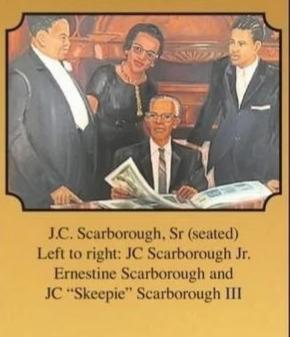
Scarborough Family Portrait, Courtesy of Scarborough and Hargett Funeral Home
John Sr. and Daisy’s son J.C. “Johnnie” Scarborough, Jr. lived in the 1406 Fayetteville Street home his entire life. Born in January of 1907, Johnnie grew up in the Scarborough House and lived there throughout most of his life. He followed in his father’s footsteps, working for Scarborough & Hargett and Mechanics & Farmers Bank, and joining Omega Psi Phi Fraternity, Inc. Johnnie married Hattie Strong in 1933, a Kentucky-born stenographer and leader in her own right. Hattie worked as a purchasing agent/assistant bursar at North Carolina College and served in the “only negro census unit in the south.” She was also a member of Alpha Kappa Alpha Sorority, Inc. Hattie volunteered with the following organizations outside of her work and family life: Jack and Jill of Durham, Daughters of Isis, the North Carolina College Alumni Association (Durham Chapter), St. Joseph AME’s Ladies Aid club, and the Durham County Girl Scout Council. Hattie spent many occasions with the Little Slam Bridge Club and was known for throwing socials in her quarters at the Scarborough House.
Johnnie’s sister, Ernestine Scarborough Bynum, also grew up in the home. She attended boarding school for most of her youth, returning to the home in the summers. She moved to New York in 1934 and then lived in numerous other cities. She went on to get her embalming license, making her the first African American woman in North Carolina to do so. She then returned to Durham in 1951, where she lived for a few years at 1406 Fayetteville, and then settled down for the rest of her life at 1407 Fayetteville Street, across from her childhood home. After returning to Durham, she would eventually join the family business, becoming the manager at the funeral home.
The home is currently in family ownership and talks are in process to preserve the property.
“Ernestine Bynum interview recording, 1993, May 27," conducted by Karen Ferguson, from Duke University Archives, Behind the Veil: Documenting African American Life in the Jim Crow South Interviews, last accessed May 29, 2026, https://repository.duke.edu/dc/behindtheveil/btvnc03006#.
1406 Fayetteville – John C. Scarborough House – c. 1913-14 C – Building The John C. Scarborough House is the only example of Neoclassical Revival architecture in the district. This two-story, hip-with-deck-roofed house is three bays wide and double-pile. It has a full-width, two-story, hip-roofed rear ell and a lower, two-story, hip-roofed block beyond the ell on the southwest corner of the house. The house has a granite foundation, wood weatherboards, and two interior brick chimneys. It has one-over-one, double-hung wood sash windows throughout with twenty-over-one, double-hung windows on the first-floor façade, two-over-two, double-hung windows on the rear ell, and an arched window in the gabled front dormer. The house has a bow window on the north elevation. The front door has been boarded over but the beveled-glass sidelights and an etched glass transom remain exposed. A replacement door on the second-floor, under the portico, is flanked by one-over-one, double-hung windows. The two-story portico is supported by fluted columns and has dentil molding in the entablature that extends around the house. Beneath the portico is a one-story, full-width, hip-roofed front porch supported by smaller fluted columns. Interior elements, including Rococo and Baroque mantels were salvaged from the deconstruction of another house. The house was constructed around 1913-14 by John C. Scarborough, owner of Durham’s first African American funeral parlor, Scarborough & Hargett. In 1925, Scarborough obtained the original Lincoln Hospital on Proctor Street and donated it for use as an “old people’s and orphans’ home,” a venture that eventually became Scarborough Nursery. Both the funeral home and the nursery are still in operation today, though their original buildings in Hayti have been demolished. The Scarborough House was listed to the National Register in 1985 and is still owned by the Scarborough family.
Previous Entries on the Property:
John C. Scarborough established his funeral home in his hometown of Kinston, NC with his partner, Joseph C. Hargett. After JC Scarborough married Hargett's daughter, Daisy, they were persuaded by Alex Moore, a North Carolina Mutual agent, to move to Durham in 1901. It appears that he initially settled in the West End, at 801 Chapel Hill Road; by 1906, his funeral parlor was located at at 303 East Chapel Hill St. "opposite the Academy of Music."
The Scarborough House at 1406 Fayetteville St., was built by John C. Scarborough, Sr., likely around 1913-1914. Per the Architectural Inventory, the house was built out of the architectural elements of a disassembled house that sat on the later site of the Johnson Motor Company Showroom. It's a bit hard to piece together so far exactly which house this was, and whether the 'house' was actually the Central/Sans Souci hotel, which sat on that site. However, these buildings were supposedly demolished in 1926.
The inventory, however, notes that every interior element of the house, except for the the transoms, came from the earlier structure in the 300 block of East Main St.
Scarborough moved his funeral home into Hayti, to 522 East Pettigrew St. by the mid-1920s.
In 1925, Scarborough acquired the original Lincoln Hospital on Proctor St. (when the new facility had opened on Fayetteville) and donated the building to the "Black Minister's Alliance" for use as an "old people's and orphans' home"; this later became the Scarborough Nursery, still in operation today on Holloway St.
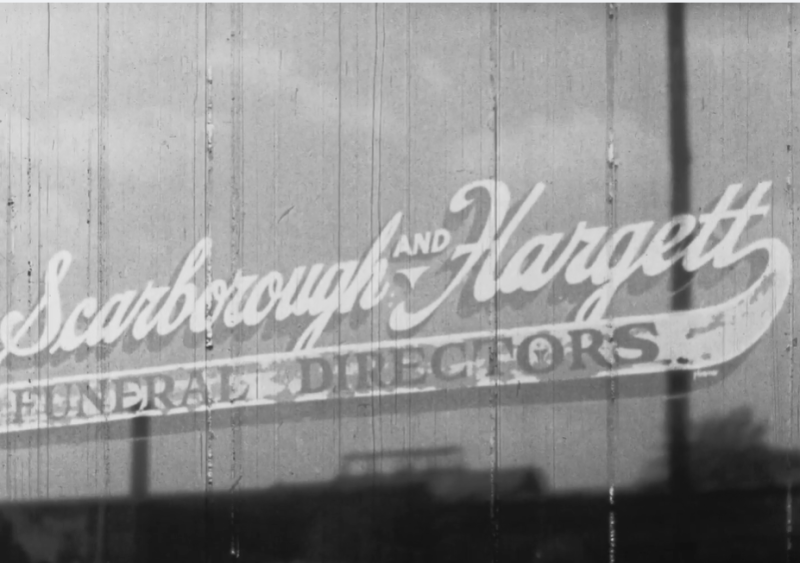
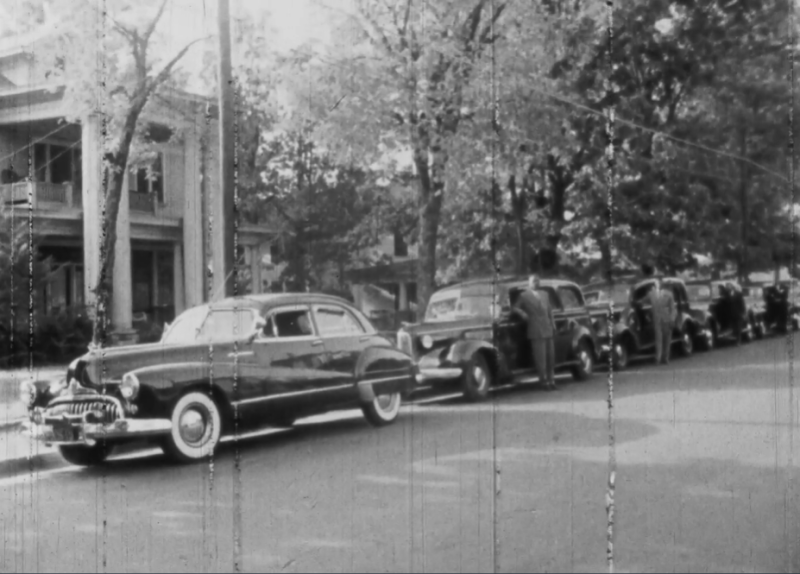
Below, a view of the Scarborough House from the 1948 "Negro Durham Marches On." The window sign is from 522 East Pettigrew, while the line of cars sits in front of 1406 Fayetteville St.
What isn't clear to me is whether the house was ever used as a funeral home, or whether it was solely the family home. Regardless, while the Scarborough Funeral Home prepares to move to move to, I believe, a fourth location, the Scarborough house remains in the family, and is currently being renovated.
Submitted by Dave Piatt (not verified) on Mon, 12/8/2008 - 2:48pm
The Scarborough house was moved to it's present site by pulling it over large cut logs by a team of horses (from Scarborough himself). It was used as a funeral parlor at one time, and the family lived upstairs. Until a few years ago, it looked exactly as it did in its heyday, complete with period furniture and a teal colored Frigidaire in the kitchen. Eventually, bums found a way in and took to sleeping there, and even stole some of the furniture. During a hurricane a few years back lightning made it's way into the attic (which was full of books) and caught fire, basically ruining the attic space and part of the top floor.
Submitted by Christopher (not verified) on Wed, 10/7/2009 - 12:27pm
I always wondered about this house, which seems to be considerably more grand than most of its neighbors. Interesting to hear its history, and I'm glad to see that it's being renovated.
^Moved? Where from?
Submitted by 306West (not verified) on Sat, 7/31/2010 - 1:37pm
@Gary...have you ever though of calling Skip Scarborugh, he and his family would definitely welcome you and tell you all about the house. The house was grandeur, I can vouch for that, and they had/have perid furniture that dates back to the Civil War if I recall, that the family had acquired.
Give them a call, or email me and I will let him know of you.
Submitted by Anonymous (not verified) on Mon, 8/9/2010 - 12:36am
I don't think this house is renovated...
Submitted by Durhamite (not verified) on Sun, 12/25/2011 - 8:13am
I remember sometime in the late 1970's, perhaps early 1980's, that somehow J.S. Carr's Somerset Villa furniture found its way into this house...an auction of the property perhaps? It was in the Durham Morning Herald or Durham Sun (of the period).
Submitted by PeterK (not verified) on Wed, 8/14/2013 - 3:46pm
Nothing appears to have been done on the exterior here. Interior is unknown. It looks today much like it did in the photo.

Comments
Submitted by Dave Piatt (not verified) on Mon, 12/8/2008 - 2:48pm
The Scarborough house was moved to it's present site by pulling it over large cut logs by a team of horses (from Scarborough himself). It was used as a funeral parlor at one time, and the family lived upstairs. Until a few years ago, it looked exactly as it did in its heyday, complete with period furniture and a teal colored Frigidaire in the kitchen. Eventually, bums found a way in and took to sleeping there, and even stole some of the furniture. During a hurricane a few years back lightning made it's way into the attic (which was full of books) and caught fire, basically ruining the attic space and part of the top floor.
Submitted by Christopher (not verified) on Wed, 10/7/2009 - 12:27pm
I always wondered about this house, which seems to be considerably more grand than most of its neighbors. Interesting to hear its history, and I'm glad to see that it's being renovated.
^Moved? Where from?
Submitted by 306West (not verified) on Sat, 7/31/2010 - 1:37pm
@Gary...have you ever though of calling Skip Scarborugh, he and his family would definitely welcome you and tell you all about the house. The house was grandeur, I can vouch for that, and they had/have perid furniture that dates back to the Civil War if I recall, that the family had acquired.
Give them a call, or email me and I will let him know of you.
Submitted by Anonymous (not verified) on Mon, 8/9/2010 - 12:36am
I don't think this house is renovated...
Submitted by Durhamite (not verified) on Sun, 12/25/2011 - 8:13am
I remember sometime in the late 1970's, perhaps early 1980's, that somehow J.S. Carr's Somerset Villa furniture found its way into this house...an auction of the property perhaps? It was in the Durham Morning Herald or Durham Sun (of the period).
Submitted by PeterK (not verified) on Wed, 8/14/2013 - 3:46pm
Nothing appears to have been done on the exterior here. Interior is unknown. It looks today much like it did in the photo.
Add new comment
Log in or register to post comments.