Preserve Durham's History with a Donation to Open Durham Today!
OpenDurham.org is dedicated to preserving and sharing the rich history of our community. Run by our parent nonprofit, Preservation Durham, the site requires routine maintenance and upgrades. We do not ask for support often (and you can check the box to "hide this message" in the future), but today, we're asking you to chip in with a donation toward annual maintenance of the site. Your support allows us to maintain this valuable resource, expand our archives, and keep the history of Durham accessible to everyone.
Every contribution, big or small, makes a difference and makes you a member of Preservation Durham. Help us keep Durham's history alive for future generations.
(The following information in italics is from the Historic Preservation Society of Durham Plaque Application for the Mabel and G. Frank Warner House)
By the early 1890s, Brodie Leonidas Duke, Washington Duke's eldest son and an early Durham tobacco entrepreneur, had bought up large swaths oflandjust north of the city of Durham. In 1892, Duke incorporated the town of North Durham in order to develop his still unfinished Pearl Cotton MiJis. He became the town 's mayor; commissioners included Fred C. Geer and H.E. Seeman. Brodie Duke went bust in 1893, leaving his stockholders to complete the building of the mills. By 1901, he had recovered financially, and began parcelling his land in North Durham for sale and development. That same year, a trolley was built from downtown Durham to North Durham. With easy access from Little Five Points to downtown, North Durham became one of Durham's most fashionable "streetcar suburbs." Today, the North Durham-Duke Park National Historic District includes large portions of this tum-of-the-century suburb.
A "Map ofNorth Durham Property ofB.L. Duke, April 1901" (Plat Book 5, page 103, in the Durham County Register of Deeds office) shows the extent of Brodie Duke's property holdings. Attorney Jesse A. Giles purchased the eastern portions of lots l, 2, and 3 of block 35 from the Duke Land and Improvement Company in 1916. Judging from the leap in cost, from "$100 plus other valuable considerations" that Giles paid in 1916 to $3350 that G. Frank Warner paid for the property in early 1917, it is most likely that the house at 119 West Lynch Street was built on Giles' land in 1916. Giles never lived at the address, but Durham City Directories list Warner at the address in 1917. A "Map Showing the Changes in Block No, 35 of the Duke Land and Improvement Company, Durham N.C.," dated November 2, 1922, shows an outline of the house, providing the earliest mapped record of its existence.
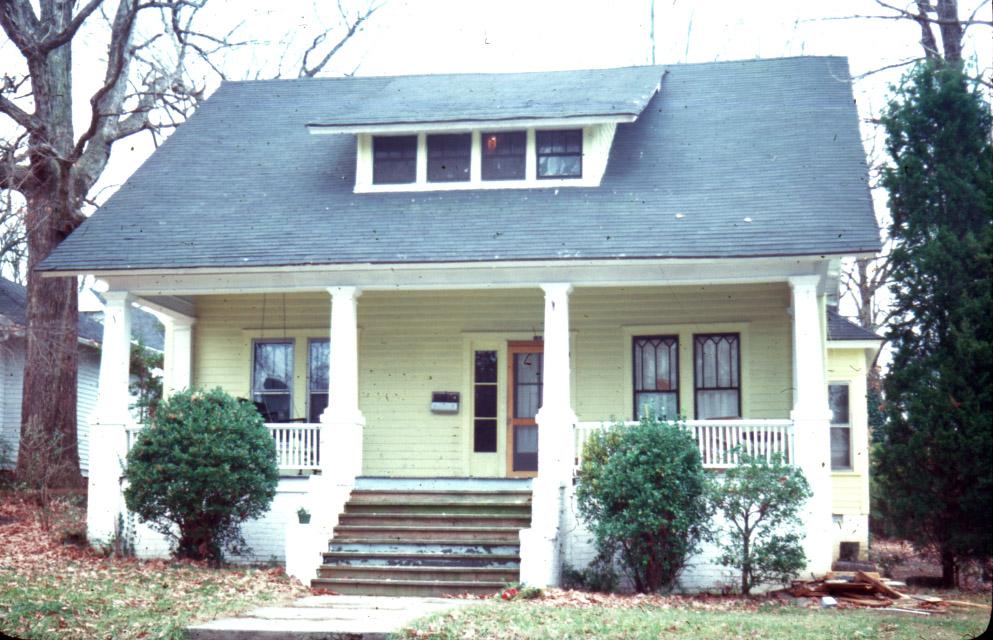
The National Register of Historic Places Inventory Nomination Form for North Durham-Duke Park describes the house as follows: "Ca. 1920. Attractive one and one half story clapboarded bungalow with steeply pitched side facing gable roof which runs over front porch. Porch roof supported by four wood on brick pier columns. Large shed roof dormer in front. Brackets on eaves on huge side gables."
The deep angle of the roof distinguishes the house from most other bungalows in the neighborhood. The house retains four original coal fireplaces, with original handmade tiles surrounding one. The house is in excellent condition, with significant foundational repairs having recently been made by the current owners.
Durham City Directories list an address for G. Frank Warner for the first time in 1917, when he purchased and moved into the house at 119 West Lynch Street. Warner was general secretary for the Durham YMCA and the Durham Rotary Club. Warner, his wife Mabel, and their son G. Frank Warner, Jr., remained at 119 West Lynch Street until late 1925 or early 1926, when they moved to Durham's Forest Hills neighborhood.
Though G. Frank Warner, Jr., (hereafter Frank Warner) also made the YMCA his professional career, he is far better known as one of the leaders in the folk-music revival that took place in the United States following World War II. A guitarist, singer, and banjoist, Frank Warner and his wife Anne Locher Warner eventually collected thousands of folk songs from musicians in rural areas in the South, New England, and down the eastern seaboard. Probably the most famous of these songs was Frank Proffitt's "Tom Dooley." The Kingston Trio learned the song through Alan Lomax, who had learned it in tum from the Warners. The Trio made the song a national hit in the 1950s, and though it took many years, Frank and Anne were instrumental in making sure that Proffitt finally received credit for the song. Another now- famous song collected and recorded by the Wamers was Sue Thomas's "He's Got the Whole World in His Hands."
Frank Warner's career as a folk musician began in Durham while he resided at 119 West Lynch Street. Of his time as a Duke student (1921-1925), Warner explained, "while I was in college I was active in music. I was in the glee club, and some ofus were used by our English professor, Dr. Frank C. Brown, to illustrate his lectures on the folk music ofNorth Carolina. I learned then many of the songs he had collected" (Baggelaar and Milton). Warner made his first public solo appearance at the 1924 State Fair in Raleigh, illustrating a lecture by folklorist Brown.
Duke University's Special Collections Library now houses nearly 5000 items of the Warner family papers, including audio and video tapes, interviews, photographs, letters, and printed material. After Mabel and G. Frank Warner, Sr., moved to Forest Hills, the house at 119 West Lynch Street was rented for a year before being sold to May Belle Kearney in 1927. Kearney (1882-1968) owned the house (possibly with other members of her family) for nearly four decades, renting it out for sixteen years before finally making it her home in 1943. Kearney was born in Franklin County and received A.B. and M.A. degrees from Trinity College (now Duke University). She never married, and spent her long professional life as a teacher in the Durham County schools, primarily at Southside School. For much of the time that she rented out 119 West Lynch Street, she lived on Cleveland Avenue with several other members of her family, including Joseph C. Kearney, owner of an apron-manufacturing business; Marcellus and Moe Kearney, both brokers; and Caroline Kearney, also a teacher.
The most prominent tenants among the many at 119 West Lynch Street between 1927 and 1943 were Lex E. O'Briant and his family. O'Briant was longtime owner ofO'Briant Music Store downtown; he and his son Lex Jr. both worked at the store. The family lived at 119 West Lynch Street from 1935-43.
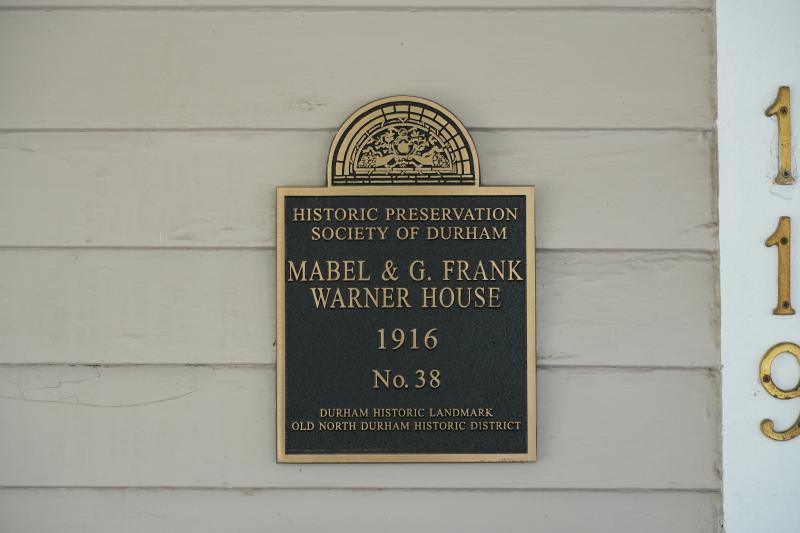
Preservation Durham Plaque #38
Sources: I. Jean Bradley Anderson, D11rham Co1111(Y (Durham: Duke University Press, 1990). 2. Roberts, Claudia P., et al. , The D11rham Architectural and Historic Inventory (Durham: City of Durham, 1982). 3. National Register of Historic Places Inventory Nomination Fonn for North Durham-Duke Park ( 1980-81 ), a copy stored in the office of the North Carolina Room at Durham County Library (no call number). 4. Durham County Register of Deeds, Plat Book 5/Page 103 and Plat Book 3/Page 185.
5. Deed books of the Durham County Register of Deeds. 6. Durham City Directories, available on micro{i!m at U1e Durham County Library. 7. Obituary for May Belle Kearney, Du,-l,am Moming Herald, 4 May 1968. 8. Cemetary Survey of Durham County, NorU1 Carolina, ed. Allen Dew, accessed online ilirough http://apdew.com/cemelery/durh/ 011 9 September 2003. 9. James G. Leyburn, The Way We Lived: Du,-l,am, 1900-1920 (Elliston VA: Norilicross House, 1989): 172. JO. Appleseed Recordings, "The Warner Collecliou, Vol. II: The Siugers," 2000, accessed ouline al http://www.appleseedrec.com/wamerstwo/singers.hlml on 9 September 2003. 11 . Irwin Stambler and Grelun Landon, Encyclopedia of Folk, Country and Western Music (New York: St. Martin's Press, 1969), and Kristin Baggelaar and Donald Milton, Folk Music: Mol'e Than a Song (New York: Crowell, 1976). Biographies of Frank Warner from iliese two sources quoted online at http://users2.evl .net/--smyili/linemotes/personel/WarnerFrauk.htm, accessed 9 September 2003.
Comments
Submitted by Elizabeth Paley (not verified) on Mon, 8/5/2013 - 7:19am
Attorney Jesse A. Giles purchased the eastern portions of lots 1, 2, and 3 of block 35 from the Duke Land and Improvement Company in 1916. Judging from the leap in cost, from “$100 plus other valuable considerations” that Giles paid in 1916 to $3350 that G. Frank Warner paid for the property in early 1917, it is most likely that the house at 119 West Lynch Street was built on Giles’ land in 1916. Giles never lived at the address, but Durham City Directories list Warner at the address in 1917. A “Map Showing the Changes in Block No, 35 of the Duke Land and Improvement Company, Durham N.C.,” dated November 2, 1922, shows an outline of the house, providing the earliest mapped record of its existence.
The National Register of Historic Places Inventory Nomination Form for North Durham-Duke Park describes the house as follows: "Ca. 1920. Attractive one and one half story clapboarded bungalow with steeply pitched side facing gable roof which runs over front porch. Porch roof supported by four wood on brick pier columns. Large shed roof dormer in front. Brackets on eaves on huge side gables." The deep angle of the roof distinguishes the house from most other bungalows in the neighborhood. The house retains four original coal fireplaces; one still retains its original handmade tiles.
Durham City Directories list an address for G. Frank Warner for the first time in 1917, when he purchased and moved into the house at 119 West Lynch Street. Warner was general secretary for the Durham YMCA and the Durham Rotary Club. Warner, his wife Mabel, and their son G. Frank Warner, Jr., remained at 119 West Lynch Street until late 1925 or early 1926, when they moved to Durham’s Forest Hills neighborhood.
Though G. Frank Warner, Jr., (hereafter Frank Warner) also made the YMCA his professional career, he is far better known as one of the leaders in the folk-music revival that took place in the United States following World War II. A guitarist, singer, and banjoist, Frank Warner and his wife Anne Locher Warner eventually collected thousands of folk songs from musicians in rural areas in the South, New England, and down the eastern seaboard. Probably the most famous of these songs was Frank Proffitt’s “Tom Dooley.” The Kingston Trio learned the song through Alan Lomax, who had learned it in turn from the Warners. The Trio made the song a national hit in the 1950s, and though it took many years, Frank and Anne were instrumental in making sure that Proffitt finally received credit for the song. Another now-famous song collected and recorded by the Warners was Sue Thomas’s “He’s Got the Whole World in His Hands.”
Frank Warner’s career as a folk musician began in Durham while he resided at 119 West Lynch Street. Of his time as a Duke student (1921-1925), Warner explained, “while I was in college I was active in music. I was in the glee club, and some of us were used by our English professor, Dr. Frank C. Brown, to illustrate his lectures on the folk music of North Carolina. I learned then many of the songs he had collected” (Baggelaar and Milton). Warner made his first public solo appearance at the 1924 State Fair in Raleigh, illustrating a lecture by folklorist Brown.
Duke University’s Special Collections Library now houses nearly 5000 items of the Warner family papers, including audio and video tapes, interviews, photographs, letters, and printed material.
The Mabel and G. Frank Warner House became a local historic landmark in 2004.

Comments
Submitted by Elizabeth Paley (not verified) on Mon, 8/5/2013 - 7:19am
Attorney Jesse A. Giles purchased the eastern portions of lots 1, 2, and 3 of block 35 from the Duke Land and Improvement Company in 1916. Judging from the leap in cost, from “$100 plus other valuable considerations” that Giles paid in 1916 to $3350 that G. Frank Warner paid for the property in early 1917, it is most likely that the house at 119 West Lynch Street was built on Giles’ land in 1916. Giles never lived at the address, but Durham City Directories list Warner at the address in 1917. A “Map Showing the Changes in Block No, 35 of the Duke Land and Improvement Company, Durham N.C.,” dated November 2, 1922, shows an outline of the house, providing the earliest mapped record of its existence.
The National Register of Historic Places Inventory Nomination Form for North Durham-Duke Park describes the house as follows: "Ca. 1920. Attractive one and one half story clapboarded bungalow with steeply pitched side facing gable roof which runs over front porch. Porch roof supported by four wood on brick pier columns. Large shed roof dormer in front. Brackets on eaves on huge side gables." The deep angle of the roof distinguishes the house from most other bungalows in the neighborhood. The house retains four original coal fireplaces; one still retains its original handmade tiles.
Durham City Directories list an address for G. Frank Warner for the first time in 1917, when he purchased and moved into the house at 119 West Lynch Street. Warner was general secretary for the Durham YMCA and the Durham Rotary Club. Warner, his wife Mabel, and their son G. Frank Warner, Jr., remained at 119 West Lynch Street until late 1925 or early 1926, when they moved to Durham’s Forest Hills neighborhood.
Though G. Frank Warner, Jr., (hereafter Frank Warner) also made the YMCA his professional career, he is far better known as one of the leaders in the folk-music revival that took place in the United States following World War II. A guitarist, singer, and banjoist, Frank Warner and his wife Anne Locher Warner eventually collected thousands of folk songs from musicians in rural areas in the South, New England, and down the eastern seaboard. Probably the most famous of these songs was Frank Proffitt’s “Tom Dooley.” The Kingston Trio learned the song through Alan Lomax, who had learned it in turn from the Warners. The Trio made the song a national hit in the 1950s, and though it took many years, Frank and Anne were instrumental in making sure that Proffitt finally received credit for the song. Another now-famous song collected and recorded by the Warners was Sue Thomas’s “He’s Got the Whole World in His Hands.”
Frank Warner’s career as a folk musician began in Durham while he resided at 119 West Lynch Street. Of his time as a Duke student (1921-1925), Warner explained, “while I was in college I was active in music. I was in the glee club, and some of us were used by our English professor, Dr. Frank C. Brown, to illustrate his lectures on the folk music of North Carolina. I learned then many of the songs he had collected” (Baggelaar and Milton). Warner made his first public solo appearance at the 1924 State Fair in Raleigh, illustrating a lecture by folklorist Brown.
Duke University’s Special Collections Library now houses nearly 5000 items of the Warner family papers, including audio and video tapes, interviews, photographs, letters, and printed material.
The Mabel and G. Frank Warner House became a local historic landmark in 2004.
Add new comment
Log in or register to post comments.