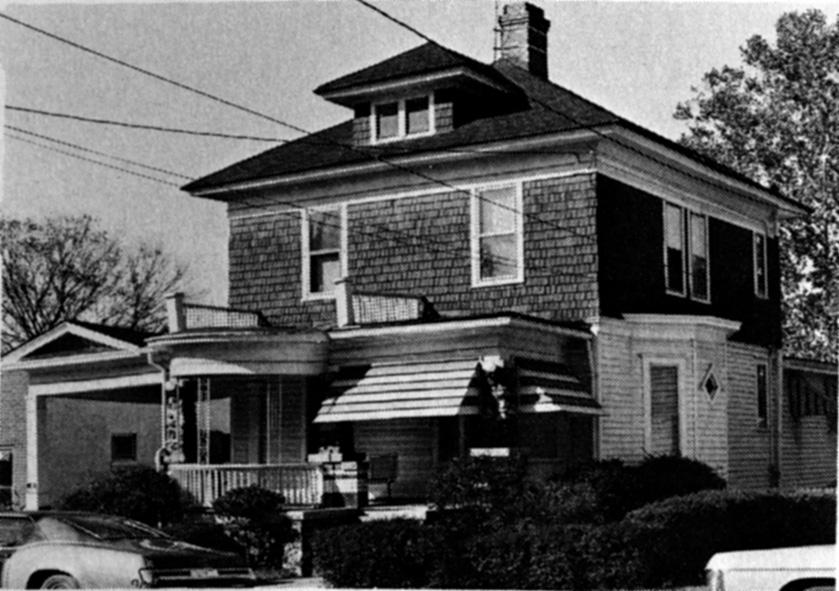
FK Watkins house, late 1970s.
From the Preservation Durham Historic Plaque Application:
1218 Fayetteville Street was the home of Frederick K. Watkins. Watkins, known as ‘The Movie King,’ became the most prolific theater owner in North Carolina. Before arriving in Durham, F.K. Watkins grew up in the small town of Russum, Mississippi, and later attended Alcorn A&M College (now Alcorn State University), the first Black land grant college in the U.S.
He first owned the Electric Theater in 1913, the second Black American movie theater in North Carolina, and the Wonderland Theater. These theaters gave Hayti residents, and Black Durham more broadly, viable access to cinema and entertainment when white theaters often refused or gave substandard service to Black patrons. Watkins later expanded across North Carolina and other states on the East Coast, owning theaters in Raleigh, Chapel Hill, Apex, High Point, Goldsboro, Wilson, and Reidville, as well as South Carolina, Virginia, and New Jersey. He worked in other professions as well, notably as a real estate agent, presiding over the King Real Estate Company. Watkins was also known for hosting pageants and parades where he wore a fez and tassel and rode a horse.
Outside of his business ventures, F.K. Watkins served as the first President of the United Negro Democrats of North Carolina, which, at the time, mobilized the largest turnout of Black voters for the Democratic ticket in state history. He also served as a Durham magistrate. Watkins was a member of White Rock Baptist Church, Doric Lodge No. 28, Bull City Lodge No. 317, the James E. Shepard Memorial Foundation Inc. Board of Directors, the John Avery Boys Club Board of Directors, and the Durham Business & Professional Chain.
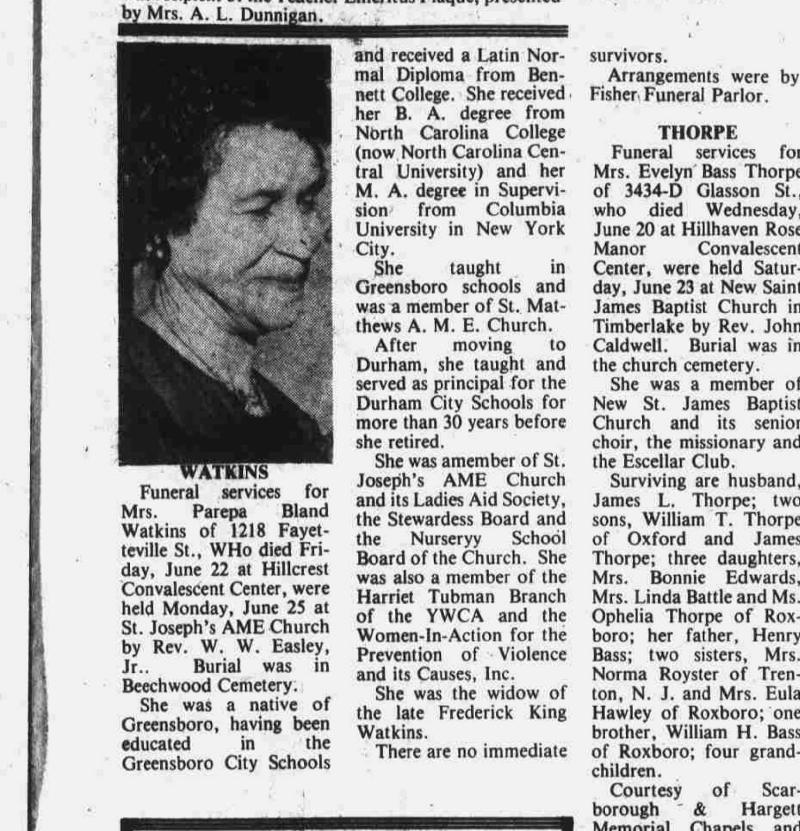
Parepa Watkins grew up in Greensboro, NC, and attended Bennett College, where she earned a Latin Normal Diploma. Mrs. Watkins also received her B.A. from North Carolina College (now NCCU) and her M.A. from Columbia University in New York. She began her career in public education in Greensboro, then moved to Durham to teach at East Durham School (now Burton Elementary) in 1930, where she would also become principal. Parepa also taught at and became principal of Whitted Elementary before serving as the first supervisor for Black elementary schools in Durham. The community named the street where Burton Elementary was located in reverence for Mrs. Watkins’ service.
In addition to her work in Durham’s Black education system, Parepa was a long-time member of St. Joseph A.M.E. Church, serving in the Ladies Aid Club and the Stewardess and Nursery School boards. Moreover, Mrs. Watkins was a member of the Wisteria Bridge Club, the Harriet Tubman Branch of the YWCA, Prevention of Violence & its Causes, Inc., the Year Round Garden Club, the Volkamenia Literary Club, and the So Different Club (of Greensboro)."
As of 2026, property is currently in good, stable condition.
Sources:
Carolina Times
___________________________________________________________________________
Frederick K. Watkins constructed the house at 1208 Fayetteville St. around 1913. Watkins either dubbed himself, or found himself dubbed (P.I.) 'The Movie King' for his ownership of, first, the Electric Theater, which became the Rex Theater and moved to 522 East Pettigrew St., and then the Wonderland Theater - it appears that he may have also developed the Booker T Theater on East Pettigrew St.
Watkins was evidently an exuberant figure, staging pageants and parades in which he would ride a horse, wearing a fez and tassel and other regalia.
Watkins evidently came to Durham from Mississippi, where he had run a nickelodeon. He opened the Electric in 1913, making it the second African-American movie theater in North Carolina.
Watkins had already started to spread his business again prior to the 1920s. Prior to the construction of the Wonderland Theatre, Watkins opened The Dunbar in Winston-Salem. By 1917, Watkins had established himself as the most prolific theater owner in the state of North Carolina, having opened theatres in Chapel Hill, Goldsboro, Raleigh, Reidsville and Wilson, as well as the Palace Theatre in Apex and the Dixie Theatre in High Point.
Watkins continued to expand his theatre operations by opening theaters in other states on the east coast, including South Carolina and Virginia. Watkins opened the Majestic Theatre in Martinsville, Virginia and theatres in Columbia and Spartanburg, South Carolina along with a theatre in Atlantic City, New Jersey. (I speculate that this was the Alan Theater)
Watkins first wife died in 1924, her funeral attended by a large crowd at St. Joseph's AME. He later married Parepa Bland who served as the Supervisor of Elementary School Teachers in the Durham City Schools, and evidently taught at the East End School.
In 1926 with a capital of US$100,000, Watkins organized the First National Theater Corporation to finance theater and vaudeville operation as well as film production.
Watkins lived here until death in 1955.
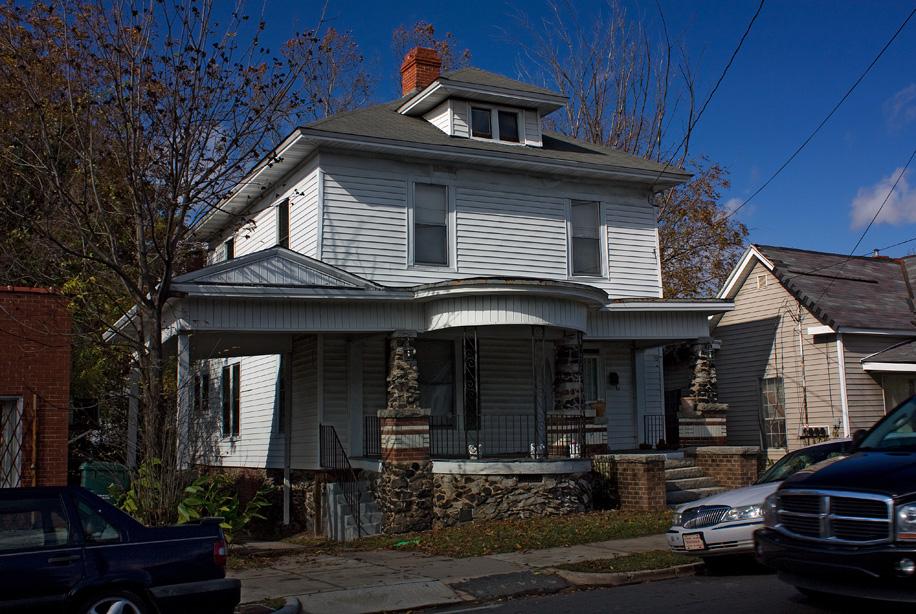
Looking west, 11.15.08
But it still bears the strong imprint of Watkins.
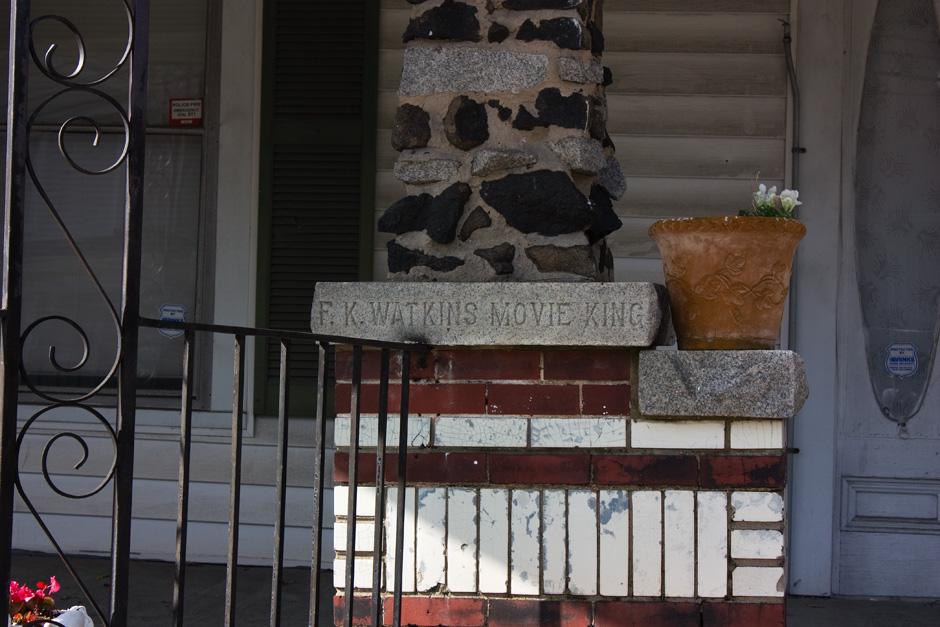
11.15.08
The Stokesdale NR district nomination reads:
This two-story, hip-roofed Foursquare house is two bays wide and double-pile with a one-story, full- width, flat-roofed rear ell. The house has a painted brick-pier foundation, vinyl siding, one-over-one, double- hung wood sash windows on the main block and metal casement windows at the north rear. The hip-roofed front porch is supported by rubble stone posts on granite topped brick piers. Watkins was the proprietor of the Rex Theatre and one of the granite tops is inscribed, “ F. W. Watkins Movie King.” A semi-circular bay on the left side of the porch is supported by decorative metal posts. The porch is accessed by a granite stair with granite topped brick knee walls. A pedimented porte-cochere extends south from the porch; it is supported by square metal posts on stone piers. The roof has a wide overhang, an interior brick chimney in the ridgeline, and an exterior chimney on the rear ell. The hip-roofed front dormer has two single-light windows and a one- story, hip-roofed bay on north elevation has one-over-one, double-hung wood sash windows on the sides and a diamond-shaped window in the central panel. The house has a replacement front door with original oval- light sidelight to its left. The house appears on the 1913 Sanborn map.

Comments
Submitted by Anonymous (not verified) on Tue, 11/25/2008 - 11:48am
Wish they'd use the historic rehab tax credits to remove all that aluminum. Surely this house is eligible for the National Register because of the Movie King!
Submitted by Andrew Edmonds (not verified) on Tue, 11/25/2008 - 1:33pm
Folks interested in learning more about the "Movie King" Watkins and the experiences of attending black movie theaters in North Carolina are encouraged to read UNC professor Charlene Regester's 2005 journal article in Film History entitled, "From the Buzzard's Roost:
Black Movie-going in Durham and Other North Carolina Cities during the Early Period of American Cinema".
The article can be accessed here.
Submitted by John (not verified) on Tue, 11/25/2008 - 4:07pm
This should be good...
Hayti novelist visits library
Herald-Sun, 25 Nov 2008
Lewis Shiner, author of "Black and White," a novel set in Durham's Hayti community, will host a book talk and signing at noon Monday [Dec 1], at Stanford L. Warren Library, 1201 Fayetteville St.
Shiner's novel chronicles civil rights, race relations, business success, residential relocation and African-American uplift in Durham.
Durham native, historian and former N.C. Central University administrator and professor Beverly Washington Jones will also be on hand to contextualize the social history of Hayti.
This event is free and open to the public.
Submitted by Steve (not verified) on Wed, 11/26/2008 - 3:35pm
Very cool post! I've always been interested in Watkins, as he ran several movie theaters throughout NC.
The "From the Buzzard's Roost" article is very informative. I think someone else also wrote an article or paper on him years ago that I recall, that I used for researching Watkins.
Submitted by Andrew Edmonds on Tue, 10/22/2024 - 9:46am
Watkins was also vice president of the West Indies Cigar Company, which was owned and managed by Carlos Calende Valle and located - at least in 1922 - beside the Wonderland Theater at 302 Ramsey Street.
Add new comment
Log in or register to post comments.