Preserve Durham's History with a Donation to Open Durham Today!
OpenDurham.org is dedicated to preserving and sharing the rich history of our community. Run by our parent nonprofit, Preservation Durham, the site requires routine maintenance and upgrades. We do not ask for support often (and you can check the box to "hide this message" in the future), but today, we're asking you to chip in with a donation toward annual maintenance of the site. Your support allows us to maintain this valuable resource, expand our archives, and keep the history of Durham accessible to everyone.
Every contribution, big or small, makes a difference and makes you a member of Preservation Durham. Help us keep Durham's history alive for future generations.
From the Preservation Durham Plaque Application (below in italics):
On 30 May, 1925, Annie Rigsbee (née Watson) purchased the parcel of land from Bettie Esma Ray on the newly designated constructed Englewood Avenue for the sum of $100.00. She purchased the land in concert with her three children: Pearl Olive Rigsbee, George Thomas Rigsbee, and Catherine Rigsbee.
Annie was born on September 22, 1891, the daughter of George and Mattie Watson, a farmer in Orange County, North Carolina, according to the 1910 Census living in a community known as Little River. The Little River is a tributary of the Eno River that spans both Durham and Orange Counties.
Annie was the widow of Thomas J. Rigsbee, whom she had married on February 2, 1910. According to his death certificate, Thomas died of septicemia (also known as sepsis or blood poisoning, caused by bacteria entering the bloodstream triggering a massive immune-system response attacking the entire body) following a bout of appendicitis, on 29 March, 1924.
The sprawling Rigsbee family played a foundational role in the development of Durham, leaving a lasting imprint on the city’s economic, civic, and educational landscape. Among their most important contributions as prominent early landowners was the provision of land that would become part of the campus of Duke University. Their sale and donation of key parcels of land facilitated the relocation and expansion of what was then Trinity College in the late nineteenth century, a critical step in its transformation into Duke University in 1924 following the Duke family’s major endowment. The Rigsbees engaged in agriculture, real estate development, and civic life, helping to lay the groundwork for Durham’s emergence as a tobacco, textile, and transportation hub. Streets such as Rigsbee Avenue running through the city’s center and other local landmarks commemorate their role in the city’s early growth.
The neighborhood to which Annie moved was centered on the nearby Watts Hospital (now the campus of the North Carolina School of Mathematics). Opened in 1910 at the corner of Broad Street and West Club Boulevard, the hospital drove home-building and urbanization in the immediate area, including on what would come to be known as Englewood Avenue. According to The Durham Architectural and Historic Inventory, the hospital reshaped the neighborhood, changing its character from practically rural at the time Annie bought the land in the 1920s to fully suburban (linked by streetcar to the city center) by the 1940s.
Exactly when Annie moved to 2115 Englewood Avenue is unclear. On Durham County tax records and in the Watts-Hillandale Historic District’s Department of the Interior registration form, the house is listed as having been constructed in 1930. This leaves unclear what was done with the property between Annie’s purchase of the plot in 1925 and that date.
The most plausible explanation for this discrepancy is that the plot Annie purchased from Bettie Esma Ray already had a home built on it, which was demolished and replaced by the existing structure in 1930 either because of damage from some manner of accident or intentionally in order to better accommodate its inhabitants. It is unlikely that a widowed mother of three would have been in a position to wait five years for a house to be built.
2115 Englewood Avenue is a hipped-roof bungalow clad in painted wood lap siding which features an engaged front porch, Craftsman-style posts, and the four-over-one windows typical of this phase of construction in Durham. Likely during the last years of her time at 2115 Englewood Avenue, Annie had a garage constructed on the rear of the property with German profile siding, a small entrance door to a storage space, and a large garage door with shed overhang.
Annie lived at 2215 Englewood Avenue until 1946, when the house passed to her daughter Pearl through an unconventional transaction. First the house was sold to their next-door neighbors at 2117 Englewood Avenue, William and Mertie Jeffreys, by Annie and her three children for the price of $10.00 — some two decades ago, Annie had purchased it for $100.00. Then, the Jeffreys sold the home to Annie’s daughter Pearl and her husband Clyde Umphlett, also for $10.00. The deeds, both recorded on February 8, 1946, are on successive pages in the county deed book. Annie died on December 18, 1962, at Watts Hospital.
Pearl and Clyde Umphlett resided at 2115 Englewood Avenue for roughly one year: he was an insurance agent and she was a homemaker.
Pearl and Clyde Umphlett sold 2115 Englewood Avenue to Morris and Mary Cherry on August 12, 1947, a dentist and a nurse, respectively.
Morris and Mary Cherry lived at 2115 Englewood Avenue until they sold the home to W. E. and Jessie Ferrell on February 1, 1945. He worked as a butcher and she as a sandwich-wrapper at Broadway Sandwich on Carr Street in the tobacco-warehouse district.
The Ferrells’ tenure at 2115 Englewood Avenue was also brief: on October 24, 1958, they sold the home to Macy (also known as Macie) Wicker, a widow. She in turn passed the house on her son Robert, the vice-president of nearby Clements Funeral Services on Broad Street, and his wife Ruth on March 9, 1961.
Only a year would pass until 2115 Englewood Avenue would be sold yet again, this time to Otis “Buddy” Mangum and his wife Josephine, who had been living just a block south at 2401 West Knox Street. Like the Rigsbee family, the Mangum family was prominent in Durham’s history. Willie Person Mangum, born in what was then Orange County (now Durham County), emerged as one of North Carolina’s foremost political figures in the early-to-mid nineteenth century, serving in the House and Senate for nearly two decades; his residence Walnut Hall, near Bahama, was a 600 acre plantation typical of Durham’s antebellum economy, producing wheat, corn, and of course tobacco with enslaved labor. And like the Rigsbees, the Mangums’ role in Durham’s history was commemorated with a street named for the family running through the city center.
Born on September 20, 1921, and June 16, 1922, respectively, the young couple of Otis and Josephine would be 2115 Englewood Avenue’s longest residents (thus far). Otis had served in the US Army’s 439th Engineer Battalion during World War II, in the Philippines, New Guinea, and Japan. On October 10, 1947, the couple wed. After the war, he began a near half-century career with the Durham Coca-Cola Bottling Company, working as a promotions manager at the time he bought 2115 Englewood Avenue and ultimately advancing to Vice President of Sales and Marketing by the time of his retirement. Josephine worked in clerical jobs at the Kress Department Store and Coca-Cola Bottling Company; after her marriage Josephine worked in the home and was recognized by the Watts-Hillandale Association for her garden design and landscaping.
The Mangums were the first to modify the original structure at 2115 Englewood Avenue, adding another bedroom onto the back of the house. The date of this addition is unclear.
While the Mangums were resident, in 2001, the Watts-Hillandale district was added to the National Register of Historic Places, with 2115 Englewood Avenue (and its detached garage) designated contributing structures and recorded as the Mrs. Annie Rigsbee House, an intact hipped-roof bungalow with engaged porch, Craftsman posts and railing, two interior chimneys, plain siding, exposed rafter tails, four-over-one sash windows, and a glazed front door, with a 1930 date of constriction. Following Otis’s death on May 6, 2013, followed by Josephine on March 12, 2014, 2115 Englewood Avenue was purchased by The Harris Lane Group, a firm dedicated to purchasing, renovating, and reselling properties in the Durham area. Thus, another round of renovations began on the property in 2016 to construct a new, 316-foot addition to the house and to match the then-flat roof of the preexisting addition with the house’s overall hip-style roof.
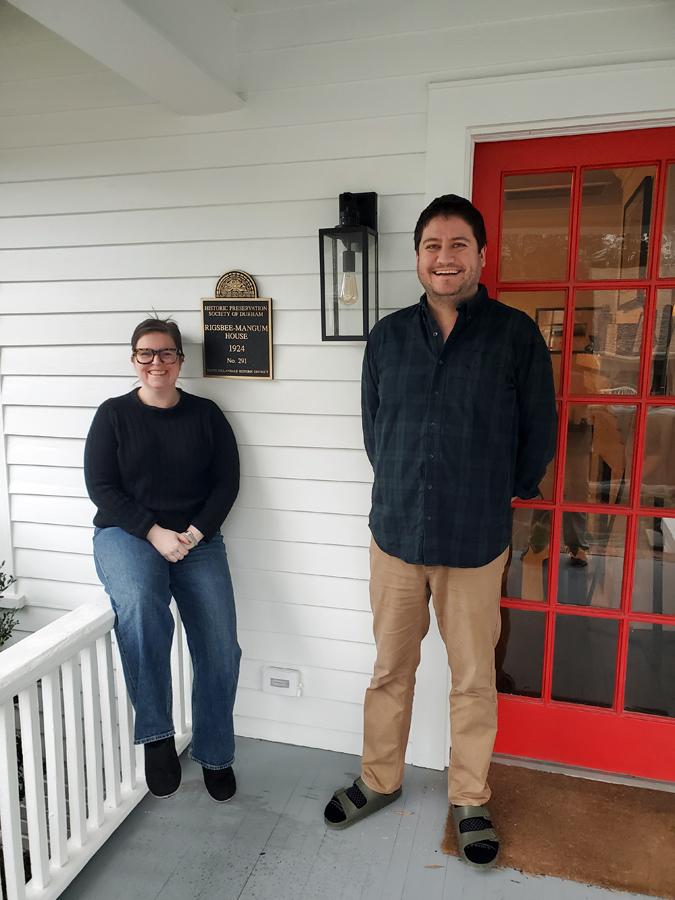
With the renovations completed, the house was sold on September 28, 2016 to Kyle and Sammar Simmons, both entrepreneurs. The Simmonses lived in the house until they sold it to the current occupants, Simon Miles and Susan Colbourn on January 7, 2020. Both are historians and professors at nearby Duke University. Miles and Colbourn embarked on a series of renovations to 2115 Englewood Avenue. First, in 2021, they converted the detached garage into a fully conditioned office building, with full bath, a storage room, and a metal awning. The garage-tooffice project was designed by Four Over One Design and executed by Zarazua Enterprises. Second, in 2023, the entire lot was re-landscaped with hardscaping design and execution by Environs Landscaping and plantings designed and selected by Silvia Miles (with assistance from the homeowners). A smaller third project, in 2024, executed by Zarazua Enterprises, replaced the two-over-two horizontally divided–lite windows installed as part of the Mangums’ addition decades earlier with four-over-one windows to match the rest on the house and appropriate for the design norms of a pre-war Durham bungalow.

Add new comment
Log in or register to post comments.