From the Stokesdale National Historic District Nomination:
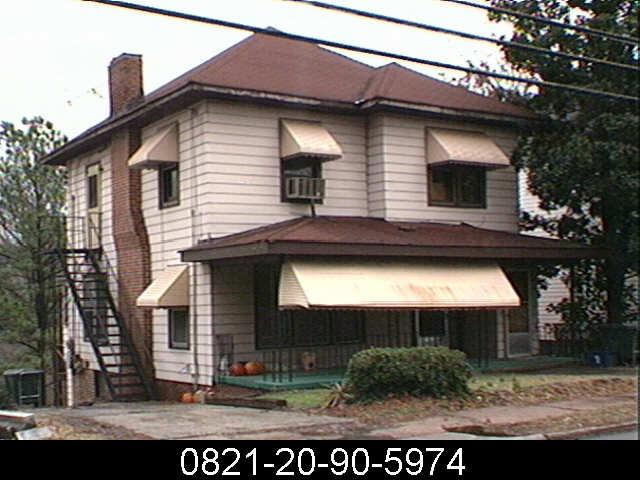
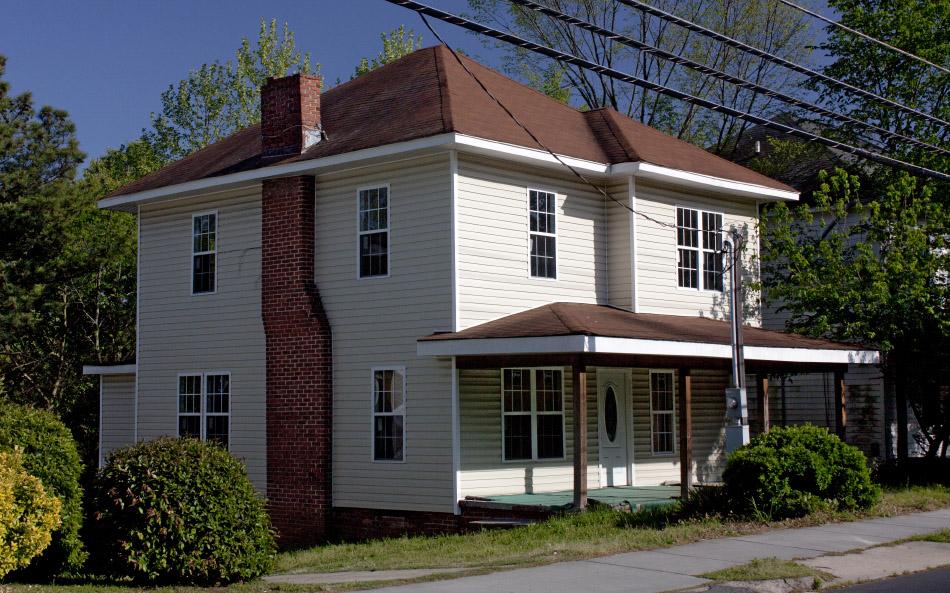
This two-story, hip-roofed house is three bays wide and double-pile with a one-story, hip-roofed rear ell. As of 2010, the house has been heavily renovated with a new brick foundation, vinyl siding, and replacement vinyl windows throughout. The replacement front porch is a hip-roofed porch on square timbers with a carpet-covered concrete floor. County tax records date the building to 1921; the earliest known occupant is Charles G. Davis (teacher, Hillside Park High School) in 1925.
04.08.12
Charles Gaston Davis and Lillian Jones Davis were the first long-term occupants to live in 1611 Fayetteville Street. Both Charles and Lillian were teachers.
Writer A.B. Caldwell produced seven volumes of “The History of the American Negro,” published between 1917 and 1923. He featured Charles Gaston Davis in the North Carolina Edition. In the brief outline of Davis’ life, Caldwell discussed Davis’ history of education, citing Davis as saying,
“In September 1899, I left home to enter school with $1.43. The distance by rail was a hundred miles. I borrowed $5.00 from my brother, who carried me to the station where I took the train for Greensboro. We reached the city about 12:30 P.M. and I was soon on the campus of the A & T College. Prof C. H. Moore was then bursar, and after paying him $3.00 for board, I had fifty cents left for my month’s laundry and no books. The next day I made my way to the mechanical building and found Prof. Snead, who was in charge of the blacksmithing department, and who wanted some mud plasted on the inside of the forges. Having finished this, I sought my next work with Mr. Rooks. The dairy cows had a disease known as foot rot. I managed to secure the job of washing the cows’ feet and earned enough money to pay my board. This being my first trip away from home I grew homesick and, in Feb., 1900, went home to see my people. On the first of the next February I returned to college to finish my work and remained till June. Realizing the disadvantages of doing so much hard work while trying to study, I decided to remain out of school one year and save money for the following year. I partially failed in this and, in 1903, returned to school, where I remained through four years of college work, winning the Odell medal given for the highest mark in mechanics for four years.”
Charles taught at numerous institutions, including Palmer Memorial Institute (1907-1909), the Berry O’Kelly Training School (1919), and Hillside High School. Notably, the Berry O’Kelly Training School was made up of three schools, which made it the largest high school for African Americans in North Carolina in 1931. Berry O’Kelly Training School was located in Method, North Carolina, right outside of Raleigh. Method was originally a Freedman’s village created in the 1870s, becoming a larger community throughout the twentieth century. The Berry O’Kelly Training School’s namesake was a local grocery store owner and notable Method resident who donated the land that would become the Berry O’Kelly Training School. Charles ran the agricultural and vocational training departments while at Berry O’Kelly High School.
Charles eventually taught at Hillside Park High School. He is listed as working at Hillside Park High School from 1922 until he died in 1931 in the Hill Directories. Lillian M. Davis taught dietetics at NC College for Negroes, the current-day North Carolina Central University. She was first listed as a dietician in the 1936-1937 Hill Directories and was listed as a teacher on her death certificate.
Charles and Lillian had one son together, Charles G. Davis Jr., who worked as a printer at the Carolina Times.
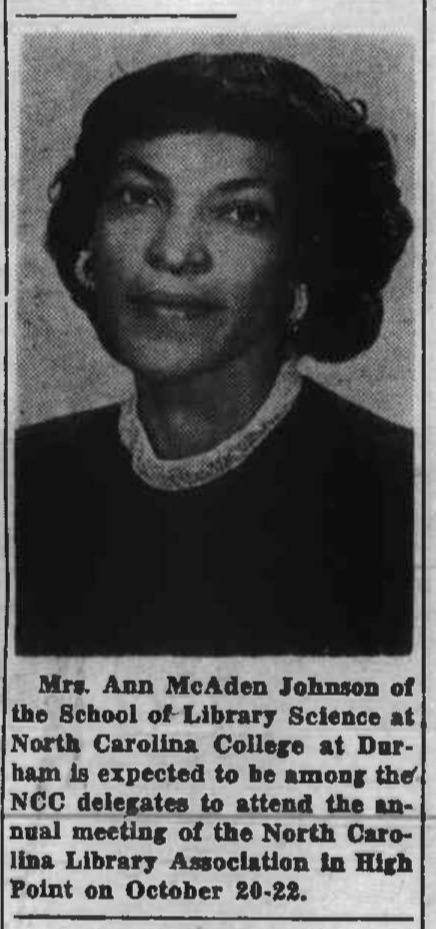
Marion S. Johnson lived in the home with his wife Ann E. McAden Johnson and their daughter Ruby from 1952 to 1954. Marion had a varied career, working as a teacher, principal, Boy Scout Executive, and administrator of the North Carolina College (now North Carolina Central University) alumni association. Marion and Ann eventually divorced, leaving Ann the sole owner of the home, which she continued to live in until her death in 1978.
Ann went on to marry Joseph Jenkins, making her Anne E McAden Jenkins. Ann taught library sciences at NCC, and was a student during the first library sciences class taught in 1941. She was the coordinator of the undergraduate library sciences program, president of the North Carolina Negro Library Association, and president of the program’s alumni association at NCC. She was honored numerous times for her work at NCC, including in 1971 in recognition of twenty-five years of service and two years later in 1973 for her retirement from the institution.
Ann’s husband, Joseph, was born and raised in Durham, North Carolina, and attended Durham City Public Schools, including Hillside High School. He went on to attend St. Augustine College in Raleigh. Joseph was also a World War II veteran and a bus operator for Duke Power Company for ten years.
Sources:
A.B. Caldwell, The History of the American Negro (A.B. Caldwell Publishing Company: Atlanta, Georgia) 1921.
Carolina Times
Herald-Sun
RHDC, “Berry O'Kelly School Campus,” Raleigh Historic, last accessed June 10, 2026, https://raleighhistoric.org/items/show/189.
RHDC, “Historic Method,” Raleigh Historic, last accessed June 10, 2026, https://raleighhistoric.org/tours/show/15.

Add new comment
Log in or register to post comments.