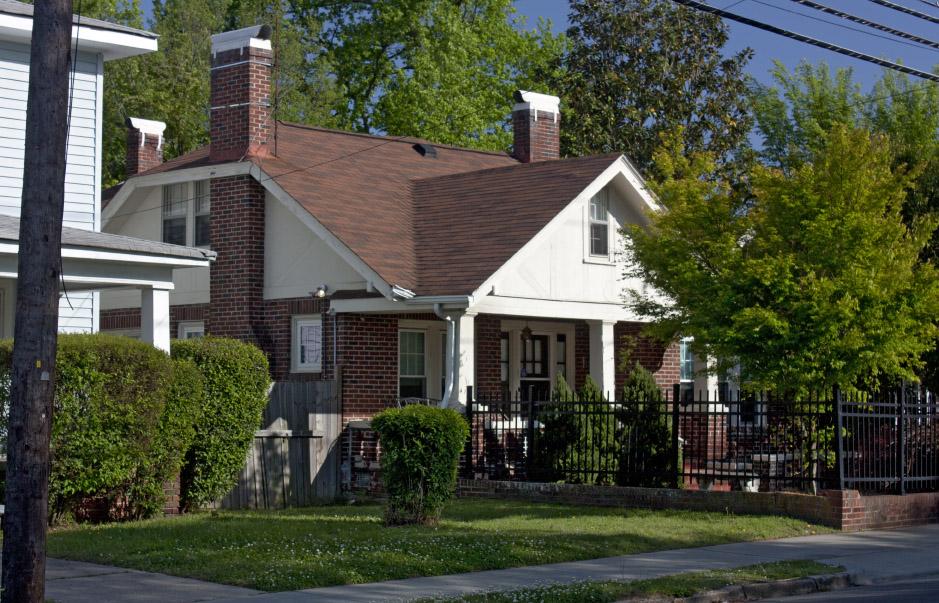
Photograph of the 1603 Fayetteville Street home - April 8, 2012.
The Williams family owned and lived in 1603 Fayetteville Street from when the home was constructed. Matthew Dean Williams, born on December 20, 1894, worked for the City of Durham’s street department and later went on to serve in the US Army. On April 29, 1918, he married Addie Hayes Williams. Together, they had two sons, Leon and Harvey Williams. Matthew died on August 8, 1960, and Addie died on October 2, 1983.
Their older son, Leon P Williams, was born September 2, 1922. He graduated from Hillside High School in 1937, then attended North Carolina Central University ("NCCU," known then as the North Carolina College for Negroes). He double-majored in chemistry and biology and double-minored in math and physics at NCCU, graduating with a Bachelor of Science degree. Leon got his master's degree from East Carolina University, then began his teaching career. In 1942, he followed in his father's footsteps and joined the US Army, serving in World War II. He returned to his career in education after his time in the military, working as a teacher and assistant principal at numerous Durham County schools. He was honored as the “North Carolina State Teacher of the Year” in 1942, and retired in 1983 after 40 years of dedicated service. He would continue to live at 1603 Fayetteville until his death on March 15, 2009.
Matthew’s younger son, Harvey Williams Sr., was born on July 30, 1930, and lived in the house during his youth. He graduated from Hillside High School in 1946. He and his wife, Mary E. Glenn, had five children. Harvey also followed in his father’s footsteps by joining the military, where he retired as Major General in 1982. After serving in the armed services, he worked in IT for a nonprofit organization that provided IT services to diverse communities.
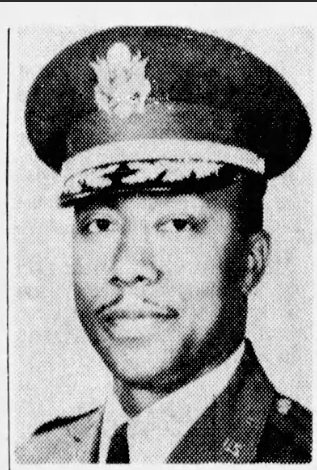
A portrait photo of Harvey Williams, Sr., taken after he was promoted to lieutenant colonel in the U.S. Army (The Herald Sun) - September 13, 1966.
Harvey led a distinguished military career that lasted until his retirement as Major General in 1982. During his time in the armed services, Major General Williams was the first African American post commander at Fort Meyer and the first Black Army officer selected to attend the senior course at Naval War College. He even broke ground as a Black Army officer instructor at an Ivy League institution. Overall, Harvey served in several roles, including deputy commanding general of the Military District of Washington and the First Army, commander of the VII Corps Artillery, and assistant chief of staff for Intelligence as chief of the security division for the Department of the Army. Major General Williams was highly decorated for his military accomplishments, earning four Army Commendation Medals, two Bronze Star Medals, five Air Medals, the Legion of Merit, and the Cross of Gallantry with Silver Star from the Vietnamese Government.
Harvey also protested racial injustice while serving in the Army. As commander of the VII Corps Artillery, he brought to light the racist treatment he faced while stationed in Germany. After an incident where a discotheque turned Major General Williams away due to his race, he called out discriminatory practices by German businesses, where they would often refuse service to other American soldiers, primarily Black soldiers. His activism in Germany led the then-mayor of Augsburg, Hans Breuer, to speak out and create policies to prohibit these discriminatory business practices.
As of 2026, the home is in good, stable condition.
Sources:
“Armed Forces,” Jet, June 29, 1978, https://books.google.com/books?id=AsADAAAAMBAJ&pg=PA27#v=onepage&q&f=false.
Carolina Times
Herald-Sun
Jim Dresbach, “Fort Meyer commander still considers post home,” U.S. Army, February 15, 2012, https://www.army.mil/article/73741/first_african_american_fort_myer_commander_still_considers_post_home.
Kane Republican
From the 2010 National Register of Historic Places application for Stokesdale:
This one-story, clipped-side-gabled house is three bays wide and double-pile with a projecting gabled bay on the right end of the façade. The projecting front-gabled porch on the left end of the façade is supported by tapered wood posts on brick piers with a brick balustrade between the piers and an original four-over-four, double-hung wood window in the gable. The house has a continuous brick foundation and veneer with exposed timbering and stucco in the gables. It has a two-story gabled rear ell on the southeast corner and a shed-roofed block with bay window north of the ell. There is an interior brick chimney in the ridgeline and an exterior brick chimney in the north gable end. It has vinyl windows throughout, but retains an original twelve-light-over-one-panel front door with four-light-over-one-panel sidelights. Other details include purlins in the gables and a terra cotta terrace with brick balustrade to the south of the front porch. A modern brick retaining wall with metal fence extends across the front of the property. County tax records date the building to 1935; the earliest known occupant is Matthew D. Williams (clerk, Durham Fish & Produce Company) in 1940.

Add new comment
Log in or register to post comments.