Preserve Durham's History with a Donation to Open Durham Today!
OpenDurham.org is dedicated to preserving and sharing the rich history of our community. Run by our parent nonprofit, Preservation Durham, the site requires routine maintenance and upgrades. We do not ask for support often (and you can check the box to "hide this message" in the future), but today, we're asking you to chip in with a donation toward annual maintenance of the site. Your support allows us to maintain this valuable resource, expand our archives, and keep the history of Durham accessible to everyone.
Every contribution, big or small, makes a difference and makes you a member of Preservation Durham. Help us keep Durham's history alive for future generations.
Isaac O. and Annie Alston were the first owners of 1509 Fayetteville. Their only son, Lathrop Alston, lived in the home with them until 1936. The home had nine bedrooms that they used as a boarding house, which Annie ran. Elizabeth Jackson, a nurse for the North Carolina Mutual Life Company, was one of their long-term renters.
Annie Rogers Alston was born and raised in Durham. She attended St. Joseph’s A.M.E. Church from a young age and continued to attend the church until her death. She was very active in the church, notably as the president of the Pastor’s Aid Club.
Isaac Oscar Alston was born in Chatham County, North Carolina, and eventually moved to Durham, where he married Annie in 1901. Isaac worked as a laborer at Liggett and Meyers Tobacco Company for 35 years. They lived at 1509 Fayetteville from 1922 to 1941. They moved to 1410 Fayetteville c. 1945, where they lived until their respective deaths.
Lathrop lived in the home while he completed his degree at North Carolina College (now North Carolina Central University) and began his career as a music promoter. During his time at North Carolina College, he played football, baseball, and basketball. After graduating, he played baseball for a local team, the Allen Red Caps.
He first started promoting for the Royal Knights Hall while attending North Carolina College. He would then start working for the Biltmore Hotel after he graduated. The Biltmore Hotel was a notable hotel for Black residents that hosted some of the most influential Black artists in the twentieth century. During the Bilmore Hotel’s heyday, Lathrop was critical in attracting numerous famous musicians to perform in Durham, including Cab Calloway, Duke Ellington, Sister Rosetta Tharpe, and many others.
The hotel, located at 322 Pettigrew, caught fire in 1977, a month after it had closed.
Alston was the manager from 1925 until he closed the establishment in 1977, which he attributed to issues of redevelopment and integration. As a designated hotel for African-Americans, many former guests stayed at other, previously white-owned hotels with upgraded features, leading to a significant drop in occupancy. He also attributed raising musicians’ rates to declining business.
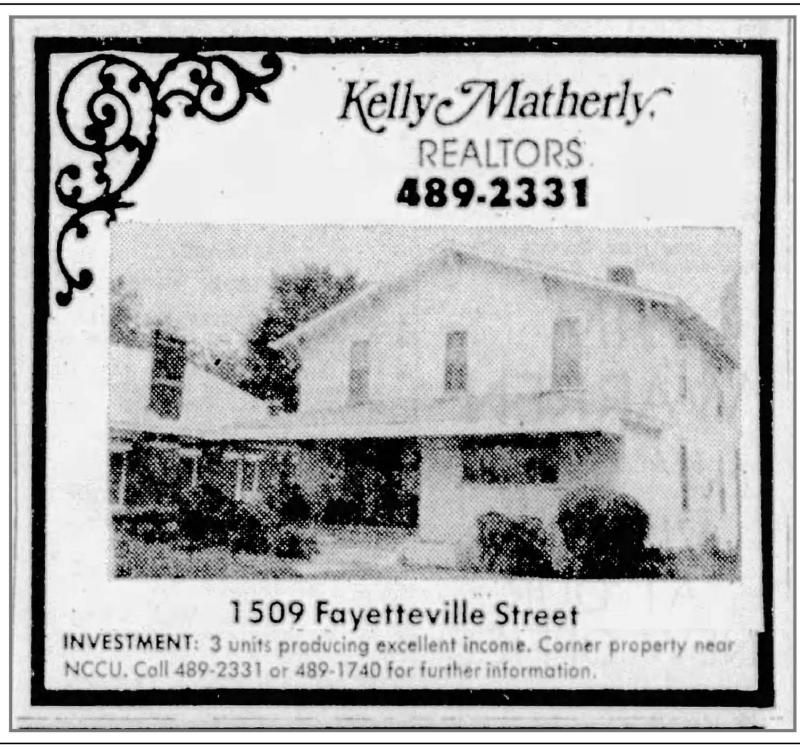
After the Alstons moved out of 1509 Fayetteville in the 1940s, the home became solely a rental property. The original nine homes in the house were offered for rent. In 1959, the home was converted into a three-family apartment. In the 1960s, Durham Business College leased the home to use for student housing to address dormitory shortages while they were undergoing renovations.
The home was embroiled in scandal in 1942, when renter Ella Edwards ran sex work services out of the home. Edwards had used the house as a “tourist home,” with food and board. She was arrested in 1942 and charged in 1943, consequently ending the “tourist home.”
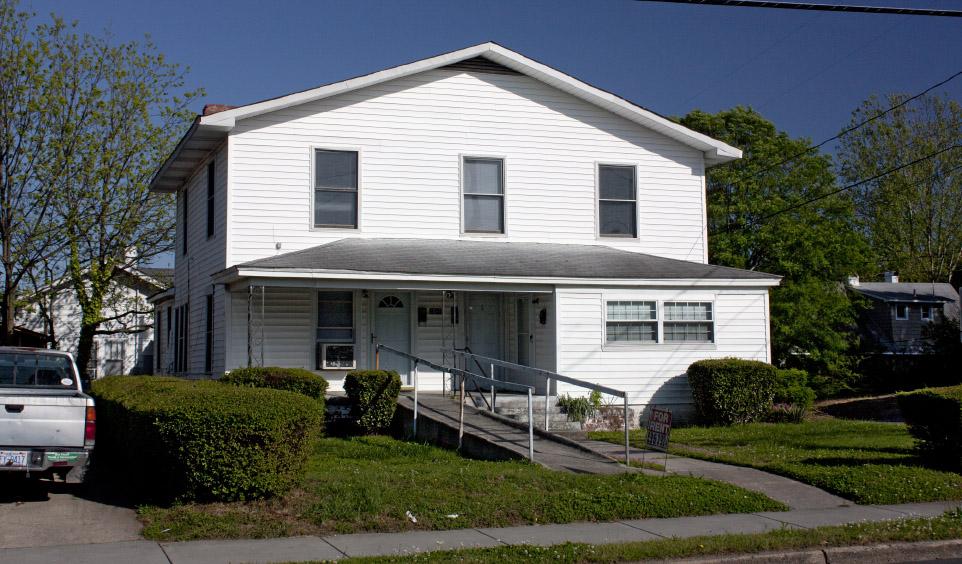
As of 2026, the building is in good, stable condition.
1509 Fayetteville- 1977
From Stokesdale National Historic District Nomination:
This two-story, front-gabled house is three bays wide and double-pile with a gabled rear ell on the southeast corner and an interior brick chimney. The house has been significantly altered with the installation of a concrete-block foundation, and vinyl siding and windows. It has a low-sloped, front-gabled roof and a hip-roofed, partially enclosed front porch on decorative metal posts. It appears to be three units. County tax records date the house to 1920; the earliest known occupant is Isaac Alston (laborer) in 1925.

Add new comment
Log in or register to post comments.