Preserve Durham's History with a Donation to Open Durham Today!
OpenDurham.org is dedicated to preserving and sharing the rich history of our community. Run by our parent nonprofit, Preservation Durham, the site requires routine maintenance and upgrades. We do not ask for support often (and you can check the box to "hide this message" in the future), but today, we're asking you to chip in with a donation toward annual maintenance of the site. Your support allows us to maintain this valuable resource, expand our archives, and keep the history of Durham accessible to everyone.
Every contribution, big or small, makes a difference and makes you a member of Preservation Durham. Help us keep Durham's history alive for future generations.
(Below in italics is from the 2005 National Register listing; not verified for accuracy by this author.)
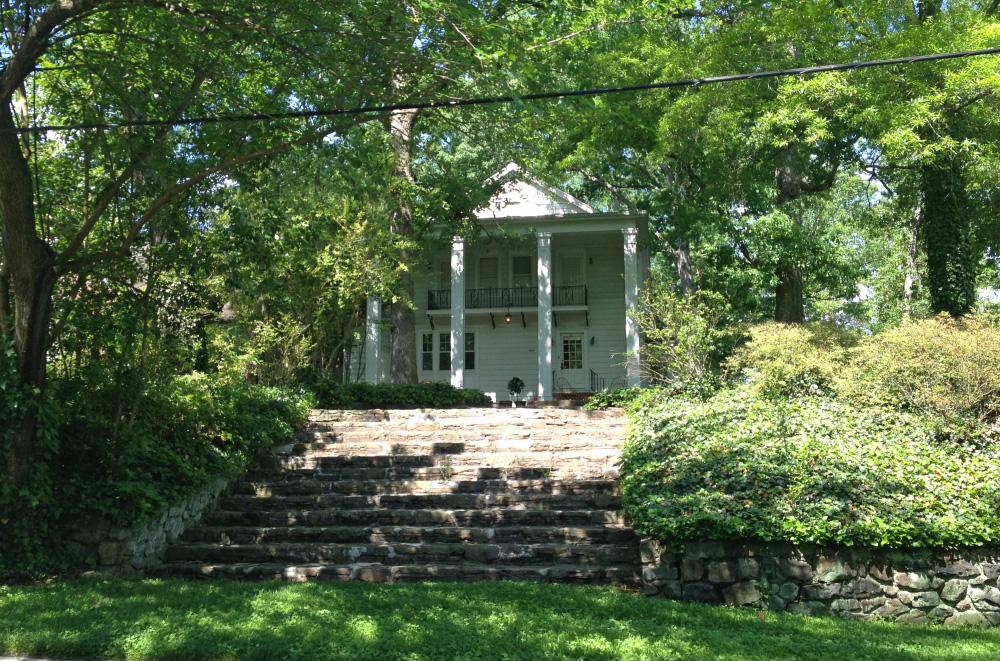
Otto W. Moss House. 2-story front-gabled Colonial Revival-style house with weatherboard, 6-over-1 sash windows, and a full portico with paneled posts and a balcony with cast-iron brackets and railing. A French door opens onto the portico. Beside the door are a triple set of 4-over-4 sash windows with paneled aprons. The north side elevation, facing Wells St., has another entrance with sidelights and a gabled entrance porch with columns. A pent roof runs along this elevation. A fieldstone retaining wall and wide stone steps lines the Arnette Avenue frontage. Otto W. Moss, president of Moss’s Bakery, was the owner-occupant in 1935.
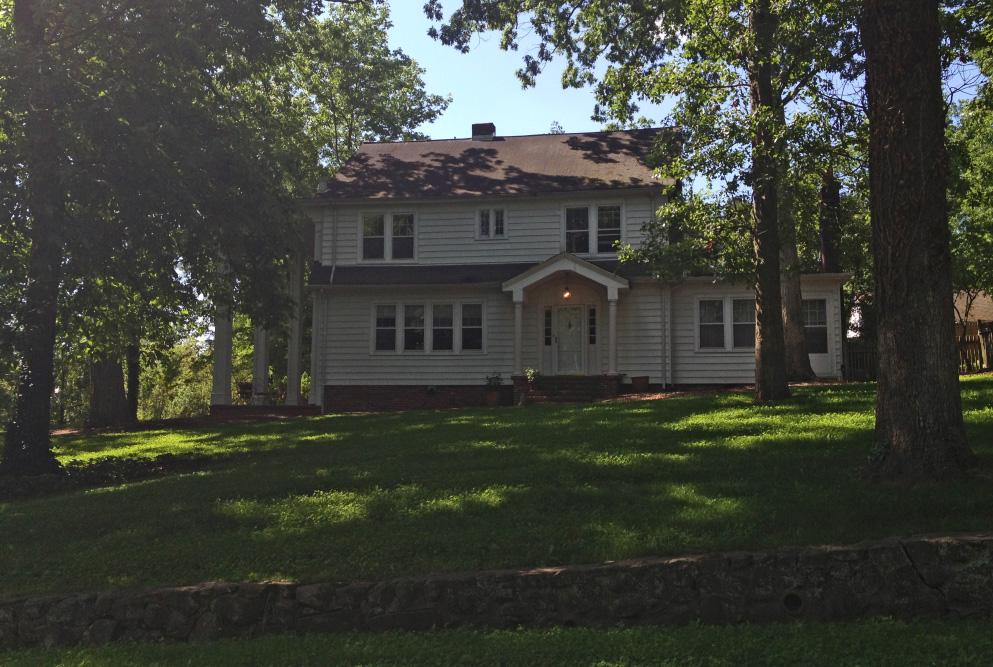
05.12.13 - from Wells Street. (Photo by Gary Kueber)
From the Preservation Durham Plaque Application (below in italics):
The home is situated on a corner lot and has two distinct entries. The north elevation of the home, which faces Wells Avenue, resembles a Dutch Colonial. The entry porch on the north elevation is typical of the Colonial Revival homes of this period. A gambrel roof runs along the north elevation. The front entry is off-center and supported by two slender pillars. The door is framed by sidelights with fanning over the door. The windows are double-hung sashes with multipane glazes. The east elevation, which faces Arnette Avenue, resembles a neoclassical style with a full-height porch and plain, unfluted columns. A small balcony sits over the entry enclosed by a plain ironwork railing. The doors and hardware of the second-floor façade facing east match the hardware and doors of the remainder of the house, which indicates that the east-facing façade was part of the original design of the home. Aerial photographs from 1950-1972 show a semi-circular driveway on the Wells Ave side of the home. The driveway was either buried or removed sometime after 1972.
A “cabin” was at one point situated near the rear of the property, which housed Mr. Moss’s large model train set. It is unclear if and when the cabin was removed. A permit to modify the existing structure with additional plumbing and electrical to add kitchen facilities to a two-room apartment in the house was issued in 1951. There is a separate entrance on the Wells Street side of the home, and the hardware and style match much of the remaining interior doors, so it is most likely original. The apartment was most likely in the rooms directly to the right of the Wells Street main entry, which now contain a bathroom, a fireplace, and a small sitting/office space.
William Otto Moss, known as W. Otto Moss, or Otto Moss was born on June 24, 1888 in Resaca, Georgia. Moss moved to Durham from High Point, North Carolina with his wife and child in 1929, and opened the City Baking Company, later known as Moss’ Bakery. Otto Moss began his career in the baking industry in High Point, North Carolina. Moss’ Bakery was a commercial bakery located at 505 - 509 E Peabody St.
Bell Bakeries of Delaware purchased Moss’ Bakery in 1944. Moss cited his desire for him and his wife to retire and include more time to support the war effort as reasons for the sale of the bakery. Moss’ Bakery was a significant employer of Durham residents and included an integrated workforce. The announcement of the sale of the bakery to an out-of-state company was cause for concern, however, Moss assured the city that the Bell Bakeries would continue to be locally managed, and he and his wife could continue to own the property, as it was only the business operations that were sold to Bell Bakeries. Bell Bakeries leased the bakery equipment buildings from the Moss’s.
Moss’s contribution to the city also included his participation in the civic and religious life of Durham. Moss was a member and held leadership positions in a number of men’s civic organizations including, the Monarch Club, the Shriners Club, the Elks Lodge, the Rotary Club the Durham Civitan Club, and the Inter-Club council of Durham. In religious matters, in 1938, Moss was the publicity chairman of a large six-week tabernacle revival located in the parking lot of the Durham Hosiery Mill. Mayor William Carr and other city dignitaries attended the opening ceremonies of the Stephens-Storrs-Mcguill. The men’s organizations promoted civic engagement, through hosting spelling bees, parades, dances, and fundraisers for various charity organizations.
In addition to his civic and religious organization work, Moss, also engaged in personal interests. Moss, was an avid photographer, videographer, and model railroad hobbyist. As a sponsor of the 1941 Durham Herald-Sun Soapbox Derby, Moss accompanied James Beaman, the winner of the local tournament to the national tournament in Akron, Ohio. While eliminated in the second round, Moss captured Beaman first round race and commented that even in defeat, that the derby “[taught] youth the lessons in sportsmanship and fair play and in stimulating imagination and determination.” Upon Moss’s return, Moss screened his “technicolor moving picture” to the Durham Civitan Club. One of Moss’s other interests was as a model railroad hobbyist. Featured in the Durham Herald-Sun, Moss was pictured at the controls of his large 41-car, 296-foot model set equipped with 20 automatic switches, miniature homes, outbuildings, and telephone polls. The model railroad was the largest in the city and housed in the “cabin” on the Arnette Ave property.
Moss’s civic involvement extended beyond religious and civic organizations and across racial lines. In 1941, Moss entered the primary race to represent the fourth ward of the Durham City Council. Elected on May 6th, Moss won the primary race against R.S. Slattery. Moss served as a city council member, representative of ward four, and later as an alderman at large from 1941 – 1949. Moss lost his final election to E. R. Williamson with the backing of “Voters for a better government,” a pro-labor organization. In Moss’ first run for city council, the “Colored Friends” placed large advertisements in support of Moss’s candidacy in the Carolina Times, a weekly African American newspaper. One advertisement included large photographs of Moss and was close to a quarter of the newspaper page. Other advertisements simply included Moss’s name, but were just as large. The owner of the Carolina Times, Louis Austin, advocated for the full participation of African Americans in American life, without restrictions. Moss’s political advertisements in the Carolina Times, were a powerful statement to the voting population of Durham. The description of Moss’s political appeal to Black voters by the Carolina Times included his role as employer and his general attitude: “[Moss] is well known among the colored element of the city, having gained many acquaintances among them through the large number of Negros employed in his baking establishment and through his unusually friendly attitude." The Carolina Times went further to describe Moss, “[Moss] is considered a friend of the masses and will easily walk off with lion's share of the Negro vote.” Moss won the election by five hundred votes. The E. Durham/Southside precinct, predominantly made up of African-American voters, garnered the largest number of votes at 254.9. Moss’s political advertising in white-owned newspapers was more frequent, but less prominent than in the Carolina Times. The daily newspapers, Durham Sun and the Durham Morning Herald carried advertisements for Moss which included a photo and an appeal to vote, but were usually a quarter of column of an eight-column page.
In an effort to bolster his chances for his initial election, Moss also distributed coupons for free loaves of bread. Moss was careful not to mention his candidacy for city council on the coupons, however, the free bread may have influenced election outcomes. Two years after his initial election, Moss’ Bakery continued to honor coupons distributed. As a city councilman, Moss went to extraordinary lengths to assist his constituents. Deployed in Germany, private Raymond T. Hardison wrote to Moss in March of 1945, and enclosed $25. Hardison requested Moss purchase a cake for his wife on her birthday. Moss purchased a cake for $5 and with the remainder of the funds purchased an assortment of other gifts. Mrs. Hardison expressed her gratitude toward Moss and stated that through his efforts, Moss “[brought] her husband close to home again.”
During his tenure as a city councilman, Moss was the selected representative on the board of Watts Hospital. As a city council member, Moss was involved in debating many issues that affected the daily lives of Durham residents. A few issues of note were alcohol sales on city-owned property, housing conditions, the consolidation of the city and county government, parking meters on city streets, the Creedmoor water crisis, and the construction of the Highway 70 bypass in Northern Durham.
Moss supported the national challenges of fundraising for the war effort during the Second World War as a private individual, civic club member, and business owner. As a member of the Monarch Club, Moss, along with his club members in the spring of 1943, purchased war bonds in an effort to ‘buy a bomber” to raise over 3 million dollars. Moss also contributed $500 to a hosiery-war bond in September 1943. In February of 1944, the Durham Sun featured Moss in one of his most unusual fund-raising efforts. Photographed in bed in Watts Hospital, holding a telephone receiver and flanked by two Women’s Army Corp members, Moss participated in an auction to support war bonds. The item Moss bid on via telephone was kisses by two local Women’s Army Corp local recruiters. Moss won the auction with a bid of $5000. As a business owner, Moss modified his business practices to support the war effort. In June of 1942, the federal government required commercial wholesale vehicles to reduce mileage by 25 percent. To meet this requirement, Moss turned to an older method of bakery deliveries. Before the introduction of commercial vehicles, Moss commented that he was able to traverse the same amount of area in a day that a commercial vehicle could cover in 1942. Moss purchased three horses and wagons to deliver bakery products in Durham County.
In his final years, Moss was in and out of Watts Hospital for a variety of medical conditions. While hospitalized, Moss was unable to continue his city council work and requested leave from his city council responsibilities. Moss died in Watts Hospital on February 4, 1951. Three days later, the city council issued a resolution honoring Moss' religious, civic, and government work and noted that his dedication to these causes at times “jeopardized his physical health and wellbeing.” Moss is buried in Maplewood Cemetery.
Ruby Gladys Rowe Moss, also known as Gladys, was born in Sugar Valley, Georgia on October 10, 1894. Rowe married William Otto Moss on April 11, 1915, in Sugar Valley, Georgia. By 1920, the Mosses moved to Hamilton, Tennessee. In 1929, she had her husband, W. Otto Moss, moved to Durham, North Carolina, and opened City Bakery, later known as Moss’ Bakery. Mrs. Moss was the secretary-treasurer of the bakery from its incorporation until its sale to Bell Bakeries in 1944. Unlike many of her contemporaries, Mrs. Moss was employed for much of her adult life. She spent 15 years as the secretary/treasurer of Moss’ Bakery. While maintaining the finances for Moss’ Bakery, Mrs. Moss was also an active participant in religious and social life in Durham. Mrs. Moss was an active member of the King's Daughters organization from when she arrived in Durham in 1929 until her death. Mrs. Moss frequently attended circle meetings and often hosted circle meetings at her home. As a King's Daughter, Mrs. Moss was a co-chairman of circle 12, chairman of the membership committee, and a member of the transportation, hostess, and telephone committees. In addition to her hosting duties as a Kings Daughter, Mrs. Moss was an active member of the First Baptist Church, often hosting events at her home. On the afternoon of March 18, 1947, Mrs. Moss hosted a costume party for the Nellie Childs Bible Class of the First Baptist Church 45 members in the “playroom” of 1400 Arnette Ave. Much like her husband, Mrs. Moss was also active supporting the war effort during World War II. Mrs. Moss volunteered at the USO club on Dillard Street as a hostess at various parties and events. Mrs. Moss was also active in the Durham Woman’s Club, using her skills from her days as the secretary-treasurer of Moss’ Bakery to handle the funds of the organization. Following the death of her husband in 1951, Mrs. Moss petitioned the city board of adjustment to allow modifications to her home. Mrs. Moss requested plumbing and electrical modifications be allowed and to install a small kitchen facility. In the petition, Mrs. Moss stated she felt unsafe at home since the death of her husband and wanted the added security of a couple living in the home, but with separate kitchen facilities of their own. The board approved the request as the request did not include separate entrances to the home. Mrs. Moss continued to live in her home until sometime in 1977, when due to her ill health she moved to a nursing home. Mrs. Moss died on July 20, 1977, and is buried in Maplewood Cemetery.
Frances Moss Jarman, born December 15, 1915, was the oldest of the Moss’s daughters. As a child and as an adult, Frances was an avid piano player. Frances was a graduate of Durham Public Schools and took a course on art history at UNC Chapel Hill. Frances married John Frank Jarman Jr. on May 15, 1937 at Durham’s First Baptist Church. The wedding reception was held at the Mosses’ home at 1400 Arnette Avenue. Frances and Frank Jarman made their home in Durham, North Carolina, where Frank was the station manager for the local radio station. Frances continued to work with her mother, hosting activities with the King's Daughters, and was an active member of the First Baptist Church. After a few years in an apartment, the Jarman’s made their home in Durham at 2610 Stewart Drive. Frances died on April 8, 1987, and is buried in Maplewood Cemetery.
Marian Moss Martin was born on September 4, 1929, in Durham, North Carolina. Marian, like her sister, was musically inclined and often played the accordion at various venues around Durham. Marian was a graduate of Durham Public Schools and attended the University of North Carolina at Greensboro and majored in music. Marian married John Lawrence Martin on September 5, 1947, in the living room of her childhood home, 1400 Arnette Avenue. The main fireplace was decorated with flowers and used as the altar. The reception was also held at the house. Marian and her family lived in Georgia, South Carolina, and eventually settled in Charlotte, North Carolina. Marian died on March 22, 2012 and is buried in Charlotte.
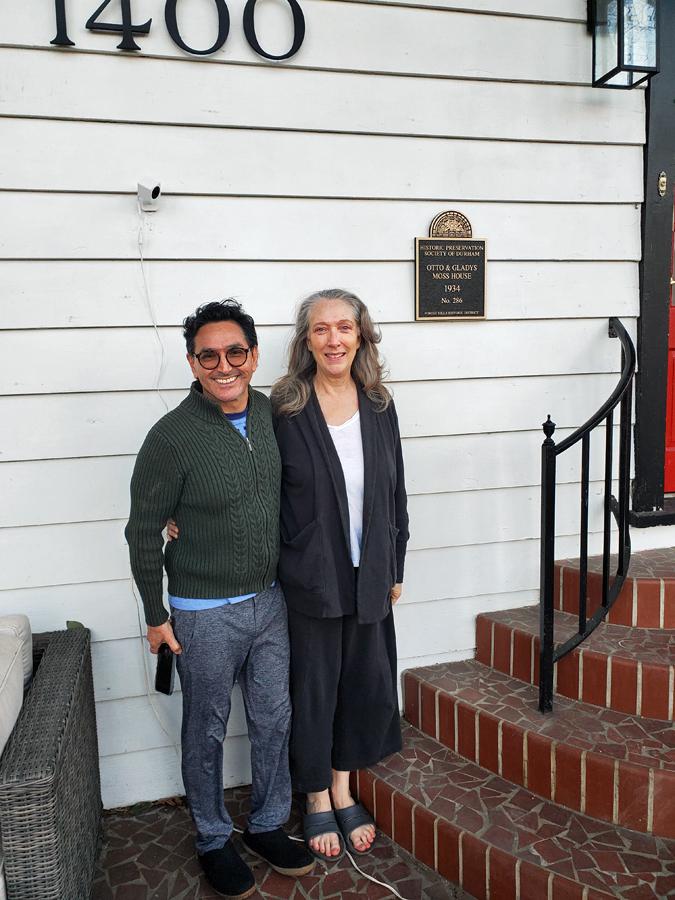
Preservation Durham Plaque #286
Comments
Submitted by Joe (not verified) on Wed, 5/22/2013 - 10:50am
This is one of my favorites in FH in part because it's almost like two houses in 1. Do we know if both facades are original? I've always imagined the Arnette-facing colonial facade was added.

Comments
Submitted by Joe (not verified) on Wed, 5/22/2013 - 10:50am
This is one of my favorites in FH in part because it's almost like two houses in 1. Do we know if both facades are original? I've always imagined the Arnette-facing colonial facade was added.
Add new comment
Log in or register to post comments.