1224 Fayetteville was originally built as a real estate development for local icon, John Merrick. Merrick was born into slavery, and in his early career worked as a brick mason and barber. He would make a name for himself, as he eventually ran multiple barber shops, demonstrating a prowess for business. With the help of Charles Spaulding and Aaron McDuffie Moore, Merrick began the North Carolina Mutual Life Company, which at one point was the biggest Black-owned business in the United States.
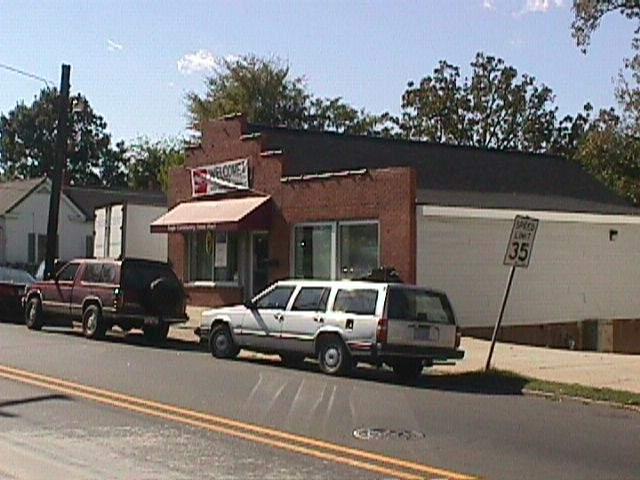
1224 Fayetteville was built towards the end of Merrick’s life, in 1912, and was likely intentionally built as a rentable space for local businesses, as it would go on to become. Merrick was very involved in buying real estate in Durham to then rent out. Interestingly, 1224 Fayetteville it had a long history with barbershops, including College Barber Shop and Powell’s Barber Shop, a connection that harkens to John Merrick’s original occupation. The property would stay in the Merrick family until 2004, but remained, and continues to be, a rental property.
Throughout its over 100-year history, 1224 has been home to 10+ businesses, including grocery stores, barbershops, repair stores, and more. The first and longest tenant was William E. Waller Meats. William Edward “Buck” Waller rented out the property for his butcher store from 1912 until he passed away in 1942. Waller’s daughter, Heavenly Light, also worked at 1224 Fayetteville as a laundry worker.
One of the early tenants was the College Barber Shop, which promoted, “...the shop will employ only experienced barbers and will only have modern and sanitary equipment…” The same article also acknowledges the central location of this barber shop, nearby to Lincoln Hospital and North Carolina College, which had previously lacked a local barber shop at the time. Robert B. Stewart and J.R. Torain ran College Barber Shop.
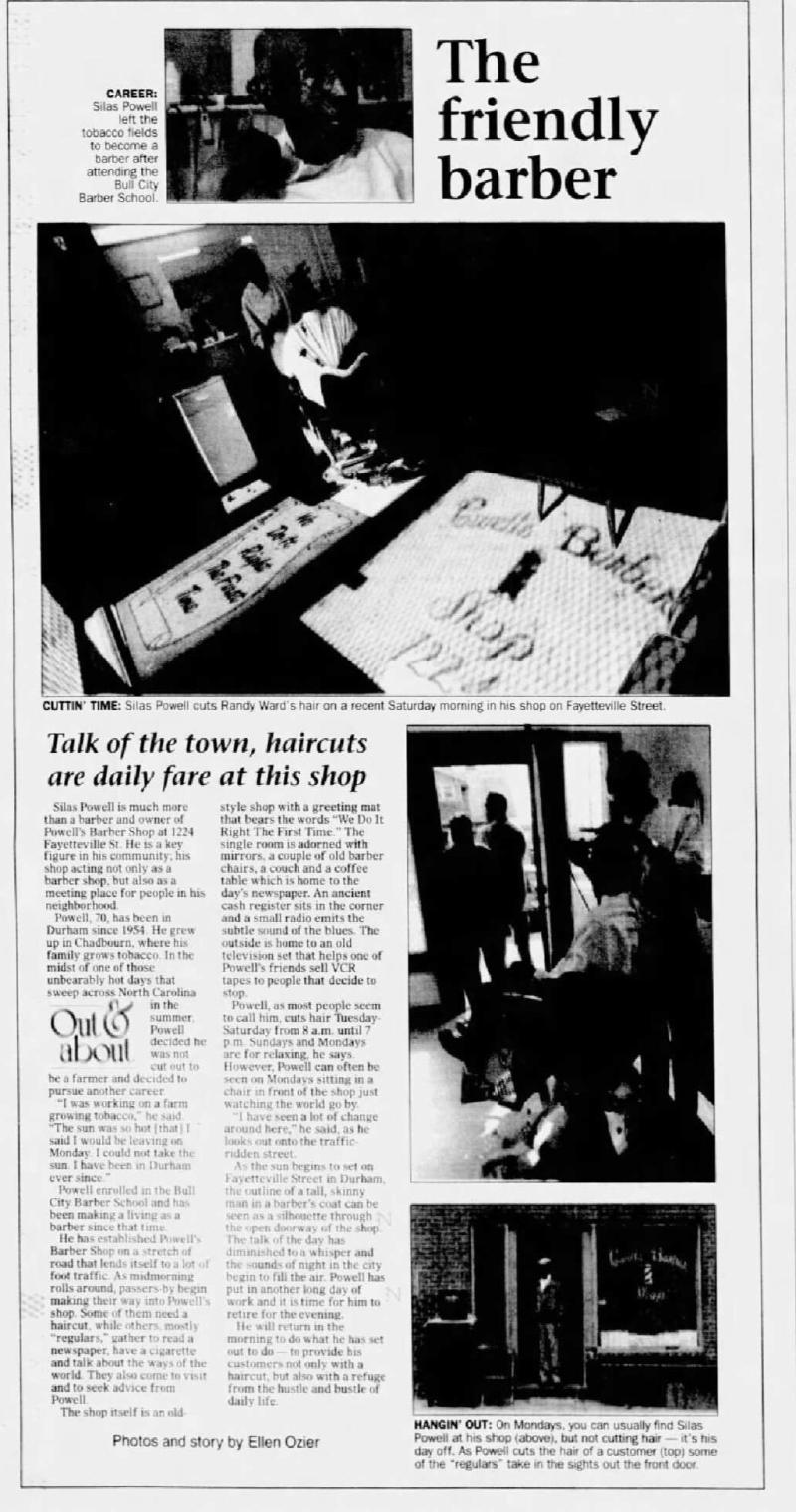
Another barber shop ran out of 1224 Fayetteville for over 20 years. Powell’s Barber Shop, run by Silas Powell, was a central meeting place for community members along Fayetteville St. Powell grew up with his family growing tobacco, and moved to Durham to start a new life. He attended Bull City Barber School in Durham and began his own business. Powell’s Barber Shop was a hub for community gathering, not only as a barber shop, but also as a central place where people could meet and talk with each other about everyday life. In an article about Powell’s Barber Shop, Powell is quoted “I have seen a lot of change around here,” regarding changes to the Fayetteville Street community. Powell ran his business out of 1224 Fayetteville up until the late 1990s.
Union Electric Company also operated out of 1224 Fayetteville for a time. The Union Electric Company often promoted their company with the grand openings of new businesses/companies that they wired, including the 112 W Parrish St location of the Mutual Building and Loan Association and Frazier’s Luncheonette.
As of 2026, Big Lex Bodega operates out of 1224 Fayetteville.
Sources:
Carolina Times
Herald-Sun
Robert McCants Andrews, John Merrick: A Biographical Sketch (North Carolina: University of North Carolina at Chapel Hill, 2002), https://docsouth.unc.edu/nc/andrews/andrews.html
“William Edward “Buck” Waller,” Find A Grave, last accessed January 13, 2026. https://www.findagrave.com/memorial/47024927/willie-edward-waller?_gl=1*exiodr*_gcl_aw*R0NMLjE3NjI3ODc5NDIuQ2p3S0NBaUF0OGJJQmhCcEVpd0F6SDF3NmJjRFlYY3drQjJZak50b3htWmxEUGd6cjE0MDBkOHNRUjFTNXN0bkRaazhtRFNWVi12aWxob0NBeDRRQXZEX0J3RQ..*_gcl_dc*R0NMLjE3NjI3ODc5NDIuQ2p3S0NBaUF0OGJJQmhCcEVpd0F6SDF3NmJjRFlYY3drQjJZak50b3htWmxEUGd6cjE0MDBkOHNRUjFTNXN0bkRaazhtRFNWVi12aWxob0NBeDRRQXZEX0J3RQ..*_gcl_au*MTEzNjM3NDg5LjE3NjE5Mzg3NTE.*_ga*MTI1NjEwNTgwNC4xNzUzNzIwMDA4*_ga_4QT8FMEX30*czZiNTZlYzIzLTkzYWUtNGY5Mi1hMDY2LTRhZDQ0YTZhYTY1ZSRvNDAkZzEkdDE3NjgzMTQ5MTckajckbDAkaDA.*_ga_LMK6K2LSJH*czZiNTZlYzIzLTkzYWUtNGY5Mi1hMDY2LTRhZDQ0YTZhYTY1ZSRvNDAkZzEkdDE3NjgzMTQ5MTckajckbDAkaDA.
From Stokesdale National Historic District Nomination:
This one-story commercial structure is two-bays wide, with a gabled roof on the southern bay and a flat roof on the northern bay. Both roofs are concealed behind a stepped parapet with terra cotta coping. The building has a brick façade (possibly a later addition), a brick-pier foundation with concrete-block curtain wall and vinyl siding on the north and south elevations. The southern bay has an aluminum storefront with recessed metal-framed glass door. The northern bay has a pair of large picture windows in an aluminum frame. The building appears on the 1913 Sanborn map. It was listed as vacant in the 1920 city directory; the Busy Bee Pressing Club and William E. Waller meats were listed at this address in 1925. It is currently the Eagle Community Food Mart.

Add new comment
Log in or register to post comments.