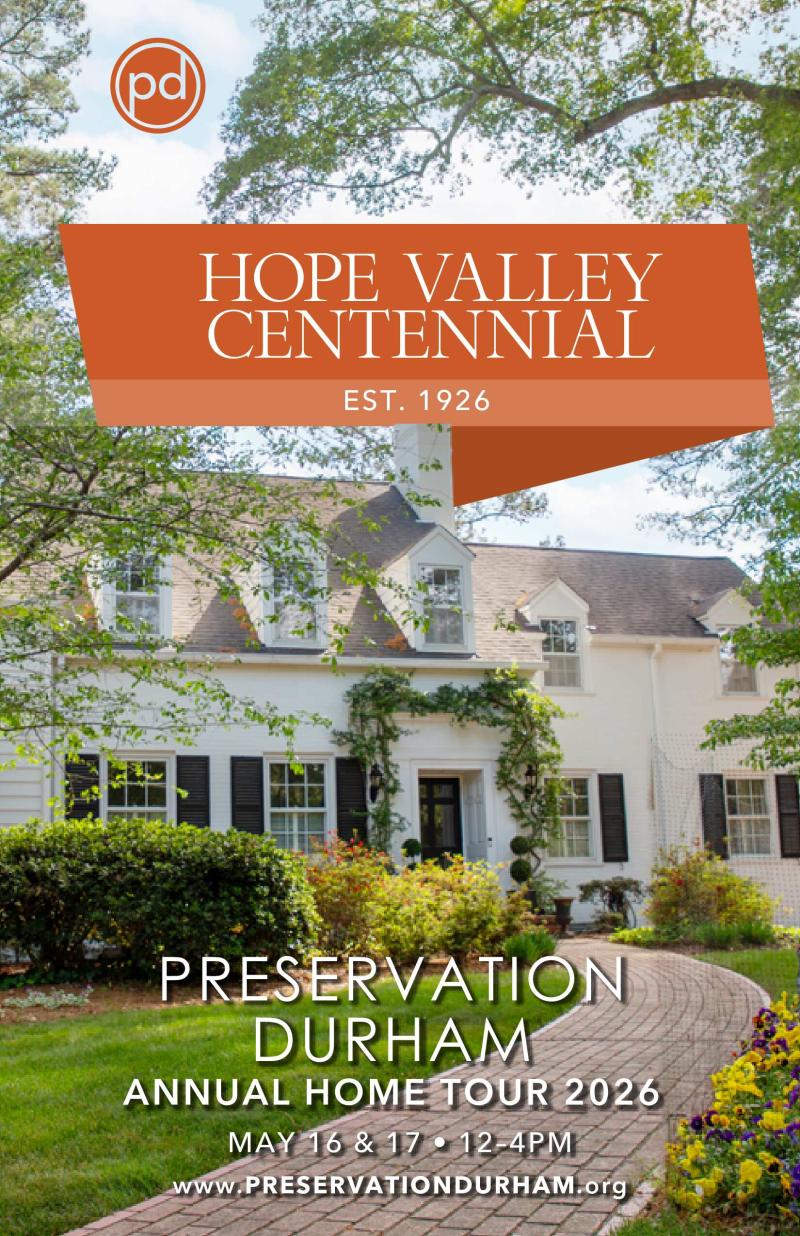
Cover and program designed by Pam Lappegard. Click on the cover to view the entire program.
Hope Valley Centennial 2026 Home Tour
Introduction by Tad DeBerry, Hope Valley Resident since 1966
Welcome to Hope Valley, now 100 years old.
We look forward to sharing our architectural legacy with you! It would be easy to say that Hope Valley is the product of just one company, or a couple individuals. Nothing is further from the truth.
Hope Valley is the culmination of the efforts of Durham’s early twentieth century social and business leaders, a visionary Duke physician, two bold real estate developers, willing farmers, and a handful of intrepid suburban pioneers.
Since 1926 each decade has put its stamp on Hope Valley. The 1920’s saw a magnificent Aymar Embury II Clubhouse, a beautiful residential park designed by Robert Cridland, and of course a show stopping Donald Ross golf course. Homes during this era were largely designed by Durham’s George Watts Carr, but notably there were three homes designed by the renowned Charles Barton Keene. Keene had an office in Winston-Salem, and was working at Reynolda.
The 1930’s and 1940’s witnessed slow but deliberate growth characterized by significant architect designed homes, and an abiding passion for the nascent Club. Notably the Clement-Aylea House was designed by M.E. Boyer in 1935, and the Wiley and Elizabeth Forbis House (NR) was designed by E. Murray Nelson in 1931.
The Forbis House burned to the ground and was rebuilt in 1933, with Mrs. Forbis remarking that she was able to fix all its problems on the rebuild.
The home famous for its matching dollhouse, the Hubert and Mary Teer house was completed in 1932. Carr designed this home in the Mt Vernon style. Colonial Williamsburg had awakened interest in 18th century architecture and Hope Valley was no exception.
The 1940’s saw George Watts Carr design the Lenox Baker House on Cornwall Road. The exterior was modeled after The Linden, and the interiors after The Briars, both historic homes in Natchez, Mississippi. Frank and Harriett Kenan built on Surrey Road in 1940, another home designed by George Watts Carr.
The 1950’s exploded with the sale of large tracts by Hope Valley, Incorporated, the Smith Richardson firm that had held the development together during the Depression and War years. Active was Robert Winston Carr, George Watts Carr’s son, who designed the John and Hatsie Moorhead House on Avon Road in 1953. Other notable architects working in Hope Valley at this time were William Van Eaton Sprinkle and Hackney and Knott.
The 1960’s and 1970’s saw Hope Valley double its population and become the suburb we know today. Significant homes were the Perry and Dukie Sloan House on Westover Road and the Charlie and Josie Humphries House on Somerset Drive. The Humphries called on national home builder Sholtz to design and build their home. Sholtz was a mid-century design build firm and had a components factory in Durham at the time. Hope Valley has several examples of their work.
Another notable 1960’s example was Maryvale, the home of Eddie and Mary Cameron, designed by Robert Winston Carr, modeled after the work of Thomas Jefferson.
The 1980’s, 1990’s and the new millennium continued to confirm Hope Valley’s preeminence, with new construction filling out its now land locked boundaries. The neighborhood began to see some limited examples of infill. Designers Hutch Johnson and Rodney Ward were prominent during these years and continue to be active in the neighborhood today.
While there are many Hope Valley stories, my family’s began in March of 1954 when my father interviewed with Watts Norton over lunch at Hope Valley Country Club. Mr. Norton was a General Agent with Northwestern Mutual, owned a home designed by George Watts Carr, was a charter member of the Club, and one of Hope Valley’s earliest residents.
My father got the job, and thus our family began an over 70 year love affair with Hope Valley. What’s remarkable to me is that while I live in the house, designed by Durham Builder, Earnest Wilkerson, in which I grew up, I am just one of many who returned to start and raise their families here. It’s a special place and we keep coming back.
I hope you enjoy the tour this weekend, we are proud to share this special place with you.

Add new comment
Log in or register to post comments.