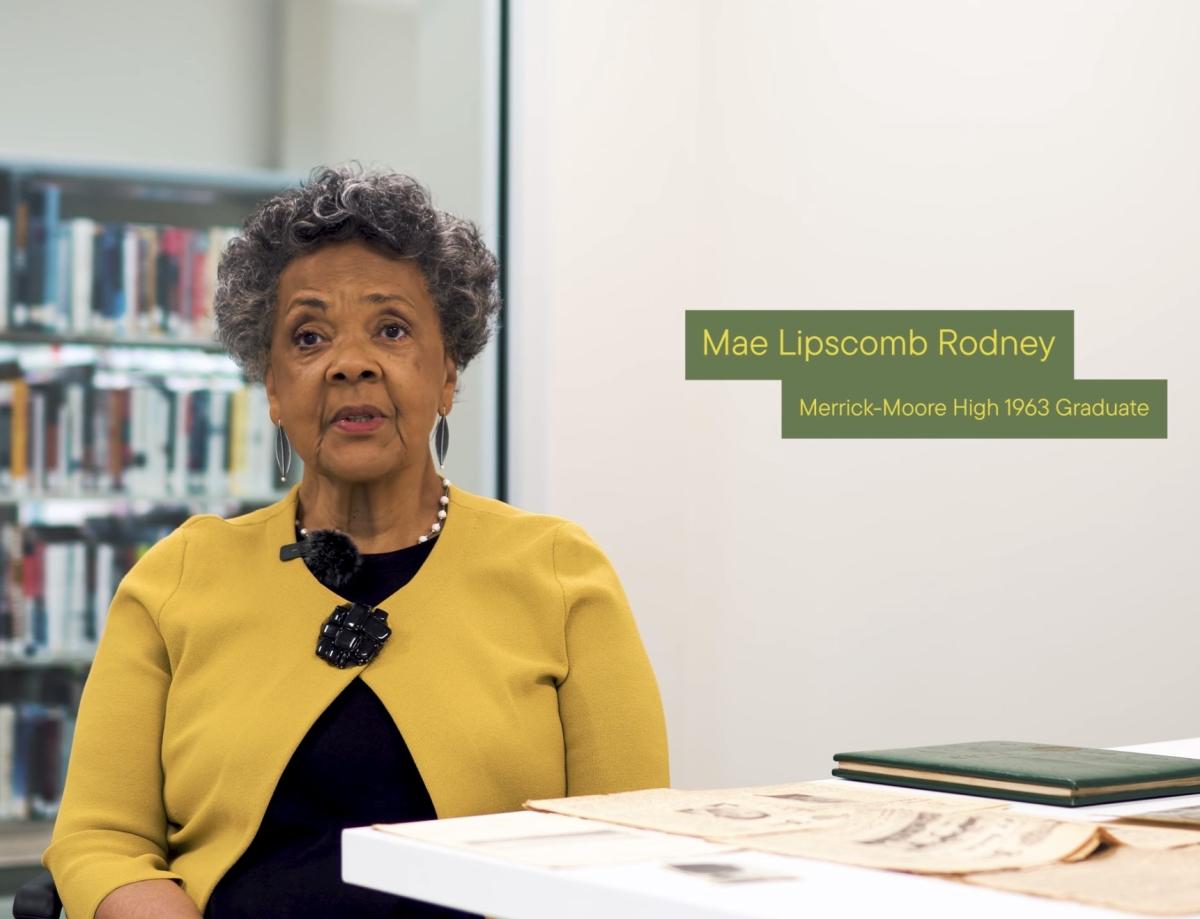
While I was at Merrick-Moore, I was Mae Frances Lipscomb. I am now Mae Lipscomb Rodney. I attended Merrick-Moore all 12 years that I was in school. My class in 1963 was the second class that would have graduated from Merrick-Moore where the students attended all 12 years. There were other classes that graduated before mine, but they started when they were in high school or possibly junior high school.
My family lived in Mill Grove, and we were transported by bus to Merrick-Moore. The ride was probably about 25 minutes, and we didn't consider it busing—we were just riding to school. There were four of us: one girl and three boys. My older siblings were in charge, and I was the youngest of the four, so they were my bosses. And I do mean my bosses, because at the time, during the '50s and '60s, the older children were indeed responsible individuals, and the younger children had to follow their directions.
We had an average life back then. My older brother was a very industrious person; he always had jobs. My brother next to me was not quite as industrious and preferred to play basketball as opposed to work.
In my family, if you didn't toe the line, there was no drama—not like it is now. We didn’t have drama; I don't remember any drama in our household, and I definitely had to follow the rules. My sister was the boss of the family. She took care of us, and that was her role. She was about eight years older than I, so she was definitely the head of the household alongside my working mother. I followed whatever big sister said and did. It was a classic older-sister, younger-sister dynamic, and she remained the boss and head of the family until her passing.
My mother was a cook for a private family, and my father worked at Nelson Till Quarry, where he ran the rock crusher. My father put a basketball hoop in our backyard for my youngest brother, and it was very rough—not the asphalt surface you think of now when you say "basketball court." That hoop became the main attraction for all the boys in the community who were the same age as my brother. Eventually, two goals were installed on a vacant lot right beside our land, and the boys could literally run up and down and play basketball as if they were on a standard court. They would play from the time they got out of school until they had to go home for dinner.
That basketball court kept a lot of the guys occupied and out of trouble. It was something the young men would always talk about—spending that time and energy running up and down, getting dirty, playing on dirt, but playing their hearts out. Two of the guys who played on that court were Albert Love and Kenny Davis, who became star basketball players at Merrick-Moore while they were in high school. So that basketball court was extremely important.
Mount Level Baptist Church and Community Life
The next important fixture within Mill Grove was Mount Level Baptist Church. We had a Sunday school that was very popular, and since we all went to Merrick-Moore together, the bond between us extended to church as well. There were activities throughout the year for almost every major holiday—except maybe the Fourth of July—sponsored by the Sunday school for the young people.
In the spring, the big event was the Easter egg hunt, where all the kids could go to the church and search for eggs. In the summer, we all went to Pullen Park in Raleigh for a Saturday outing, and the winter event was the Christmas pageant, where the kids received Christmas presents along with a bag of candy and fruit. The superintendent at the time made sure that all the kids received a bag before they left church, along with their candy and Easter eggs.
When we went to the park in Raleigh, he insisted that every child on that bus come to the picnic table and have a full meal. The boys didn't like it because they wanted to stay in the swimming pool, but he wanted to make sure everyone was well-fed. That created and maintained a strong bond among the 1960s age group. It wasn't just our parents; the activities available to us as teenagers and pre-teens kept us connected. Since we lived out in the county and didn't have traditional recreation centers, that backyard basketball court and the church served as our recreation centers.
Our parents were traditional, with clearly defined rules and regulations. Monday through Friday, children went to school. In the afternoon after we got home, we had chores and assignments to finish before my mother got home from work. On Saturday, we had to get up, clean the house, and be ready to go grocery shopping by the time she got home around 1:00 PM.
On Sunday, my mother prepared breakfast, we ate together, read scripture, and went to Sunday school and church. Around 3:00 or 4:00 PM on Sunday, we had our main family meal together. That was the routine and schedule we followed in our household—it was what was expected, and we didn't know any different.
Most of that time, we didn’t have a television or a telephone, so there wasn't the constant interruption or schedule changes that parents deal with today regarding technology distractions. When it was time to play, we went outside, and by 6:00 PM we came in for dinner, cleaned up the kitchen, and did whatever else was needed.
Later on—around age 14 or 15—I became responsible for preparing the evening meal. However, I was quite distracted by television. American Bandstand came on at 5:00 PM, and that definitely messed up my cooking! I wasn't a very good cook during that period because I was too busy watching American Bandstand.
Students at Merrick-Moore
I didn't realize until much later in life what a unique experience we had going to public school. When I say "we," I mean the kids who were there from 1950 through the early 1960s. We were lucky that a good portion of the students at Merrick-Moore went to school together from grades 1 through 12—something kids don't experience today.
Albert Love, Myrtle Lipscomb, Gerry Johnson, and a couple of others whose names escape me right now were all from Mill Grove and went from the first through the twelfth grade together. The kids from Bragtown, the neighborhood next to Mill Grove, were also in that group, with Walter Riley being the first person who comes to mind. Then there were a few others who moved into the Merrick-Moore district around the 4th or 5th grade and finished out with us.
Otella Daye, Robert Rodgers, Carolyn Beasley, and George Goss are names that immediately come to mind as being in the first grade with us and going all the way through the twelfth grade together, which was very unusual. We maintained a bond for many years. Charles Clay and Charles Evans moved into the area around the 5th or 6th grade and finished out with us.
Then, when we hit the 9th grade, kids from Pearsontown came into the mix. One of my childhood friends, Charles Clay—we actually had lunch together last week—was saying that Otella Daye was at the top of the class during grades 1 through 8. But after the Pearsontown students joined us, the class dynamics changed because a young lady named Shirley Watson, who was from Durham City, became the smartest person in our classroom.
Fond Memories of School Life
My fondest memories of Merrick-Moore are of the teachers and, of course, the playground and monkey bars. I also remember the huge water tower sitting behind the school—I didn't realize its importance back then, but it was there.
In 1961, Merrick-Moore fielded its first football team, which I remember vividly because my brother played on it. While football started that year, they always had a basketball team, and during the years my older brother was in high school, they also had a baseball team. My brother told me that when he was a senior, they also fielded a track team. They didn't do a whole lot to prepare the young people—you usually have to build up your endurance, legs, and muscles, but not with this group! They were just told, "Meet me on the track on Saturday, and we are going to run in this competition." He was out there running, and everyone was hollering, "Ray, run, Ray, run!" but he petered out before he got to the end of the track. I always thought that was funny.
Another great memory was the high school choir. A longstanding tradition was that the choir would travel to various schools and locations for competitions, singing our hearts out. I was in the choir for a couple of years. I wasn't necessarily the best singer in the world, but I was a good filler!
In junior high—around the 8th or 9th grade—we hopped on a bus and went to North Carolina Central University to hear the North Carolina Symphony perform. We were exposed culturally and athletically in a wide variety of ways. We didn't just go to school; we had all these rich activities going on, and it was such a safe environment back then.
By the 10th, 11th, and 12th grades, there would sometimes be altercations toward the end of the year, but those were just minor fights. I think maybe one time a guy had the nerve to bring a knife to school, but mostly they were just fisticuffs, and nobody got hurt. Maybe some people were embarrassed by the experience, but no one got hurt. It's nothing like the violence kids experience today.
The History of Education in Durham
You live those life lessons and aren't even aware you're living them at the time. The strongest lesson was to be prepared and get an education so you could take care of yourself. That wasn't a rule spoken every single day, but you knew it was expected of you so you wouldn't be dependent upon others.
To understand this, you have to know the history of education in North Carolina. Education is funded through taxes—that's fact one. Fact two is that there was a mandatory school attendance age, which initially was 16. However, when the state established that, it didn't provide funding for schools. Only city schools with a decent population size had the tax revenue to build schools. Later, the state began funding school construction across the board.
Initially in Durham County, Hillside was the only high school for African Americans. Any parent wanting their child to get a high school education had to send them to Hillside. The problem was: where was the child going to live? Most of these families lived out in the county, and the roads weren't paved like they are now. Very few people had cars, so you couldn't just hop in your car and drive kids to school the way people do today.
When funds were finally allotted across the state, Durham County constructed schools for African Americans. The first county school constructed in Durham was Mill Grove, which opened in 1929. Students living anywhere in Durham County had to be bussed from wherever they lived to Mill Grove. At first, the state did not provide transportation funding, so people in rural areas had no way to get their children to school.
Another major factor was that over 75% of the county's population lived on farms, and children were the primary farm workers, so families couldn't easily afford to let them go to school. It wasn't until mandatory school age laws and state-funded buses were implemented that public school attendance grew. When Mill Grove opened, they did have school buses to transport kids across town. Eventually, as Durham's population grew, Mill Grove became too crowded and too small, so Merrick-Moore School was constructed.
It was a historic time, and they carefully selected the name for the school. Merrick and Moore were two individuals instrumental in developing the African American business world in Durham, including "Black Wall Street," North Carolina Mutual, Mechanics and Farmers Bank, North Carolina Central University, and all the businesses located along Fayetteville and Pettigrew Streets in the Haytie district.
Kids were bussed to Merrick-Moore because it was the only high school for African Americans in Durham County at the time. The population wasn't huge back then, so it didn't demand schools in Lowesgrove or northern Durham immediately. Eventually, they opened Little River way out in northern Durham. Population growth eventually caused more schools to open, but if you wanted an education back then, you got on the bus.
The African-American Community and Dedicated Teachers
You take so much for granted. I was very naive, and it never crossed my mind that I was in such a secure, safe, and supportive environment where people genuinely wanted you to succeed. Looking back now, I’m not sure if I had been in an integrated environment whether I would have been able to accomplish all that I have in my lifetime.
My childhood home was a stone's throw from Mill Grove, so we saw the school every day. When teachers went to work or left work, they passed our house. The teachers at Mill Grove knew my parents, and typical of my mom, she let it be known that she expected her children to behave and do well in school. When I started school at Merrick-Moore, many of those same teachers from Mill Grove had transferred over to the new big school.
That expectation my mother shared with them was passed down to me and my brothers. They expected us to do well and do what was necessary to go on to college. If I had been in an integrated environment right away, I probably would have failed the first grade!
Those experiences within that African-American community made a difference in my success, and I know it. I used to attribute that attention to the fact that those teachers knew my parents, but looking back now, they were simply dedicated to all their students and wanted every single one of them to succeed, because we had some really good teachers.
One of the teachers who impressed me the most was Pearl George, an English teacher, and A.K. Thornton, who was also an English teacher. Mrs. Cradle was my sixth-grade teacher, and Frances Clemmons taught at Merrick-Moore for a while before becoming the principal at Lakeview for many years. She was a fantastic teacher, a great musician, and had a beautiful voice. Teachers like that and their deep dedication to their students truly made a difference in a child's life.

Add new comment
Log in or register to post comments.