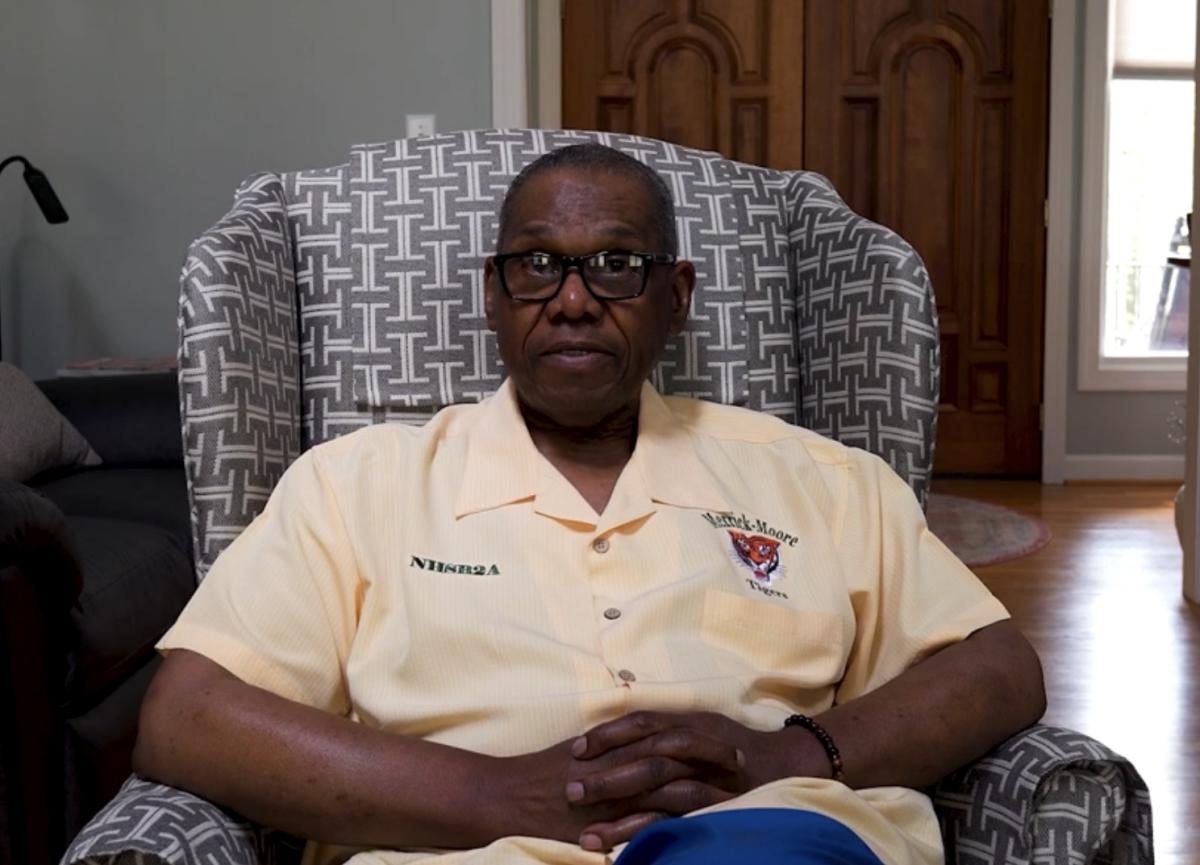
Wayland Burton: Hello, everyone. My name is Wayland Burton, and I am about 69 years old.
Originally, I grew up on the southern portion of Durham, in the Fayetteville Road and Highway 751 area. My family were sharecroppers at that time, and that entire Southern Durham area was part of the Merrick-Moore Community. Everything south of the Eno River heading to Southern Durham County was considered Merrick-Moore for Black residents. Everything north of the Eno River up to the Person County line in Durham County was slated for Little River High School, which is out on Roxboro Road on Highway 501. There was one Black city school, which was Hillside, which took care of all the Black students within the city itself.
All my siblings—two older brothers and an older sister—attended Merrick-Moore. The progression was that you went to Pearsontown from first grade to eighth grade, and then you went over to Merrick-Moore to finish ninth through twelfth grade for high school. We would ride the bus from Pearsontown. Everyone caught the bus from their particular locale and came to Pearsontown Elementary. The elementary kids would get off the bus, and then the high school kids would change to a different bus that would take them over to Merrick-Moore High School. They would spend the rest of the day there and do the reverse process on the way back.
That pattern continued until about 1969, which marked the end of all-Black schools and the beginning of integration.
School Integration and Transitioning to Northern High
There was some voluntary integration that went on prior to 1969, starting at the sixth grade. They started phasing out the elementary schools as kids graduated from the sixth grade and went to the seventh. If your parents volunteered for you to go, you went to an all-white school.
For me, my family had moved to the northern side of Durham County in the Bahama area at the time. My parents chose to send me to the all-white school, which was Carrington Junior High. I attended Carrington for sixth, seventh, and eighth grade. For ninth grade, I went to Northern High School, where I graduated in 1972.
Like I said, that whole Southern Durham area was considered the Merrick-Moore Community, especially for all the Black residents prior to integration. It wasn't just the local area right around the high school itself; it was the entire community. With all the kids going to that one high school or following that same migration pattern from Pearsontown to Merrick-Moore, you got to know everyone—all the Black residents within the city and rural areas. You encountered them when you went to the barber shop, went shopping, or participated in any local activities. You would run into those same school students, teachers, principals, and church members wherever you went.
The Pearsall Plan and Desegregation Delay
In 1970—and it took that long after the 1954 Brown v. Board of Education decision—North Carolina schools finally integrated. The reason it took so long was because State Representative Pearsall laid out a plan for the legislature. First of all, they wanted to shift control of the school system from state control to local control. That is how local counties took charge, because at one point, the entire public school system was under state authority.
The state legislature made the rules, but they did not want to take the political heat of performing integration on their watch, so the plan was to stall it as long as possible. The Pearsall Plan achieved this by first turning decisions over to local counties and municipalities—first the county schools, then the city schools. Once that was set up, deliberations continued regarding how funding would be distributed between the county and city entities.
Then, each district had to create an individual plan on how to integrate the schools—determining which schools would close and which would remain open. In Durham County, Merrick-Moore and Little River, the two all-Black high schools, were closed, and the students were sent to previously all-white schools. Some went to Southern, some went to Jordan, and some went to Northern; they were scattered about.
The only all-Black high school that was maintained was Hillside. That was due to Mrs. Spaulding being on the committee alongside individuals from Duke University who were very vocal and involved in local politics. They made the decision that those two all-Black high schools would close and Hillside would remain open, and it went on from there.
It was a real shame because all three of the Black high schools had performed fantastically, both scholastically and athletically. There seemed to be no valid justification for why that particular approach was selected.
Experiences in Integrated Schools
As many parents explained to their children when volunteering them to attend all-white schools, the goal was to secure a much better future. However, it was to my amazement and astonishment when I started attending all-white schools that I wasn't necessarily learning more. I had already learned a lot; in fact, my preparation was comparable to all the white students across various subjects, from math and science to social studies and art.
The primary difference was that they had much better facilities. The school buildings were newer, with better restrooms and cafeterias. Furthermore, the textbooks weren't hand-me-downs. At all-Black schools, we always received hand-me-down textbooks from the white schools. You would find the names of past students written in them, but you had to take care of them because they needed to be passed down to the next group of students coming behind you.
In reality, the teachers taught the same core concepts and used similar lesson plans. A few teachers from the all-Black schools transitioned into the white school system, but very few. In 1970, when I started attending Northern High School, out of the entire faculty, there were only about eight Black teachers. They came to Northern from Merrick-Moore, Little River, or other schools across the state after graduating from teachers' colleges. They maintained a rigorous curriculum, and students still had to keep their grades up. Whenever conflicts or fights occurred, it was usually the Black teachers who stepped in to help mediate the peace.
By 1970, we protested the lack of Black principals, assistant principals, and teachers at Northern. We held a sit-in in the main hall and organized a walkout. Just as students recently walked out regarding gun violence, we walked out because there was a lack of Black studies, Black faculty, and Black administrative representation in the schools.
At Southern, Black students walked out to protest the mascot name. It was originally the "Southern Rebels," which was viewed negatively, leading to a mascot change after integration.
While there was turmoil, it was not as drastic as what you might see today. Upon entering Northern, we were occasionally pelted with tomatoes and rotten eggs. However, many of us had undergone civil rights training. We were taught to be peaceful, not to fight back or escalate conflict, to hold our heads high, and to persevere, which we did.
Cultural Shifts and Personal Connections
As time went on, relationships improved because some white students had attended middle school with us at Carrington, where we had hung out and laughed together. By 1970, times were changing. It was the "Age of Aquarius," a period with a strong counterculture movement. Many white students during that era viewed everyone as equals, so there was minimal conflict among our peer group.
One of my best friends was white—Barry Center. His parents were teachers. He was an artist, and I was an artist, so we talked a lot and hung out together. We even skipped school together! I spent quite a bit of time at his house and met his parents, who were very personable people. We often hung out at Duke Gardens.
It was a period when times were changing rapidly among the youth, though not as quickly among parents. Many parents remained staunch in their attitudes regarding separation, bigotry, and prejudice, whereas the kids were much less so.
There wasn't much interracial dating occurring at that time, but as time went on, that changed—especially as we reached college age.
Perspectives on Education and History
For me, progressing through Northern from 9th to 12th grade was a very insightful period. A lot was happening globally, such as the Vietnam War, which we discussed frequently in class. However, there were no meaningful classroom discussions concerning the history and contributions of other races, whether Latino, Native American, or African American.
The curriculum presented limited perspectives: Native Americans were often portrayed negatively through stereotypes about raids and scalping, without contextualizing why those events occurred or how history evolved. For Black history, discussion was limited almost exclusively to slavery. For Hispanic history, the focus was limited to Pancho Villa and little else. There was no instruction regarding culture, everyday life, or historical figures who contributed to society. As a result, students were kept uninformed about these topics.
This struck me as curious because I had already learned about many of these subjects in the all-Black school system. I had learned about Harriet Tubman, various Black leaders, and how slavery culminated in the Civil War. Furthermore, because I have Native American heritage, I was knowledgeable about Cherokee history, the Trail of Tears, and the richness of Native culture. I had also gained exposure to Hispanic culture through travel.
My primary interest was art, and I intended to pursue a career as an artist. I spent a considerable amount of time on Duke University’s campus and in their library studying master artists, their techniques, and their styles. Being on campus allowed me to meet a diverse group of people and engage in meaningful conversations, which broadened my worldview and made me eager to explore further.
Military Service and Global Exposure
My desire to see the world led me to join the military. I pre-enlisted for delayed entry during my junior year of high school, and upon graduation, I entered active duty.
I served for 36 years in the military working as an electronics engineer before retiring in 2008. That career provided me the opportunity to travel globally and experience numerous cultures firsthand. I gained insight into how different societies fit into the broader global context during various historical periods. That is similar to what younger generations are doing today: expanding their awareness of themselves and the world.
Dual Identity and School Legacy
Had integration not occurred when it did, I would have attended Merrick-Moore as a Merrick-Moore Tiger after Pearsontown, but I ended up graduating from Northern High School instead. Today, I proudly wear the symbols of both schools at reunions because I represent a blend of both experiences. Merrick-Moore’s colors were gold and green, and Northern’s colors are blue and gold, so they complement each other well.
I am proud of both institutions and the people who came before me. My two older brothers and sister graduated from Merrick-Moore, and I take pride in their contributions to the school's legacy. I work to honor their memory and preserve the accomplishments of Merrick-Moore, while also acknowledging my history at Northern. I view myself as a blended individual who bridges both schools.
My career with the military and the Department of Defense was rewarding, challenging, and exciting. I traveled extensively, visiting countries such as Germany, Great Britain, Israel, Spain, Korea, Vietnam, the Philippines, France, and Turkey. Engaging with diverse cultures allowed me to learn about local traditions, languages, and customs. Having gone through school integration prepared me well to navigate new environments with an open mind and build connections across cultural boundaries.
Modern Concerns and Community Involvement
Reflecting on current events after returning to North Carolina in retirement, it concerns me to see efforts that seem to limit educational exposure, such as textbook restrictions or library collection limits. Access to libraries and books about different places and cultures was transformative for me because it allowed me to expand my horizon without leaving home. Restricting access deprives students of learning about diverse perspectives and communities, which is essential for personal growth and building a better society. Stigmatizing groups can cause long-term harm, so I encourage young people to actively seek out diverse experiences despite any obstacles placed in their way.
My parents wanted me to have broader opportunities when they volunteered me for middle school integration, and I hope I made them proud.
Current Role in Durham and Merrick-Moore
Interviewer: Awesome. Thank you. As a final question regarding your sense of community today, what is your relationship now with the Triangle, Merrick-Moore, and Durham County? How do you view your role?
Wayland Burton: I see my role within the broader community as someone who can provide perspective. As the saying goes, "there is nothing new under the sun." People often encounter challenges similar to those experienced in the past, so having lived through those times allows me to offer meaningful input regarding local issues in Durham County.
I have worked within Durham County government. Even before retiring around 2006 or 2007, while still stationed in Washington, D.C., I would travel back to Durham on Thursday nights to participate in the Durham County Neighborhood Academy program organized by Deborah Craig-Ray and the county communications team. The program provided education on local government, the police department, and recreational facilities. I made that weekly trip so I could reacquaint myself with the county before retiring after 36 years away.
After retiring back to Durham, I became involved with several local boards and community organizations:
- Served as Chair and General Manager of the Durham ABC Board, overseeing 8 to 9 local stores and increasing annual distribution contributions to the county to over $2 million per year.
- Served on the local Transportation Board to help ensure accessible transit options were available for senior citizens to attend medical appointments, shop, and access local services.
- Ran for the Board of Elections at one point, maintaining an active interest in local civic engagement.
- Active with the local chapter of the Tuskegee Airmen, working to preserve their historical legacy and providing middle and high school students with educational opportunities in aviation and aerospace.
- Serve on the board for the Merrick-Moore Millgrove Alumni Association.
- Chair the Northern High School Black Alumni Association.
Staying active across these various organizations keeps me busy and connected to the community. Bridging these groups and giving back has been a deeply gratifying and rewarding experience.

Add new comment
Log in or register to post comments.