The News and Observer reported Thursday on a Triangle-wide poll they commissioned to assess opinion on the pressing problems of the area (growth/development and traffic were the big shares) and what type of mass transit people thought was needed. People still favored rail in the transit question, strongest in Chapel Hill, then Raleigh, and then Durham.
Most of what can be said about commuter rail in the Triangle has been said, but I often feel that the fundamental point of the debate is persistently ignored, which is this:
The debate over rail has little to do with transportation, and everything to do with land use.
When Art Pope's people over at the John Locke Foundation, rail's most ardent opponents, kvetch about the capital and operational costs of rail, and the problems with the Triangle's ridership projections, they are mostly right. We don't have a good setup for successful rail in the Triangle right now.
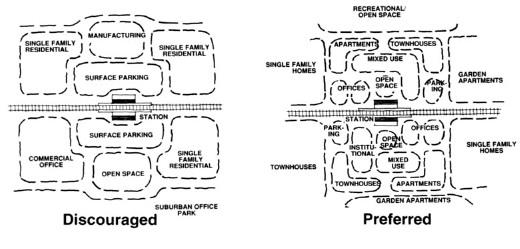
The question revolves around future land use. Although the folks at TTA haven't always been explicit about it, the clear intent is to build high-density, mixed use development within 0.25 mile - 0.5 mile of the transit stops, with the expectation that these 'pearls on a necklace' will be the seeds for more compact development around the rail line.
 |
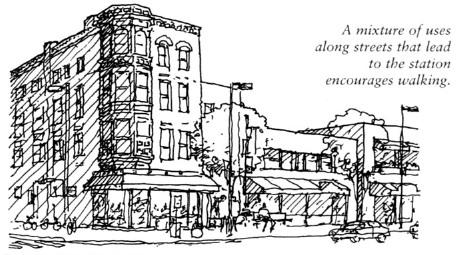
The TTA "Station Area Guidelines" from 1997 clearly laid out design features of this development, including an emphasis on pedestrian accessibility. |
Land Use Mix
Land Use Design
This is the best case for using the existing rail corridor; the corridor abuts some of the highest connectivity, pedestrian-accessible land in Durham-Cary-Raleigh. Much of our developed land cannot be efficiently served by public transit - low density, limited connectivity, pedestrian-averse development means that people have to drive to the bus. And people only drive to the bus if the cost of driving farther and/or parking are high and cost of riding the bus is low/free (i.e. UNC).
Much of the bait-and-switch discussion revolves around these buses. Buses are fine - I ride the TTA most days of the week. But buses here will always suffer from the same efficiency problems they do now if 1) The land uses/pedestrian networks they serve don't change and 2) They continue to operate on our regular winding-cow-path roads. Once you start changing those things, the price evens out. But some folks like to conflate regular buses (the kind we have right now) with Bus Rapid Transit (which needs a new infrastructure/context to function appropriately.)
Clearly, the folks at John Locke are fans of our current land use paradigm and think there should be no government intervention into land use and so, at best, do not see the purpose of such a development plan. Others (including me) think that greenfield land is a valuable resource that conveys public benefit outside of its development potential. If it is developed poorly (or excessively) there can be serious deleterious effects that are not limited to the person who develops that land. - i.e. there are public costs (externalities).
In a scenario where we conserve greenfields and opt for compact, sustainable, walkable development (preferably on vacant/underused land closer to downtown and by rehabbing vacant historic structures), the rail system becomes truly viable. I think this has been the tacit plan all along, but everyone's too afraid to use words like density, compact, smart growth, etc. So we avoid having the land use discussion that really needs to happen. We need to decide - what is our policy on land use? (Even if that policy is to not have a policy.) Do we continue as we have? Or do we make a plan?
Comments
Submitted by Dan Clever (not verified) on Sat, 11/4/2006 - 4:37pm
Thank you for this post. Local politicians may be hesitant to provoke the development lobby, but the land use aspect of the regional rail line is the one that would probably have more 'traction.' Folks in northern Wake county or Durham county obviously aren't thrilled about being taxed for a train they'd rarely use. But if you explain to them that the development around the train could curb future development pressure in rural areas (i.e. the remaining farms and open space that surround the Triangle), they might sign on. Unfortunately it's not really TTA's job to explain this; it's up to local politicians and community groups.
Submitted by Sven (not verified) on Sat, 11/4/2006 - 8:41pm
Dan
Thanks for your comment. Land use is provocative, but it sometimes seems like the giant pink elephant in the corner of the room that we really aren't talking about (except the consequences, such as school overcrowding, traffic congestion, etc.) Somehow we've conflated economic growth with 2-dimensional growth and it's hard to convince many people that there is a better (win-win) way.
Add new comment
Log in or register to post comments.