Preserve Durham's History with a Donation to Open Durham Today!
OpenDurham.org is dedicated to preserving and sharing the rich history of our community. Run by our parent nonprofit, Preservation Durham, the site requires routine maintenance and upgrades. We do not ask for support often (and you can check the box to "hide this message" in the future), but today, we're asking you to chip in with a donation toward annual maintenance of the site. Your support allows us to maintain this valuable resource, expand our archives, and keep the history of Durham accessible to everyone.
Every contribution, big or small, makes a difference and makes you a member of Preservation Durham. Help us keep Durham's history alive for future generations.
The below information is from the 2018 Preservation Durham Home Tour Program:
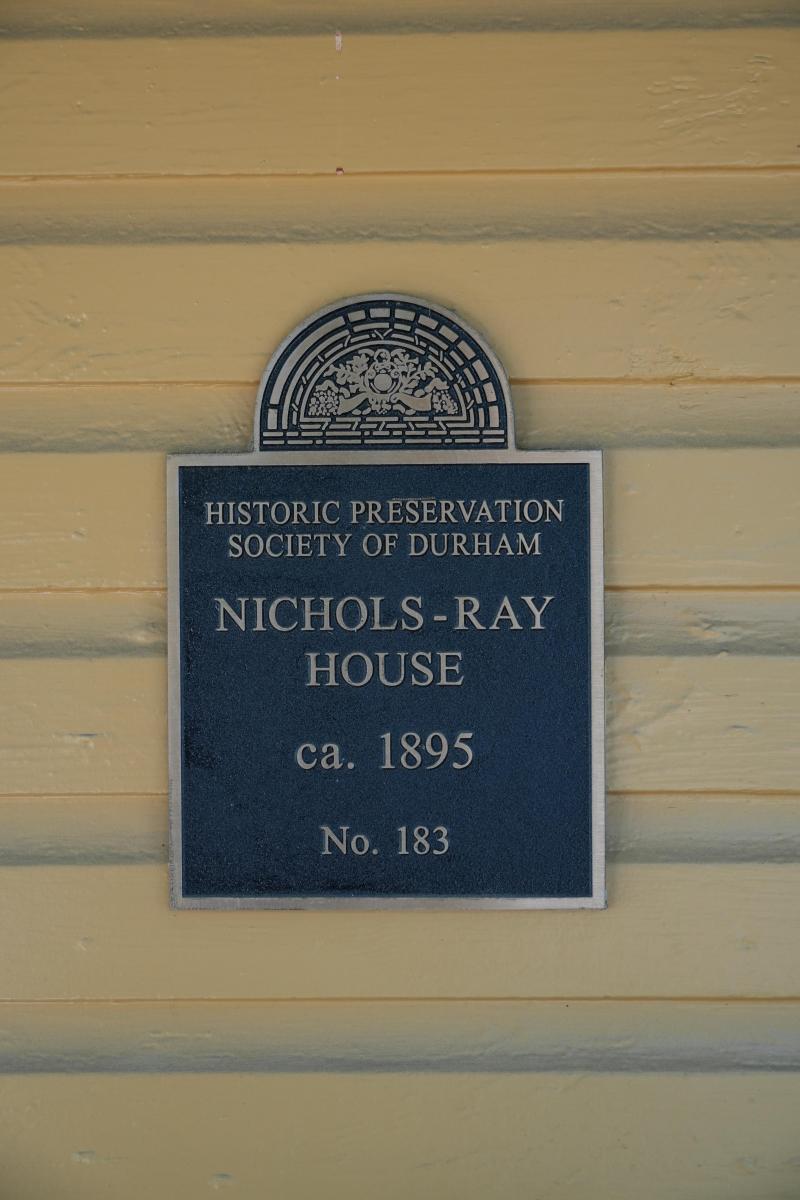
Nichols-Ray House, ca. 1895
1007 North Roxboro Road
This lovely little house was owned by the Nichols-Ray family for nearly 125 years. There is no evidence that any member of the family ever lived in it.
In 1891, John Thomas Nichols was a prominent farmer in Oak Grove Township on the eastern edge of the new Durham County. Nichols was a justice of the peace and postmaster of the community post office. As a young man he had served in the Confederate cavalry with millionaire industrialist Julian S. Carr. Now in his early fifties, Nichols was investing in real estate in the booming town of Durham. In that same year, Durham’s first and most famous tobacco auctioneer, Col. James Edward Parrish, was in bankruptcy. Parrish dabbled in everything – tobacco manufacturing and sales, banking, and real estate. He would later bounce back in spectacular fashion as the Dukes’ man in Asia, but in 1891, he was overextended and his real estate holdings were in the hands of trustees.
Parrish’s difficulty was John T. Nichols’s opportunity. Nichols bought a tiny lot on Roxboro Road from Parrish’s trustees in December 1891. Soon afterward, Nichols, or perhaps his widow, Eliza, and their son, James Camp Nichols (John T. Nichols died in December 1892) built this small house as an investment property.
The house is in the folk gable-and-wing form with Queen Anne details inside and out. From the early 1890s until around 1910, Durham experienced dramatic growth. The Dukes consolidated tobacco production nationwide and expanded tobacco factories here in town. They also introduced textile manufacturing to Durham and built large factory complexes on the eastern and western edges of town. People flocked to Durham and investors like the Nichols built simple frame houses by the thousands to house them. Until Urban Renewal and a beginning cycle of decline during the 1970s and '80s, these houses defined Durham’s in-town neighborhoods. Today, they represent the most threatened component of Durham’s architectural heritage.
Fortunately, the house at 1007 North Roxboro survived and has been rehabilitated for modern living. The exterior of the house is essentially unchanged. The porch still displays its Victorian turned posts and charming saw-work spandrels. Much of the original drop siding has been saved. Deteriorated siding has been replaced with modern wood material to match the old. A relatively new invention in the 1890s, drop, or “German” siding was milled with a coved edge on the top and a rabbet on the bottom to lay flat against the studs. This added stiffness to a frame structure without a sheathing layer. The three paneled front door is original. On the front of the house and wherever possible, the original two-over two windows have been preserved.
The interior of the house was originally laid out in a hall-and-parlor plan. The four rooms of the house had no clearly identified purpose. There was no bathroom, and the kitchen, located in one of the back rooms, contained no cabinets, only an iron stove. In time, of course, the house was plumbed and the interior spaces were modified for different uses. Today, the interior space has been reorganized in a way that respects the original plan. The front room, which probably always served as a parlor, has been opened into the spacious hall. The hall has been cleverly repurposed as the kitchen. This freed space to make way for two bedrooms. The shed porch that originally ran along the rear of the house now contains two full bathrooms.
Everywhere, original interior details have been preserved. The classical mantelpiece in the parlor is original and here and there, original woodwork, including door and window frames were saved an reused. Note the simple cross detail in the corner squares at the tops of the doorframes.
The earliest known occupant of the house was William Jones. According to the 1907-1908 city directory, Jones was a stone cutter with Durham Marble Works, now Durham’s oldest business in continuous operation. From 1919 until 1932, the house was home to the Oscar Maynor family. Maynor was a bricklayer and woodworker. From the mid-1940s through the early 1950s, Lucy Copley, a widow, lived in the house. In the 1970s and '80s, Orange Peaks and his wife Maggie lived in the house. For about ten years before the house was rehabilitated by the current owner, the house was neglected and vacant.
The house at 1007 North Roxboro was passed down through four generations of the Nichols family until 2017 when Carolyn Ray Thompson, John T. Nichols’ great-grand daughter, sold the house. Today, the rehabilitated house is a rare survivor of a residential architectural type once typical in Durham.

Add new comment
Log in or register to post comments.