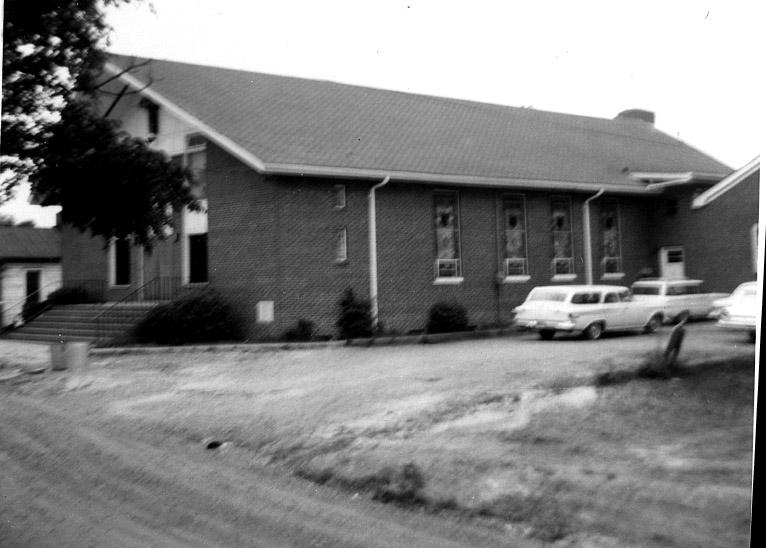
A photograph of Fisher Memorial United Holy Church of America (Durham Urban Renewal Records Collection, Durham County Library, North Carolina Collection) - June 1965.
Fisher Memorial United Holy Church of America was first established in 1884 at the home of Reverend C.C. Craig and Emma C. Craig, originally named the Gospel Tabernacle United Holy Church. The church was an independent entity led by Reverend Craig until 1886, when The United Holy Church of America, Inc. was founded, making Gospel Tabernacle the first of the denomination. The Gospel Tabernacle was a Durham leader in ushering in the holiness-pentecostal movement to the area. Subsequently, the denomination grew over time to have hundreds of churches throughout the United States, Africa, and the Caribbean. It was said that Reverend and Emma Craig were originally attendees at St. Joseph’s A.M.E. Church, "but [the church] became a little too noisy for the congregation and felt it best to leave rather than to cause further problems." From the outset, the church encouraged the prohibition of dancing and popular music among its congregants. This policy was officially passed in a resolution in 1959.
Throughout the 142-year history of the church, there have only been a handful of pastors, most of whom have led the church for significant periods of time. Reverend Craig was the first of the church’s leaders, who co-pastored with Reverend Atkinson. In 1904, Reverend Henry Fisher came to the church to lead a month-long revival. Later that year, the original church structure was erected, and he was invited to speak at the dedication. He came back the next year, this time as the pastor. Reverend Fisher led the church for over forty years.
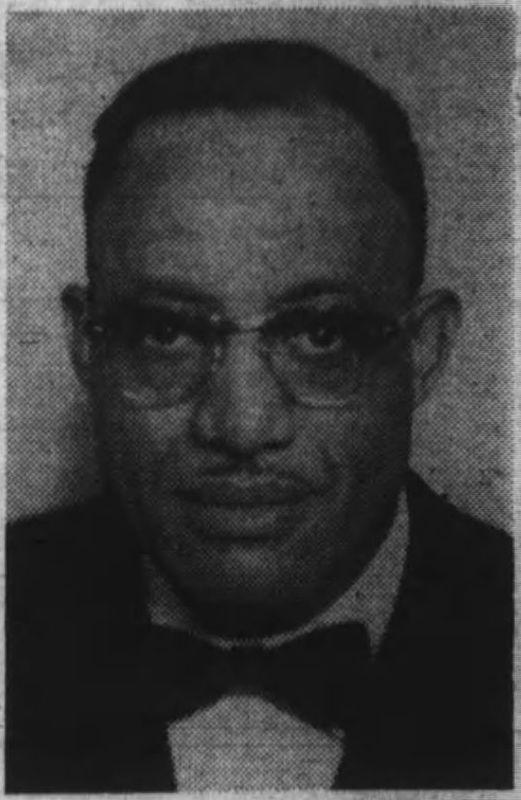
A picture of Rev. Lawson (The Carolina Times) - 1957.
After Reverend Fisher’s tenure, the next pastor was Reverend A. L. Lawson, who served the church from 1944 until he died in 1981. Beyond his leadership at Fisher Memorial, Reverend Lawson was also the Junior Bishop of the United Holy Church of America, Inc. and the President of the Interdominational Ministerial Alliance of Durham and surrounding areas for a time. During his tenure, the current church structure was built in 1958 after the previous structure was condemned as a fire structure, necessitating a rebuild. The church was rebuilt to include a new edifice, five large classrooms, a Sunday School auditorium, a Fellowship Hall, a business office, a kitchen, and other modern facilities. With the construction of the new building came a new name, the Fisher Memorial United Holy Church, named in honor of Reverend Fisher.
Reverend Elroy Lewis took over the pastorate after Reverend Fisher died in 1981. The previous pastors had all had co-pastors (Reverend Craig and Reverend Atkinson; Reverend Fisher and Reverend Lawson; Reverend Lawson and Reverend Zollie Dunn; and Reverend Lawson and Reverend Lewis), making Reverend Lewis the first full-time pastor. Reverend Lewis served the congregation for 36 years, retiring in 2016. The current pastor, Elder James Blake, has been serving the church ever since.
In the long history of the church, it has been a crucial community hub, providing space and resources for advocacy, education, and more. In 1982, Reverend Lewis emphasized the importance of Black churches as a means to ensure Black autonomy and equal rights, saying, “the black church is owned by black people, and you cannot say that about the courthouse or the public schools. It serves as a launching pad for everything that is positive in the Black community.” Fisher Memorial has epitomized this belief throughout the history of the institution by hosting important civil rights leaders and organizations.
In 1962, the church hosted a talk by Daisy Bates in celebration of the eighth anniversary of the Brown v. Board of Education decision. Daisy was a part of the Little Rock Nine, nine African-American students who desegregated Central High School in Little Rock, Arkansas and faced backlash, threats, and violence from whites for doing so. During this talk, Daisy expressed the importance of young people in the fight for equality, a beacon of hope in the otherwise depressing state of race relations at the time.
Starting in 1970, Fisher Memorial began to host an annual convocation for the Western North Carolina Convocational District of the United Holy Church of America. These convocations fostered important conversations and decisions about the beliefs, functions, and roles of the United Holy Church of America denomination. At the eighth annual convocation, the church called on North Carolina Governor Jim Hunt to commute the Wilmington Ten’s sentences. The Wilmington Ten were a group of eight African-American activists and one white activist who were wrongly incarcerated for a firebombing and shooting that took place after a peaceful protest turned violent upon the arrival of an armed white supremacist group.
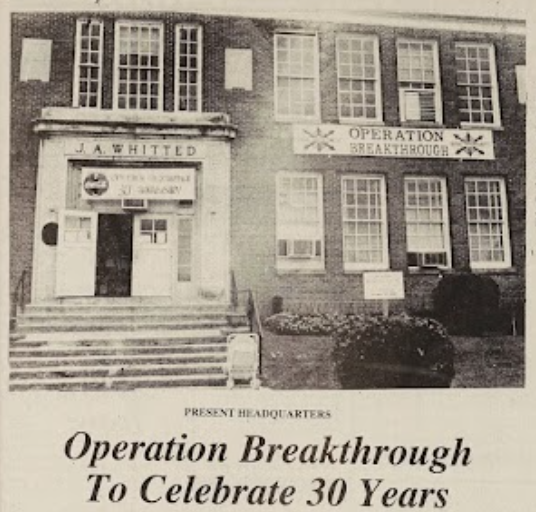
Furthermore, the church has provided many crucial services and support to the community. Starting in 1966, the church opened a daycare through Operation Breakthrough, a local anti-poverty organization. They also hosted the original Head Start program through Operation Breakthrough, seeking to prepare children for success in school. In the early 2000s, Fisher Memorial worked with local institutions, including Glaxo Wellcome, North Carolina Central University, and Duke University, to fund a computer lab for community members.
A news clipping commemorating the 30-year anniversary of Operation Breakthrough (The Carolina Times) - October 22, 1994.
The church is still active today, and is currently undergoing a renovation to help grow the church’s capacity.
Sources:
Carolina Times
Herald-Sun
“Our American Story: The Little Rock Nine,” National Museum of African American History & Culture, Smithsonian, last accessed June 23, 2026, https://nmaahc.si.edu/explore/stories/little-rock-nine.
“Wilmington Ten,” Britannica, last accessed June 23, 2026, https://www.britannica.com/topic/Wilmington-Ten.
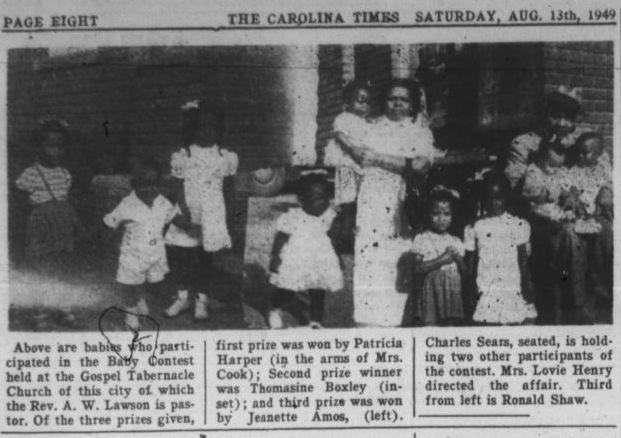
A news clipping of a baby contest held at the Gospel Tabernacle Church (The Carolina Times) - 1949.

Add new comment
Log in or register to post comments.